Robert Jacques Godet, Paris (probably acquired from the artist around 1948-1951)
By descent to a Private Collection
Christie’s, Auction of Modern Art, Paris
Private Collection, Canada
One of the most recognized artists of the twentieth century, Salvador Dalí was born in Figueres, Catalonia in 1904. He attended the Municipal Drawing School at Figueres in 1916; in the same year he discovered modern art during a summer vacation in Cadaqués with the family of Ramon Pichot, a local artist who made regular trips to Paris. The following year, Dalí’s father organized a home exhibition of his charcoal drawings, and by 1918 the young artist was featured in his first public exhibition at the Municipal Theatre in Figueres.
While he is best known for his Surrealist works, Dalí’s noteworthy artistic development was rooted in historical painting and early modernism. His early influences were Impressionism and Renaissance masters, though he became increasingly drawn to Cubism and other avant-garde movements. In 1921 the Pichot family introduced him to Futurism, and his uncle in Barcelona, a bookstore owner, supplied Dali with copious material on Cubism and contemporary art.
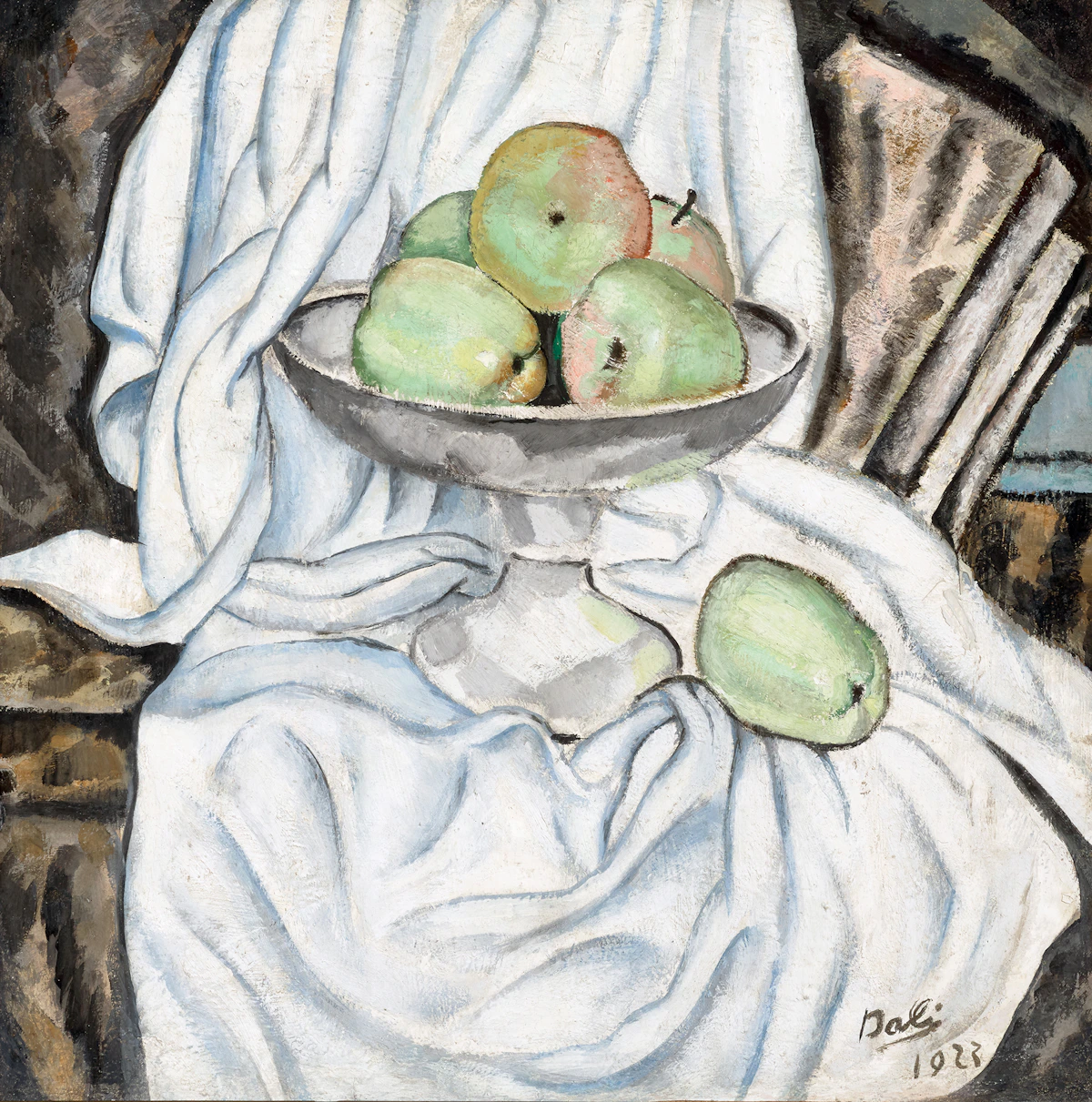
Following the tragedy of his mother’s death in 1921, Dalí embarked on a new chapter in life by moving to Madrid in 1922 to study at the San Fernando Royal Academy of Fine Arts. There, he experimented further with Futurism, Impressionism and Cubism, while making regular trips to Paris. “Nature morte aux pommes”, painted in 1923, bears striking similarities to the still-lifes of master Post-Impressionist Paul Cézanne. His work is recognized as the bridge between Impressionism and early Cubism, and Dalí appears to be aptly focusing on this transitional period in this fine composition.
In Cézanne’s still-life paintings from the mid-1870s in particular, the artist abandoned thickly encrusted surfaces and began to address form and colour by experimenting with very subtle tonal variations and rejecting intense contrasts of light and shadow, in order to create dimension in his objects. Dalí employed similar muted tones in “Nature morte aux pommes”, with pale green and peach apples surrounded by a background of greys and off-whites. The delicate Impressionist palette is contrasted by a more cubist perspective and structure to the composition. Also during the 1870s, Cézanne began to reject the laws of single-point perspective, rendering his still-life objects without use of light or shadow. “Nature morte aux pommes” reveals Cézanne’s approach of building forms completely from colour and creating scenes with distorted perspectival space. The objects in this painting, such as the fruit and tablecloth, are rendered not with light and shadow, but through extremely subtle gradations of colour. As well, Dalí presents a distorted perspective and picture plane, akin to Cézanne and the early Cubists. The ambiguous dark grey material behind the tablecloth provides a flattened, two-dimensional space that appears to be in the foreground.
In May 1925 Dalí exhibited eleven works in a group exhibition held by the newly-formed Sociedad Ibérica de Artistas in Madrid. The compositions ranged from realist and Impressionist to increasingly Cubist styles. Dalí received much acclaim for his work and proceeded to hold his first solo exhibition in Barcelona in November 1925. This exhibition, just prior to his exposure to Surrealism, included twenty- two works and was a critical and commercial success. Four years after enrolling at the San Fernando Academy of Art in Madrid, he was expelled after refusing to be examined in the theory of art and declaring the examiners incompetent to judge him. Salvador Dalí returned to Catalonia, where his art became increasingly bizarre and grotesque, turning to Surrealism and taking a completely new direction in his career.
This artwork has been certified by Nicholas and Olivier Descharnes at Archives Descharnes, providing an archive reference number of h987.