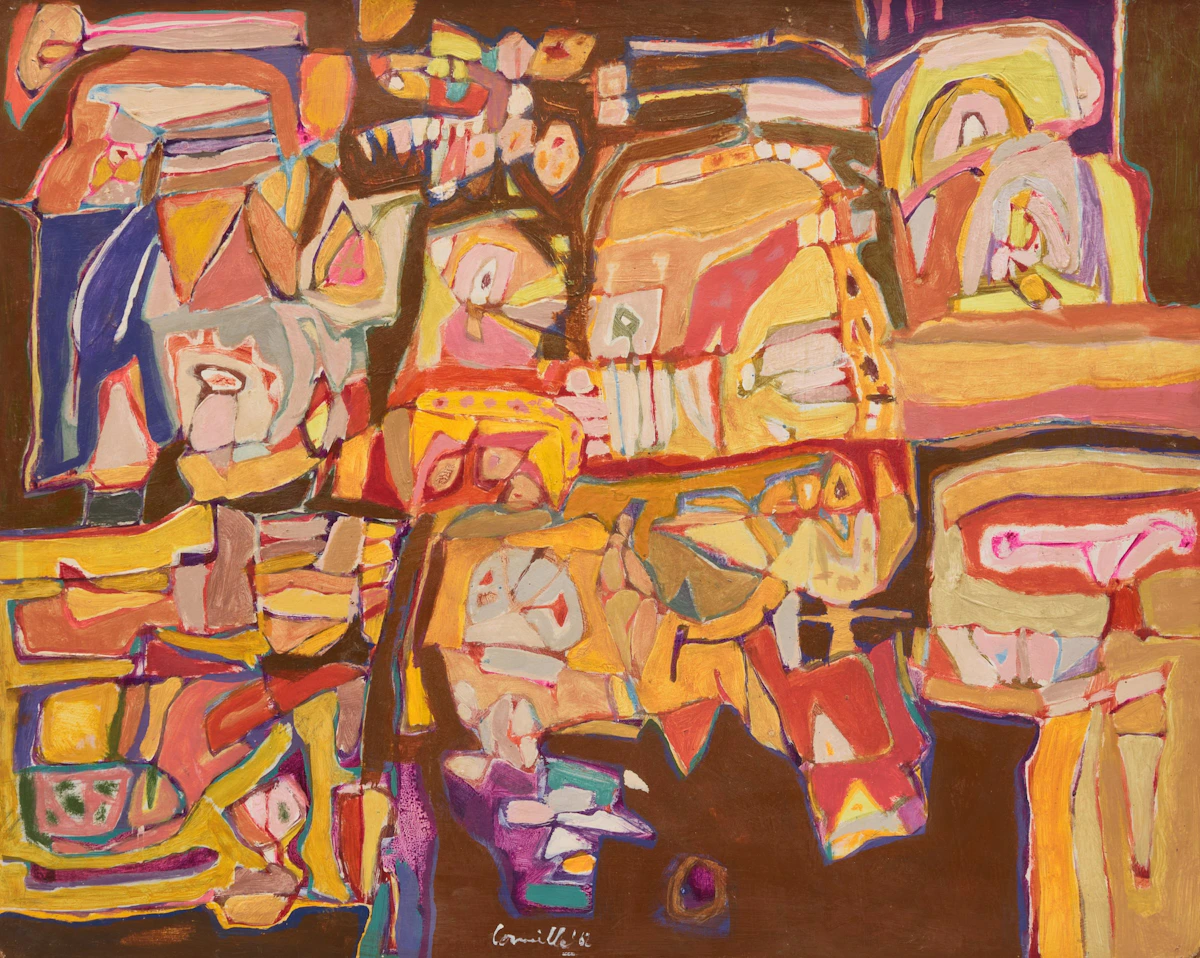
signed and dated 1962 lower middle; titled on a gallery label on the reverse
24 × 30 in (61.0 × 76.2 cm)
Cobra Gallery, Eindhoven
Private Collection, Quebec
A founding member of the influential post-war avant-garde CoBrA group alongside Karel Appel and Constant, Dutch artist Guillaume Cornelis van Beverloo—known as Corneille—pioneered a poetic, instinctual approach to abstraction. Rejecting academic rationalism and the austerity of formal geometric abstraction, Corneille sought to reconnect with a sense of childlike spontaneity, taking inspiration from folk art, primitive forms, and the expressive freedom of Joan Miró and Paul Klee. Following the dissolution of CoBrA in 1951, his travels through North Africa and the Americas profoundly transformed his visual vocabulary, leading to a lyrical style where landscapes and organic forms merge into rhythmic, vibrant compositions.
In this work, Corneille captures the warm, shifting mood of twilight through an intricate network of interlocking shapes and painterly fields. The composition is grounded in earthy, deep brown tones, across which are luminous passages of ochre, yellow, red, and violet. Black and deep blue brushstrokes outline a mosaic of abstract forms and geometric shapes, creating a dense, labyrinthine landscape that mirrors the transition from daylight into night. The early 1960s represented a pivotal moment in Corneille’s career, marked by growing international acclaim, including his first major American solo exhibition at the Lefebre Gallery in New York in 1962.
Today, his works are preserved in public collections worldwide, including the Centre Pompidou in Paris, the Peggy Guggenheim Collection in Venice, and the Cobra Museum of Modern Art in Amstelveen. This work exemplifies Corneille’s mature abstract period, highlighting his singular ability to translate sensory encounters with nature into an evocative visual language.
