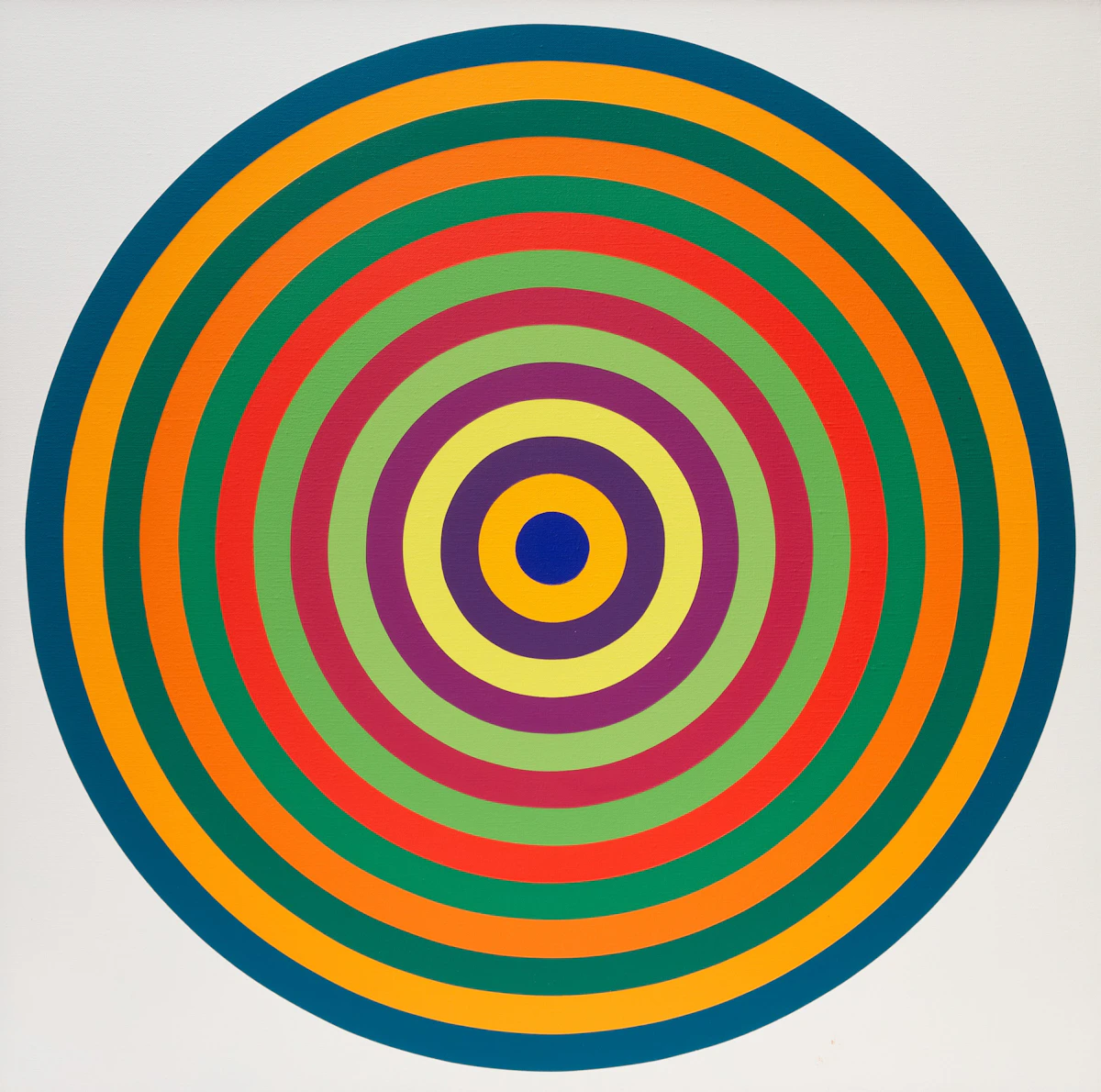
signed, titled twice, dated "1972-2021" and inscribed "sure 748" on the reverse
31.5 × 31.5 in (80.0 × 80.0 cm)
Galería RGR, Mexico
Private Collection, Quebec
A central figure of Kinetic and Op Art, Argentine artist Julio Le Parc emerged in the post-war era as a radical force in redefining the relationship between the viewer and the work of art. While studying in Argentina, Le Parc attended Lucio Fontana’s classes at the Escuela Nacional de Bellas Artes, where Fontana encouraged him to explore dynamic pictorial space. Following his arrival in Paris in 1958, Le Parc began experimenting with sequential combinations of geometric shapes in black and white or colour, opposing the dominant currents of Abstract Expressionism and, in France, Art Informel, Tachisme, Action painting, and Lyrical Abstraction. While works by Jackson Pollock, Jean Paul Riopelle, Georges Matthieu, and Wols emphasized gestural brushwork and spontaneous action, Le Parc minimized the role of the artist's personal sensibility.
In Série 19 no. 7, Le Parc explores the dynamic possibilities of chromatic variation and geometric repetition. Constructed as a sequence of concentric circular bands, the canvas presents a vibrant spectrum of blues, greens, oranges, reds, purples, and yellows radiating outward from a dense central core. The precise execution creates an intense optical rhythm where colours pulse and interact, destabilizing static perception. Le Parc sought to let the viewer engage directly with the artwork by using a limited number of geometric shapes, colours, and materials, and by conferring artistic responsibility on the viewer through perceived illusory movement in his paintings and drawings.
Throughout his career, Le Parc has been the subject of major exhibitions at institutions worldwide, including the Tate Modern, the Serpentine Gallery, and the Pérez Art Museum Miami, with his works held in permanent collections such as the Museum of Modern Art in New York and the Museum of Fine Arts in Houston. By stripping away subjective emotion in favour of systemic colour progression and visual sensation, Le Parc transformed the canvas into an active space of perceptual discovery. This work exemplifies his lifelong commitment to democratic art, engaging the eye in a perpetual interplay of form, light, and movement.
