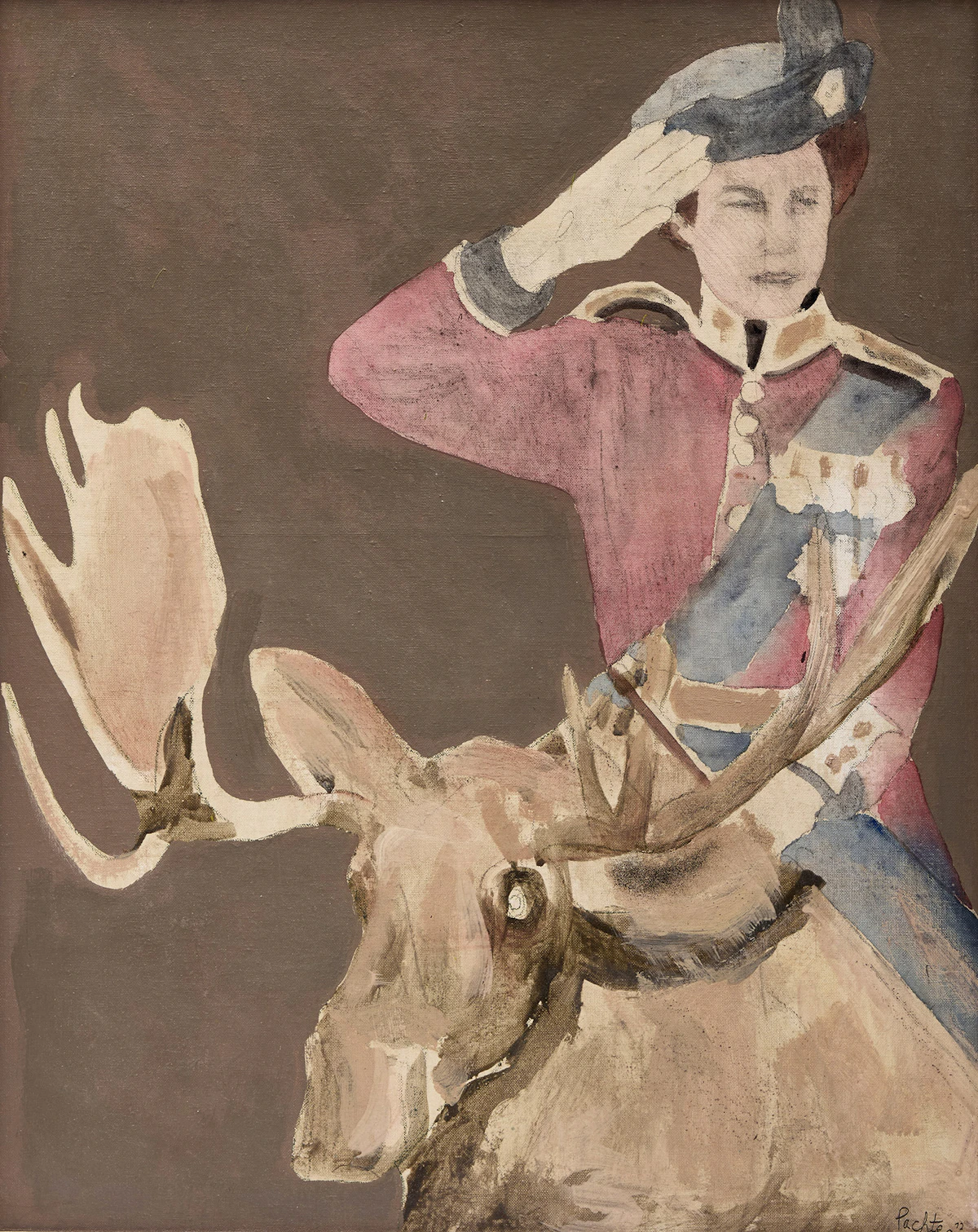
Charles Pachter's formative years included exposure to images of Queen Elizabeth and her life, an encounter with a moose as a young boy and, perhaps most importantly, witnessing the international emergence of pop art. These revelations impacting the artist's life led to an iconic representation of two of Canada's most recognized symbols, the Queen and the Moose.
In "Charles Pachter", Bogomila Welsh-Ovcharov notes that "in 1972, Pachter became involved with a group of cultural activists and began to reflect on the relationship of art to national identity. By July he was exploring the issue in depth, while collecting images of Queen Elizabeth and of the elusive animal he would come to consider the ultimate symbol of the Canadian psyche – the moose."
"By the Fall of 1972 he began to concentrate on painting in acrylic, depicting in various Canadian settings the queen alone or accompanied by a moose." The artist, amazed by the fact that Canada's Head of State did not reside within the nation which she ruled, presented Canada's English Monarch together with Canada's resident Monarch, the Moose, calling them "Monarchs of the North".
This work "Noblesse Oblige (Queen on Moose)" marked the beginning of a series of works that the artist would continue to explore for years to come. Pachter's paintings of Queen Elizabeth and the Moose are among the most recognizable images of pop art to originate from Canada. Works depicting the Monarchs of the North hang in significant private collections in Canada and internationally. One such work was gifted to Queen Elizabeth, while both Princes William and Harry received the iconic images from their father, King Charles, after he requested them from the artist during a visit to Canada. Charles was delighted by Pachter's imagery and felt that the Princes would greatly appreciate this unique portrayal of their grandmother.
Charles Pachter - Noblesse Oblige (Queen on Moose) | Cowley Abbott