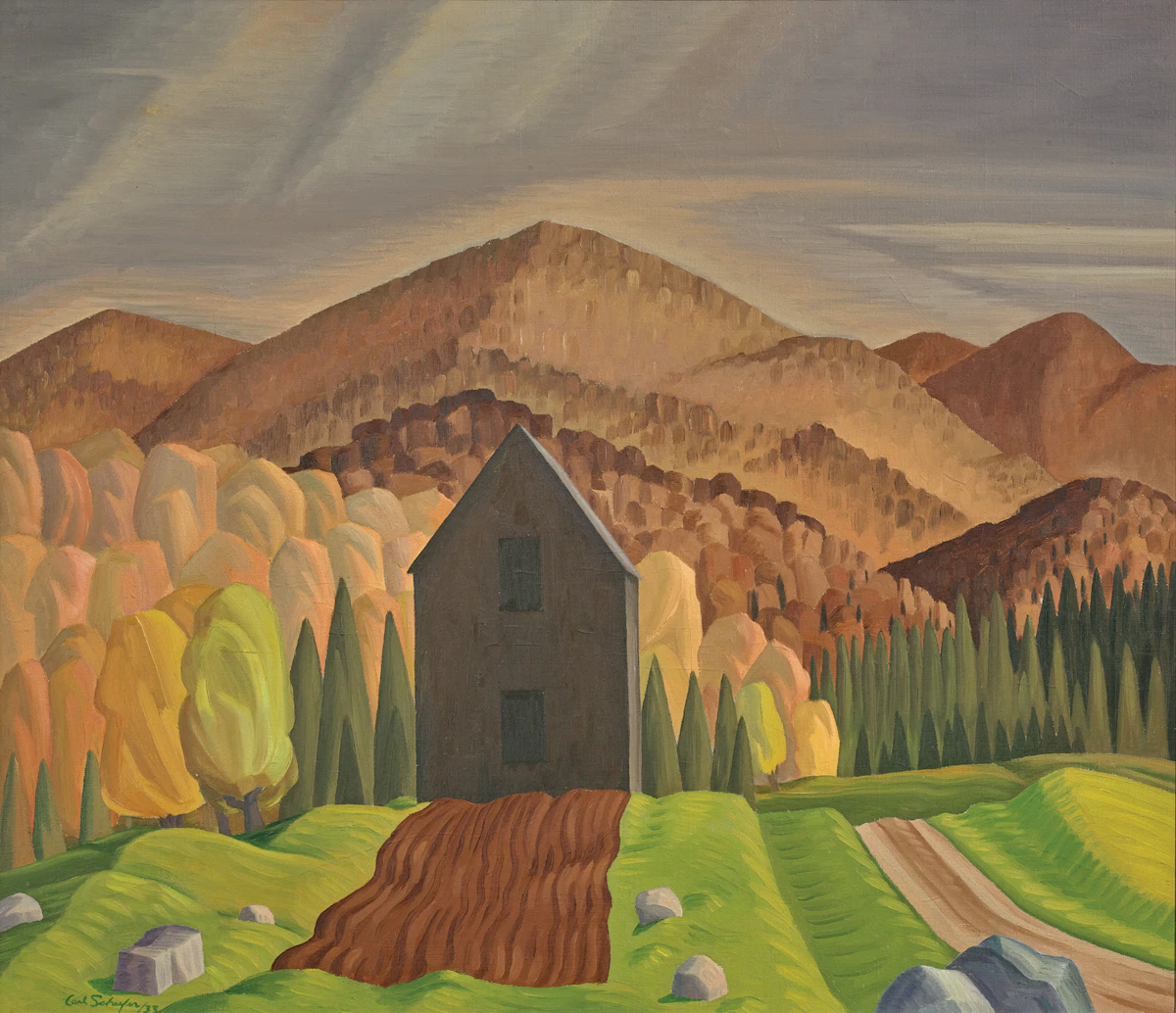
Near Cranberry Lake, Haliburton (Hills, Haliburton), 1933
oil on canvas
signed and dated 1933 lower left; signed with artist's Toronto address with extensive inscriptions on the stretcher, including the original title,
“Hills, Haliburton”
32.25 × 37.25 in (81.9 × 94.6 cm)
Auction Estimate:$30,000 - $50,000
Sale date:November 27, 2024
Price Realized
$50,400
(including Buyer's Premium)
Provenance
Collection of the Artist
L. Bruce Pierce Collection (no. 234)
Private Collection, Ontario
Exhibited
"Exhibition of Canadian Group of Painters", Art Gallery of Toronto, November 1933, no. 113 as "Hills, Haliburton"
"Carl Schaefer Retrospective Exhibition, 1926-1969", Sir George Williams University, Montreal; travelling to the Agnes Etherington Art Gallery, Queen’s University, Kingston; the Art Gallery of Hamilton; the London Public Library and Art Museum; the Art Gallery of Windsor, 30 November 1969-30 May 1970, no. 7
"Permeable Border, Art of Canada and United States 1920-1940", Art Gallery of Ontario, Toronto, 28 October 1989-7 January 1990, no. 6 as "Near Cranberry Lake, Haliburton"
Literature
Christine Boyanoski, "Permeable Border, Art of Canada and the United States 1920-1940", Toronto, 1989, unpaginated, no. 6, reproduced
Artist and teacher, Carl Fellman Schaefer, was born in Hanover in 1903. A vigorous yet sensitive interpreter of rural southern Ontario scenery, he studied at the Ontario College of Art (1921-24), where his teachers included Arthur Lismer and J.E.H. MacDonald. Schaefer held his first art show in 1924 and then had another exhibition with the Ontario Society of Artists in 1925. He got to exhibit with his former teachers, and the rest of the Group of Seven in 1928.
In the 1930s there was little money and Schaefer found it hard to make ends meet. He was forced by the Depression to re-establish himself and his family at Hanover, where he took up watercolour painting. Schaefer appreciated the landscape of his hometown and that led to him becoming a landscape artist, he found the countryside around his birthplace particularly inspiring, especially during the lean years of the 1930s. During this time, the artist chose to concentrate on agrarian and social themes, rather than the forest and wilderness.
The extensive notes found on the stretcher of this artwork provide a colourful history for the canvas. The artist notes that he was an "invited contributor" to the Canadian Group of Painter's first exhibition in 1933 at the Art Gallery of Ontario. Schaefer notes that the artwork's original title, Hills, Haliburton was used for this inaugural showing and he also inscribed his updated title, Near Cranberry Lake, Haliburton, indicating the added detail was implemented in October 1961. An important canvas from a celebrated career, Carl Schaefer's inscriptions on the reverse provide an expanded opportunity to appreciate the beauty we find on the face of the canvas.
His early work, such as the large 1933 oil painting “Near Cranberry Lake, Haliburton”, is characterized by a geometric and decorative painterly approach. Here, Schaefer presents a serene, stylized landscape dominated by autumn-coloured trees and soft mountains in the background. The dark, nearly silhouette-like shape of a building or barn stands at the centre, lending a focal point to the composition. The ground in the foreground is divided into sections, with plowed fields and grassy paths adding texture and depth. The sky is moody, with dark, brooding clouds that might suggest an impending storm or a sunset casting dramatic shadows. The composition is simplified and geometric, with clean shapes and smooth transitions between colours, giving the landscape a timeless, peaceful quality.