Born in Hamilton, Ontario, Albert Robinson left Canada to pursue academic training in Paris in 1903. He studied at the Académie Julian under William Bouguereau and at the École des beaux-arts before embarking on painting trips throughout Normandy in the summers of 1904 and 1905. Holding fast to the tenets of his formal European training, Albert Henry Robinson would nonetheless remain faithful to his Canadian roots, returning to paint the rural landscapes of Ontario and Quebec for the remainder of his career alongside Clarence Gagnon, Edwin Holgate, and A.Y. Jackson. Despite his initial foray along the south shore of the Saint Lawrence River with Jackson in 1921, Robinson preferred to paint the north shore where, throughout the 1920s and into the early 1930s, his annual trips in Beaupré and Charlevoix counties included visits to Saint-Tite-des- Caps, Baie-Saint-Paul, Les Éboulements, Murray Bay (now La Malbaie), Saint-Fidèle and Saint-Siméon.
In contrast to the Group of Seven, Robinson would remain a sensitive and authentic interpreter of the Quebec landscape. In doing so, the painter shared much with the artists of the Beaver Hall Group in Montreal, where he found many travel companions along the paths through Quebec villages. In 1933, he was one of the founding members of the Canadian Group of Painters. After suffering a heart attack at this time, the artist gradually abandoned his painting practice.
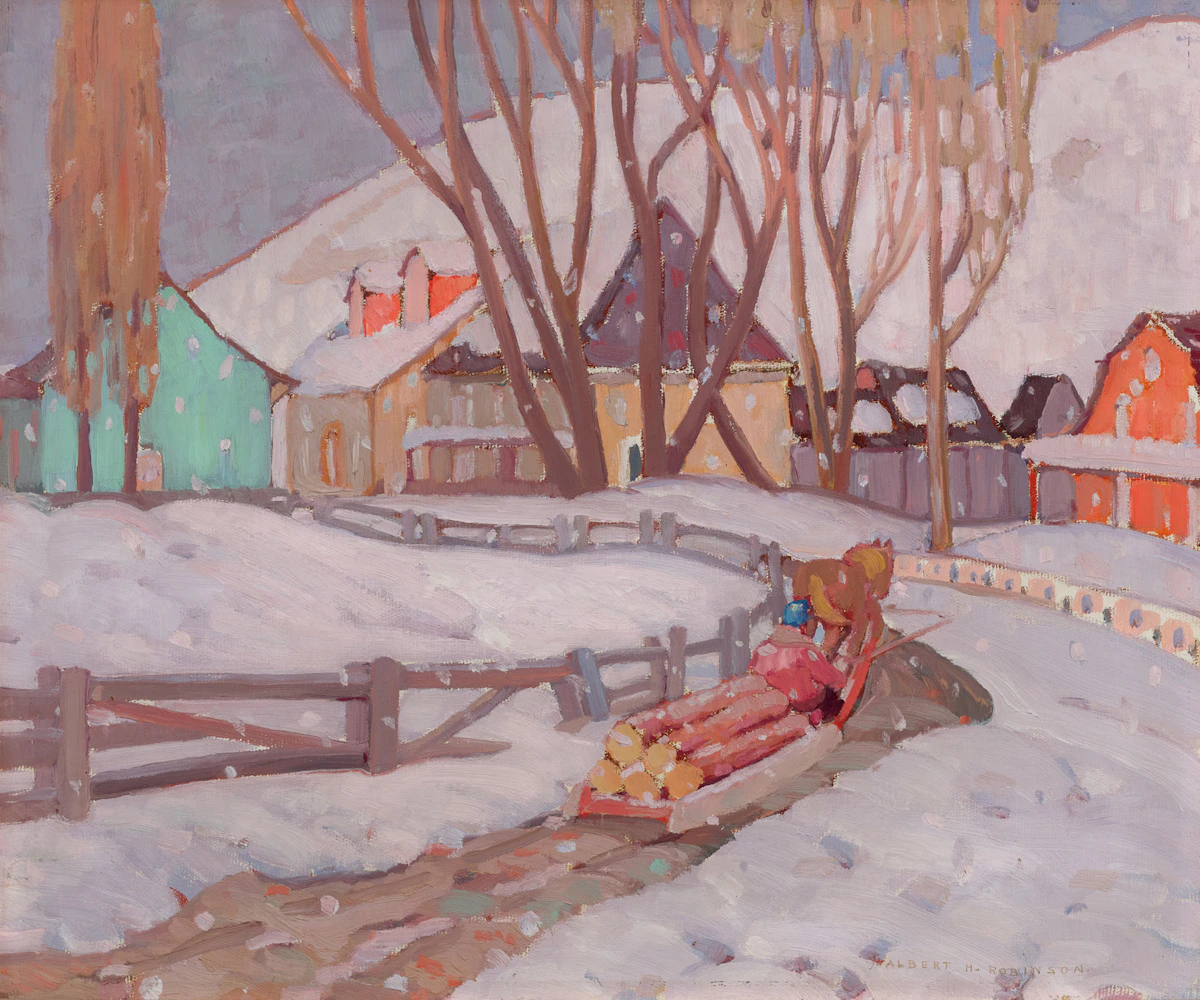
This painting depicts a serene winter scene in the rural village of Baie-Saint-Paul. A winding, snow-covered path leads through the composition, bordered by a rustic wooden fence that adds depth and perspective. A horse pulls a sled filled with logs and a seated figure, heading into town. The charming houses in muted yet warm colours—greens, yellows, and reds—contrast beautifully with the dominant whites and blues of the snow. The soft, atmospheric light enhances the feeling of a peaceful winter day. Rather than capturing the country through depictions of barren terrain, Robinson narrows his focus on the dwellings of emerging towns and cities in the early twentieth century, lending life and narrative to the prevailing landscape painting tradition in Canada.
The modern artist celebrates themes of traditional regionalism with great sophistication. As Jackson wrote, the subject in Robinson’s work is not what matters; it is his personal interpretation of it that counts. This can be recognized by the refined and balanced architecture of the composition, the use of intense and dazzling colours, and his method of generous paint application.