Private Collection, Quebec
By descent to the present Private Collection, Quebec
The Montreal-born Henri Beau arrived at age twenty-five in Paris, where he sought to further his artistic education under the French Academic Jean-Léon Gérôme and broaden his experience. Like many of his fellow Canadian artists who crossed the Atlantic during the 1890s, Beau was greatly influenced by Impressionism, which he was introduced to in commercial galleries and at the Salon d’Automne and the Salon des Indépendants.
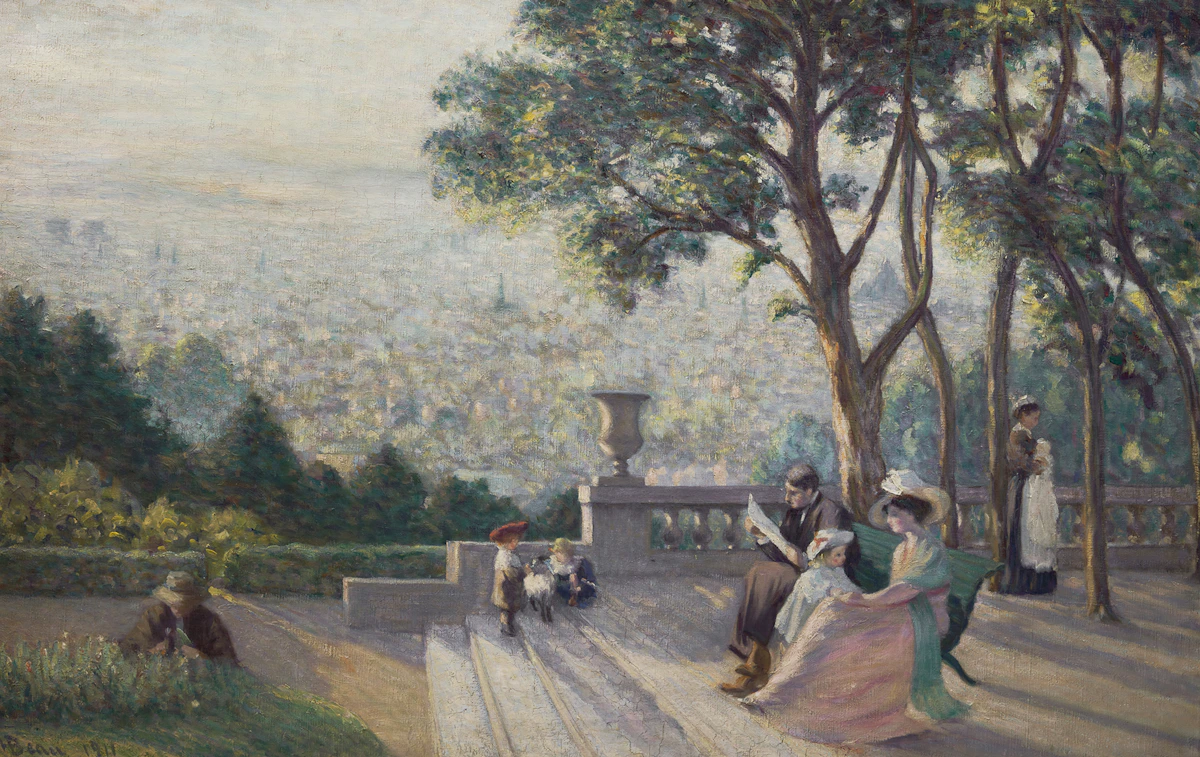
Inspired by the works of Claude Monet and Camille Pissarro, Beau studied the effects of light and atmosphere on the natural landscape. This oil painting is a large and rare composition of the Montreal lookout at the top of Mount Royal. The foreground is populated by a well-to-do couple and a young girl sitting on a bench; on the steps in front of them are small children playing, and behind them is a maid holding a baby. A gardener is tending to the well-maintained landscaping of the famous park, and behind the figures is a picturesque view of the city, with the towers of Notre Dame Basilica in the centre left and St. Patrick’s Church to its right. The painting dates to 1911, a few years after the terrace on Mount Royal was designed by the Maxwell brothers, in association with the firm Marchand & Haskell, in 1906. They designed the lookout and a pavilion, as well as a small shelter for Mount Royal Park. The Maxwell brothers worked extensively with urban planners and landscape architects as they did with artists and craftsmen. The projects for Mount Royal Park were developed in accordance with Frederick Law Olmstead’s earlier work on the park.
This painting has an ethereal French Impressionist feel, coupled with a distinctly Montreal subject. By applying small dabs of pigments in pastel tones, Beau created a richly textured surface and delineated the areas of light and shade on the canvas. The artist’s evocative "en plein air" paintings would contribute to establishing the foundation of modernism in Canadian art, emphasizing one’s subjective interpretation of nature and exploration of the transitory effects of light.