Collection of the Artist, 1965-1966
Gift of Mary H. Acheson in memory of her mother, Helen E. Acheson to the Winnipeg Art Gallery, 1966
Exhibited
"Development of Canadian Art: 1900-1965", Winnipeg Art Gallery,18 January-23 March 1975
"Images of Woman", Winnipeg Art Gallery, 14 November 1975-4 January 1976
"Through Canadian Eyes: Trends and Influence in Canadian Art, 1815-1965", Glenbow Alberta Institute, Calgary, 22 September-24 October 1976
"Images of the Prairies", The Saskatoon Gallery and Conservatory Corporation, 11 April-20 May 1979
"The Canadian Landscape", Winnipeg Art Gallery, 12 December 1980- 7 June 1981
"Trees of a Thousand Kind and Tall", Winnipeg Art Gallery, 10 December 1983-1 April 1984
"The Human Presence", Winnipeg Art Gallery, 19 August-12 November 1989
"The Figure in Canadian Art", Winnipeg Art Gallery, 5 June-19 September 1993
"Stored Secrets, The Sequel: The Vault on View", Winnipeg Art Gallery, 2 December 1995-15 September 1996
"Government House Selections", Government House, Winnipeg, 16 May 2001-23 April 2002
"Ivan Eyre: Landscapes and Still Lifes", Winnipeg Art Gallery, 15 September-31 October 2017
Literature
Ann Davis, "Images of Woman", Winnipeg, 1975, unpaginated, reproduced
Ann Davis, "Images of the Prairies", Saskatoon, 1979, unpaginated, reproduced
George Woodcock, "Ivan Eyre", Markham, 1981, reproduced page 92
Donalda Johnson, “Eyre With Honour”, Winnipeg, 1994, page 8
“Ivan Eyre: The Paintings”, Assiniboine Park, 2004, pages 18-19
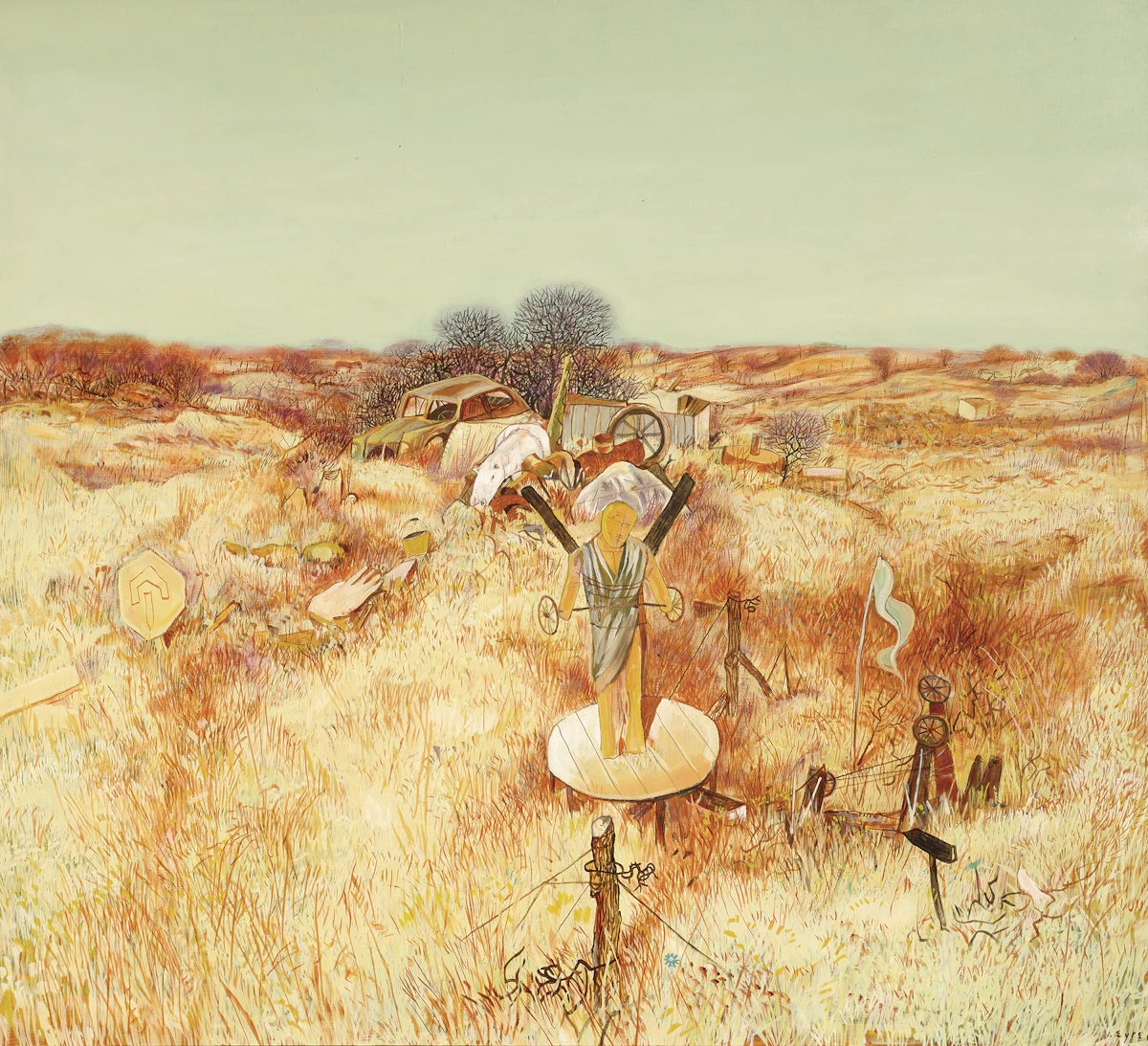
Ivan Eyre remembers that around 1960–1962, “I began to reevaluate my work and decided to begin afresh....I worked at ridding myself of all influences.” Drawing mostly on memory and dream imagery, Eyre created many surreal, post-apocalyptic scenes in the early 1960s, including “Mythopoeic Prairie II”. Dating to 1965, the oil on canvas depicts a prairie field with a broken car and other scraps of machinery. Aside from the shrubbery of the field, most of the objects are only somewhat discernible to the eye, as the forms are heavily stylized and tightly arranged. The artist’s commitment to engaging the viewer is evident here; he brings us on “an active journey through his work by creating paths of movement.” Eyre creates pathways for the eyes through his marvelous pointed shapes which twist and overlap within the landscape. The artist notes that these landscapes are never done on location and does not proclaim the scenes or even perspectives to be realistic. Eyre created over one hundred canvases in this dream-like style in the early 1960s, though many of the works ended up being destroyed by the artist.