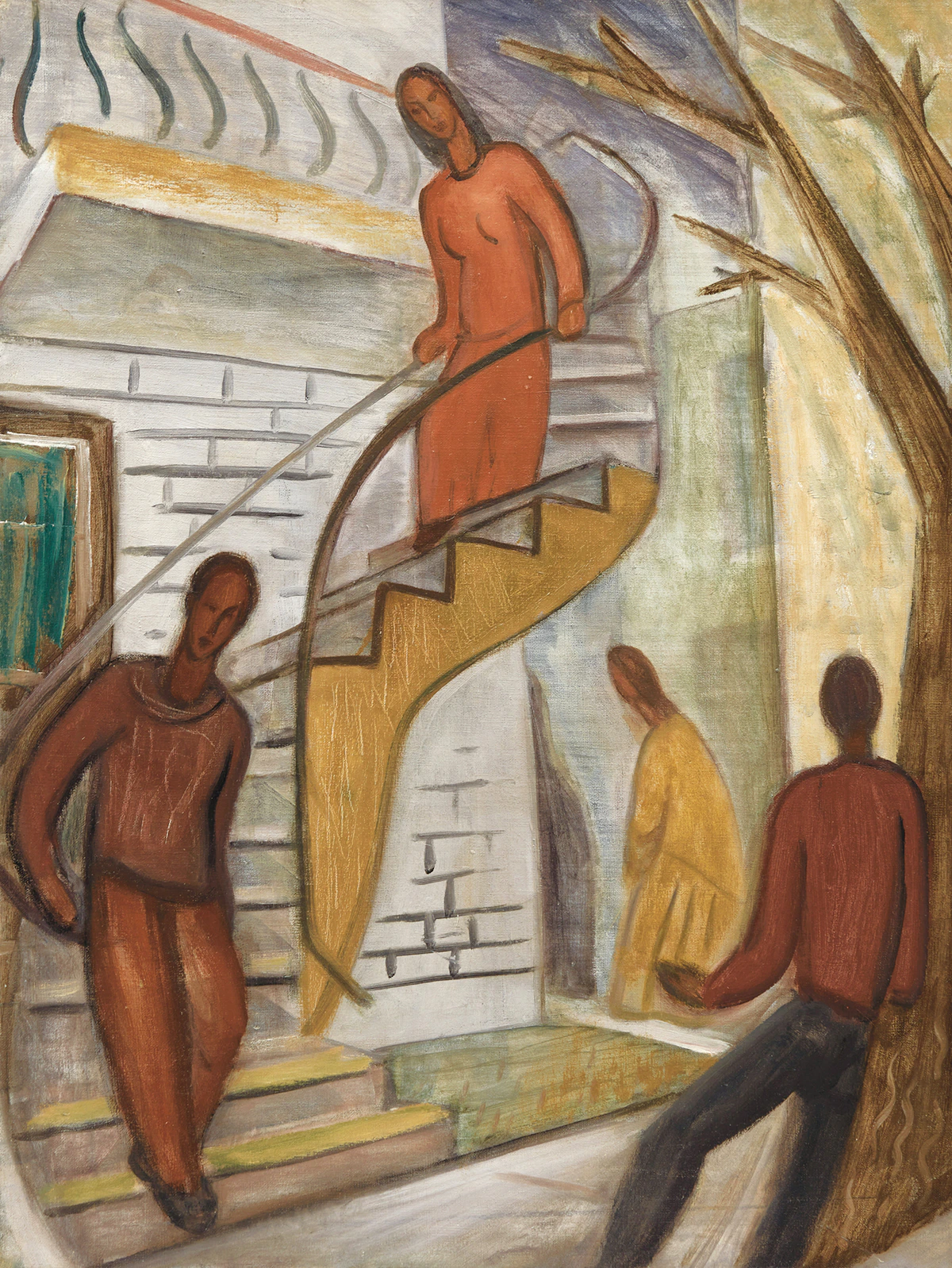
Sarah Milroy, "Uninvited: Canadian Women Artists in the Modern Moment", Kleinburg, Ontario, 2021, similar work reproduced page 250 ("Stairway", circa 1940, Montreal Museum of Fine Arts)
Montreal painter Marian Mildred Dale Scott acquired her first formal art training at the Art Association of Montreal between 1917 and 1920. She then became one of the first women to enroll in the École des beaux-arts de Montréal, before completing her training the following year at the Slade School of Art in London, England. Despite being a mother, wife of a prominent lawyer, poet, and member of Canada’s social democratic movement, Scott continued to pursue her art practice her entire life.
Over the course of her long career, Scott evolved her style from realism to abstraction as she worked to develop her own personal response to the rapidly evolving art world. While her mature work is dominated by abstraction, Scott began her career by painting very structured landscapes and botanical imagery, followed by a series of human faces with strong linear forms. During the Depression the artist depicted the people of Montreal: scenes of labourers, machinery, and urban life. "Staircase", dating to "circa" 1940, is characteristic of Scott’s style during this time. It portrays a quintessential outdoor spiral staircase of Montreal’s urban housing. The architecture, tree and four figures are painted in the artist’s structured approach, as are the quasi-abstract figures Scott depicted on the reverse of the canvas.
The year after "Staircase" was completed, in 1941, Scott was the subject of a solo show in Boston. Her style shifted again in 1943 when she was commissioned to paint an enormous mural for McGill University to commemorate their ground-breaking research on the endocrine system, executed in a style referencing ‘scientific symbolism’ or ‘biomorphism’. By the 1960s, Scott’s paintings became increasingly abstract, always maintaining a sense of order, symmetry and repetition.