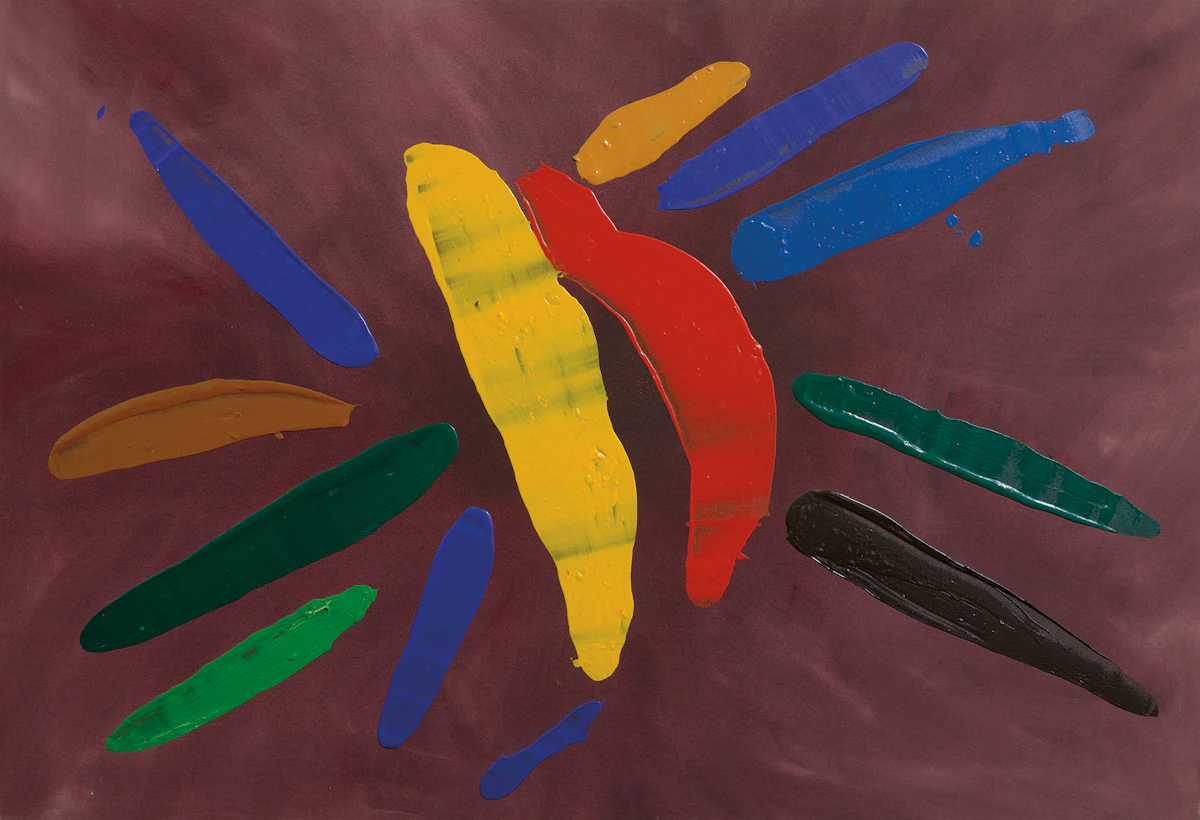
Karen Wilkin, Roald Nasgaard and Robert Christie, “The Optimism of Colour: William Perehudoff, A Retrospective”, Saskatoon, Saskatchewan, 2011, page 22
Among Canada’s foremost modernist painters, William Perehudoff’s work has been associated with a number of post–war artistic movements over the span of several decades. In the 1960s and 1970s, Perehudoff attended several iterations of the Emma Lake Artist’s Workshop in Saskatchewan. The workshops had evolved into an important venue for artists to associate and collaborate, and brought Perehudoff into contact with prominent artists such as Kenneth Noland, Donald Judd and Anthony Caro. Perehudoff and his wife and fellow painter, Dorothy Knowles, owned a lakefront cottage not far from the workshops, allowing them frequent access to this valuable artistic resource. The 1980s were a productive period for the artist, during which he experimented with bold contrasts in the surface qualities of his paintings. Perehudoff mixed acrylic paints with gel mediums, allowing him to create textural swathes of colour placed on soft backgrounds. Art historian Karen Wilkin observed, “a rapid survey of his mature work reveals him habitually taking advantage of present day acrylic paint’s ability to be dense or thin, transparent or opaque, fluid or resistant, among many other properties. This history of the painting’s making, no matter how fresh and direct the finished work appears to be, is part of its meaning.”