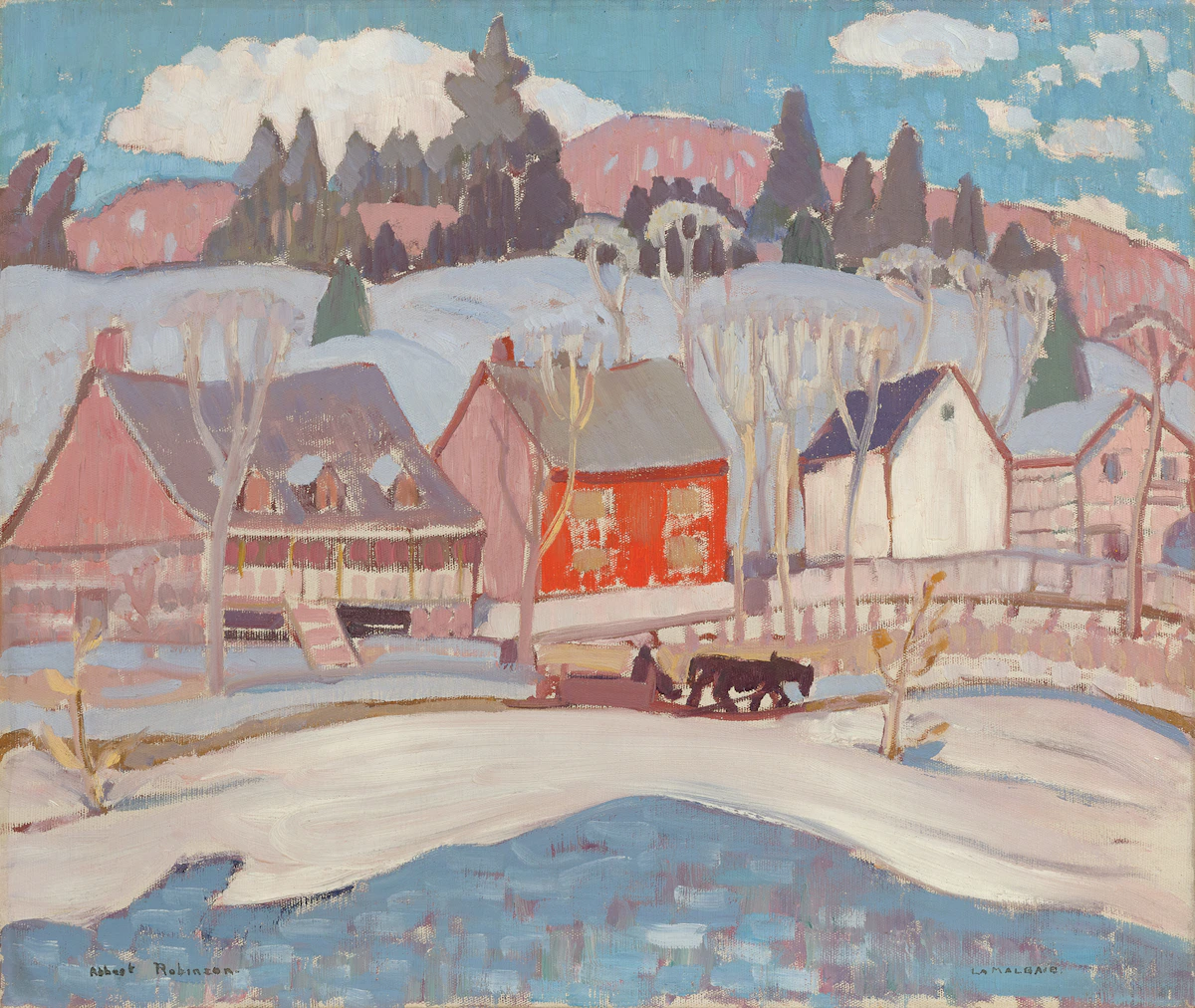
G.L. Robinson, Toronto, by 1955
Morris Gallery, Toronto
Acquired by the present Private Collection, May 1978
Exhibited
“Forty-eighth Annual Exhibition”, Royal Canadian Academy of Arts, Art Gallery of Toronto, 18 November 1926‒2 January 1927, no. 125 Spring Exhibition, Art Association of Montreal, 19 March‒12 April 1936, no. 285
“Albert Henry Robinson Retrospective Exhibition”, Art Gallery of Hamilton; travelling to National Gallery of Canada, Ottawa,
1 April‒6 May 1955, no. 37
“Canadian Classics”, Morris Gallery, Toronto, 13 May‒3 June 1978, no. 47
“Collector's Canada: Selections from a Toronto Private Collection”, Art Gallery of Ontario, Toronto; travelling to Musée du Québec, Québec City; Vancouver Art Gallery; Mendel Art Gallery, Saskatoon, 14 May 1988‒7 May 1989, no. 83 as circa 1926
“Hommage à Albert H. Robinson”, Galerie Walter Klinkhoff, Montreal, September 1994, no. 10
“Embracing Canada: Landscapes from Krieghoff to the Group of Seven”, Vancouver Art Gallery; travelling to the Glenbow Museum, Calgary; Art Gallery of Hamilton, 30 October 2015‒25 September 2016
“Highlights from ‘Embracing Canada’”, Galerie Eric Klinkhoff, Montreal, 22 October‒5 November 2016, no. 19
Literature
“Albert Henry Robinson Retrospective Exhibition”, Ottawa, 1955, no. 37
“Canadian Classics”, Morris Gallery, Spring 1978, Toronto, no. 47, reproduced
Dennis Reid, “Collector's Canada: Selections from a Toronto Private Collection,” Toronto, 1988, no. 83, reproduced page 76
“Hommage à Albert H. Robinson”, Galerie Walter Klinkhoff, 1994, no. 10, reproduced page 4
Ian Thom, et al., “Embracing Canada: Landscapes from Krieghoff to the Group of Seven,” Vancouver/London, 2015, reproduced page 163
Born in Hamilton, Ontario, Albert Robinson left Canada to pursue academic training in Paris in 1903, where he studied at the Académie Julian under William Bouguereau and at the École des beaux-arts before embarking on painting trips throughout Normandy in the summers of 1904 and 1905. Holding fast to the tenets of his formal European training, Albert Henry Robinson would nonetheless remain faithful to his Canadian roots, returning to paint the rural landscapes of Ontario and Quebec for the remainder of his career alongside Clarence Gagnon, Edwin Holgate, and A.Y. Jackson. Despite his initial foray along the south shore of the Saint Lawrence River with Jackson in 1921, Robinson preferred to paint the north shore where, throughout the 1920s and into the early 1930s, his annual trips in Beaupré and Charlevoix counties included visits to Saint-Tite-des- Caps, Baie-Saint-Paul, Les Éboulements, Murray Bay (now La Malbaie), Saint-Fidèle and Saint-Siméon.
Robinson’s scenes of the Quebec countryside and its inhabitants are characterized by their simplified forms and gentle hues, mixed with generous amounts of white paint and applied with the artist’s characteristic crisp, rectilinear brushstrokes. In “La Malbaie”, the artist used a palette of pastel tones repeated throughout the composition, accentuated by a bright orange-red building in the centre and a brown horse pulling a sleigh. Rather than capturing the country through depictions of barren terrain, Robinson narrows his focus on the dwellings of emerging towns and cities in the early twentieth century, lending life and narrative to the prevailing landscape painting tradition in Canada.