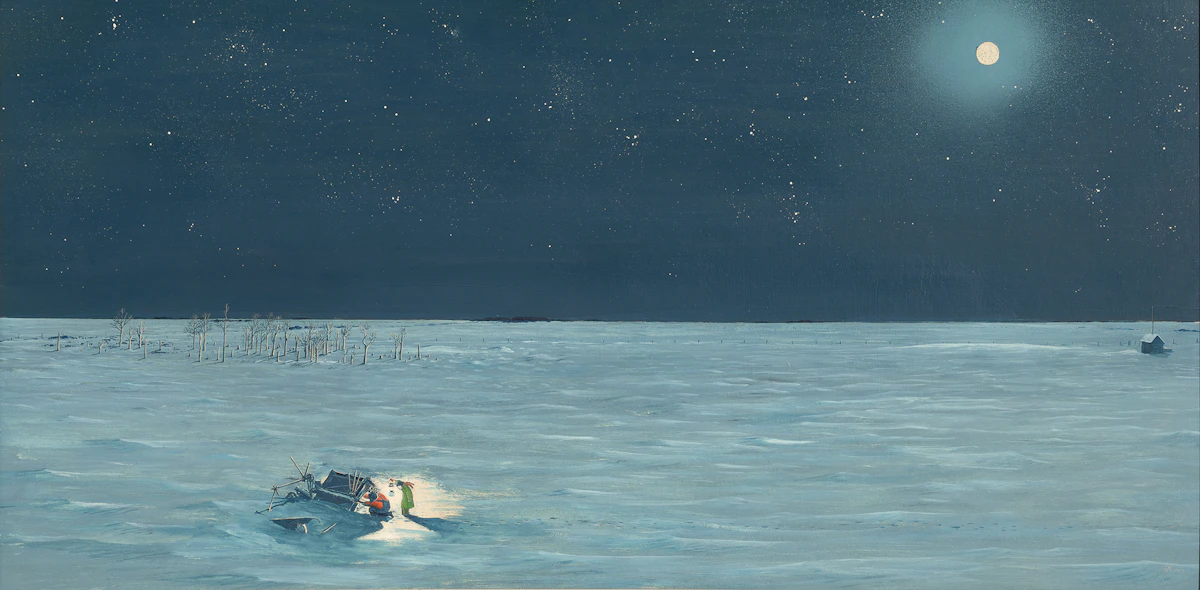
In his 1964 exhibition “An Immigrant Farms in Canada”, William Kurelek foregrounded the activities, events, and seasonal pursuits he recalled, growing up in an agrarian community north of Winnipeg in the 1930s. “A Bolt Like That”, painted a year later, resonates strongly with the artist’s work in the mid-1960s and early 1970s. “An Immigrant Farms in Canada” at Toronto’s Isaacs Gallery was the first in a series he would mount exploring the latter half of the 1960s that analyze both the tender and the gruelling aspects of daily life on the Prairies, including “The Ukrainian Pioneer Woman in Canada” (1967), “Prairie Farm Work” (1969), “Farm Humour” (1971), and “My Brother John” (1973). Although this painting was not featured in any of these exhibitions, it made an appearance in the 1967 National Film Board documentary Kurelek by William Pettigrew.
This documentary and the early chapters of Kurelek’s later autobiography, “Someone With Me”, brims with the artist’s recollected stories of his childhood in rural Alberta and Manitoba. He later envisioned some of these narratives as paintings. In other instances, as is the case with “A Bolt Like That”, the paintings speak for themselves. This work depicts two family members, Kurelek and his father perhaps,
huddled on a frozen Prairie field in the middle of winter. The child’s lantern throws a rare warmth echoed only by the sun reflecting off the distant moon. A second figure, crouching, reaches into the cavity of a hulking piece of farming equipment, obscured by the tightly packed, encasing snow. The denuded patch of trees in the middle ground, the oceanic expanse of the field, the black sky pricked by starlight, and the straight, uncompromising horizon set a scene of cold desolation.
The painting is, on the one hand, about the gruelingly mundane. Kurelek admits that, as a youth, he was clumsy, absent-minded, and completely inept at solving practical, mechanical problems. “At times,” he writes in his autobiography, “I had the uncanny feeling that I was actually sabotaging farm operations.” We can feel the painting’s cloying, bitter cold, but we also sense the matter-of-course banality of retrieving (or replacing) some sprocket, nut, or bolt with frigid fingers in the middle of the night. And yet, the picture is not without mystery. Kurelek, a devote Roman Catholic, made a point of infusing otherwise humdrum, lonely, terrestrial scenes with an abiding sense of divine presence. While he was always quick to insist that the natural world was, in itself, fundamentally ambivalent toward the affairs and values of human beings, paintings like this seem pregnant with deep, inchoate, perhaps inarticulable meaning.
We extend our thanks to Andrew Kear, Canadian art historian and Head of Collections, Exhibitions and Programs at Museum London for contributing the preceding essay. Andrew is the past Chief Curator and Curator of Canadian art at the Winnipeg Art Gallery, a Curator of the 2011/2012 national travelling exhibition “William Kurelek: The Messenger” and author of the Art Canada’s Institute’s “William Kurelek: Life & Work”, available at www.aci-iac.ca.