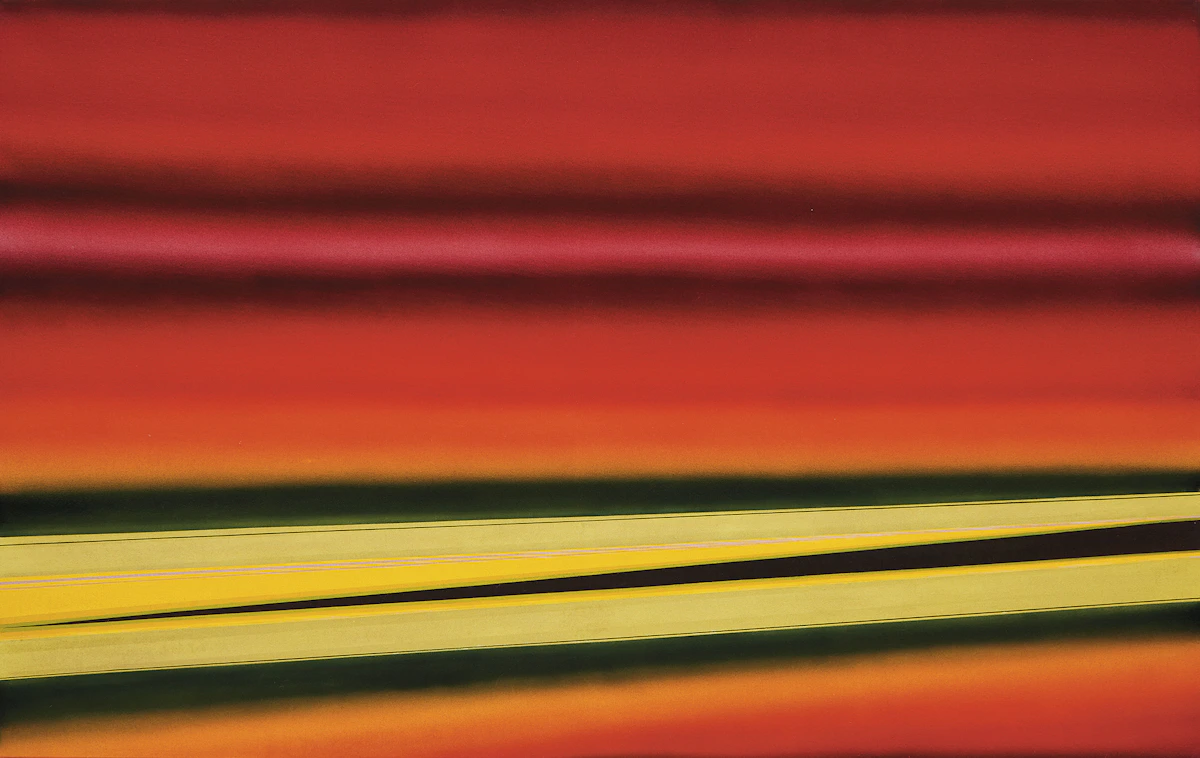
signed and dated 1975 lower right; signed (three times) and dated 1975 on the reverse; unframed
42 × 66 in (106.7 × 167.6 cm)
Auction Estimate:$25,000 - $35,000
Sale date:June 8, 2023
Price Realized
$33,600
(including Buyer's Premium)
Provenance
Waddington and Gorce Inc., Montreal
Art Sales and Rental Gallery, Montreal Museum of Fine Arts
Private Collection, Montreal
Cowley Abbott, auction, Toronto, 3 December 2020, lot 19
Private Collection, Toronto
Literature
Joan Murray, “Canadian Art in the Twentieth Century”, Toronto, 1999, pages 99 and 122
Wanda Nanibush and Georgiana Uhlyarik, “Rita Letendre: Fire and Light”, Toronto, 2017, pages 17-19
As one of the few women artists at the centre of abstract and non- figurative art in Canada, Rita Letendre holds a unique position in Canadian art history, producing some of the most iconic and innovative examples of post-war and contemporary artworks. Working closely with Paul-Émile Borduas and other members of the Automatistes in Montreal in the late 1940s and 1950s, Letendre first developed highly gestural abstract works favouring heavy applications of oil paint with the palette knife. During the 1960s, after a large mural commission at the University of California, the artist moved towards hard-edge abstraction, playing with flattened planes of colour and the use of an
airbrush, all while maintaining a consistent exploration into the light and energy radiating from her works.
Having shifted towards this more plastic realm of art, Letendre distinguished herself as a unique tour de force. Joining the Non‒Figurative Artists’ Association in Montreal in 1956, this group fundamentally helped shape her development as an artist. Preferring the moniker of Non‒Figurative rather than Abstract artists, this helped distinguish the artists apart from European counterparts exploring geometric abstraction as well as taking the teachings of the Automatistes a step further. Throughout the 1970s, Letendre focused her practice on exploring speed and vibration through her works.
Joan Murray discusses, “Rita Letendre explored colour, line and composition through the use of forceful chevrons that cut across the composition diagonally or horizontally from one corner of the painting to the other. She obtained extra energy from applying narrow ridges of contrasting colour to the borders of each ray.” Wanda Nanibush argues that “No label fits Letendre perfectly, as her influences have been drawn from diverse movements and tendencies. She belongs to the romantic tradition because of her focus on the evocative qualities of light and colour, which were categorically rejected by Les Plasticiens. However, influenced by Les Plasticiens, Letendre has maintained an interest in the ‘plastic’, or formal, elements of painting.” The selection of deep oranges, magenta and bright yellow colouring the composition in sharp wedges and airbrushed bands explode off the canvas and wrap the viewer in glowing energy. The amalgamation of influences and experimentations are expertly harnessed in “Untitled” and stand as a fiery example of the artist’s most celebrated period of work.