Private Collection, Toronto
Private Collection, Toronto
By descent to the present Private Collection, Toronto
Exhibited
“Thirty‒Eighth Annual Exhibition”, Ontario Society of Artists, Toronto, from 5 March 1910, no. 148
“Thirty‒Second Exhibition”, Royal Canadian Academy of the Arts, Montreal, from 24 November 1910, no. 33
“Exhibition of Paintings, Royal Canadian Academy of Arts”, Winnipeg Industrial Bureau, from 6 December 1912, no. 28
“Department of Fine Arts, Canadian National Exhibition”, Toronto, 23 August‒8 September 1913, no. 270
“A Memorial Exhibition of the Paintings of the Late Florence Carlyle”, A.R.C.A., Jenkins Art Gallery, Toronto, 1925, no. 69
Dorothy Farr & Natalie Luckyj, “From Women’s Eyes: Women Painters in Canada”, Agnes Etherington Art Centre, Kingston, 12 December 1975‒1 February 1976, no. 20
Florence Carlyle, “Against All Odds”, Museum London, travelling to The Varley Art Gallery of Markham, Unionville; The Woodstock Art Gallery, 18 September 2004-26 August 2006, no. 25 as “Mother and Child”
Literature
‘Thirty-Eighth Annual Exhibition of the O.S.A.’, “Toronto Saturday Night”, 12 March 1910, page 6
“Toronto Telegram”, 16 May 1925
‘Collected Pictures of Florence Carlyle’, “Mail and Empire”, Toronto, 28 May 1925
Dorothy Farr & Natalie Luckyj, “From Women’s Eyes: Women Painters in Canada”, Agnes Etherington Art Centre, 1975, no. 20, reproduced page 26
Joan Murray, Florence Carlyle, “Against All Odds”, Museum London, 2004, no. 25, listed page 86 as “Mother and Child”
Susan Butlin, “The Practice of Her Profession, Florence Carlyle”, Kingston/ Montreal, 2009, plate 16, reproduced page 156
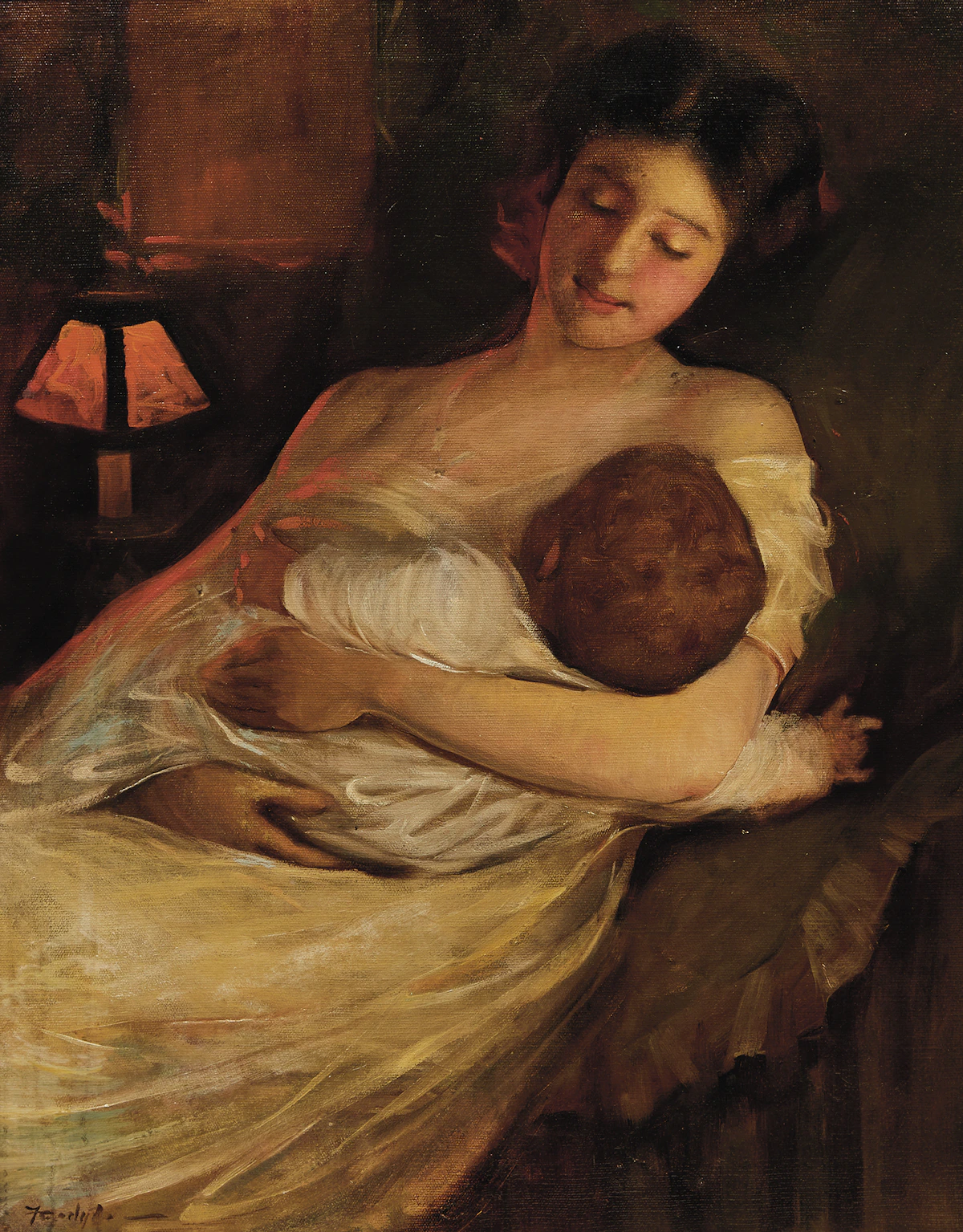
In Florence Carlyle’s charming picture “Motherhood”, a mother is absorbed in looking at a child which she lovingly holds. The child looks back at her, one arm groping but she has a secure grip and they both are content. A lamp lights this intimate scene of mother love and its light illuminates the mother’s arm and the mirror behind her in the background. Carlyle beautifully conjures here the tenderness and understanding that can surprise a parent in the performance of their duties.
Carlyle was, above all, a painter of women. Her specialty was recording key moments in the life of women, and she considered particularly in paint, not only women’s behavior in the domestic sphere but their spirituality. In this endeavour, motherhood ranked for her as a quintessential moment in a woman’s life, which gave a mother “a new heaven and a new earth”, as she later wrote in a short story titled “Mary`s Child” which she had published in a magazine titled “Time and Tide” in 1923.
In 1899, she had moved to New York and the move gave her new inspiration and places to exhibit such as the Society of American Artists, the National Academy of Design, and in 1908, at Knoedler’s Galleries on 34th and 5th Avenue in an important show of women artists. Exhibitions such as these would have expanded her notions of the depiction of womanhood in art.
In 1910, she returned to Canada and painted “Motherhood”. Possibly she used a friend or family member and child as the models in Motherhood. Her handling, especially of the diaphanous textiles, is rich and painterly and her attempt to catch the nuances of light and atmosphere in an illuminated interior space is masterly. Motherhood is a tour de force in characterization and drawing, one of Carlyle’s best and most touching works of art. As the magazine “Saturday Night” which praised the painting in 1910, said of it: “The modelling of the figures and the... light are exquisitely rendered”.
We extend our thanks to Joan Murray, Canadian art historian, for contributing the preceding essay.