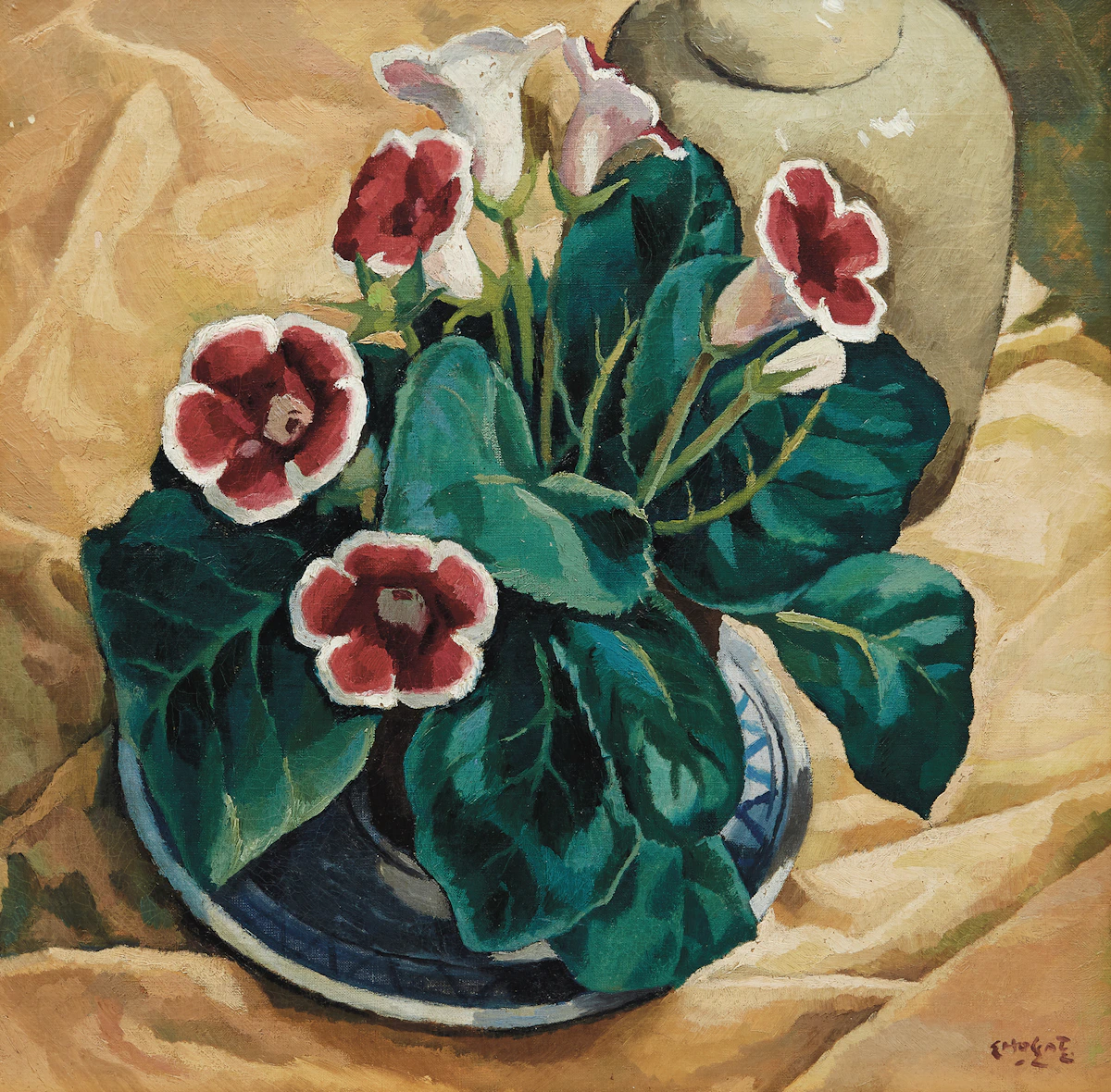
In the early 1920s, Edwin Holgate was a key player in the formation of the Beaver Hall Group in Montreal. Holgate became the eighth member of the Group of Seven in 1931 and remained a member of the Group until it disbanded in 1933. From it arose the Canadian Group of Painters of which he was a founding member. Paul Duval noted that Holgate and Varley were the only members of the Group who drew and painted nudes. Compared to his contemporaries, he had a wide range of subject matter, including landscapes, portraits, still lifes, interiors and war scenes in a variety of media. In “Still Life”, Holgate presents a gloxinia plant viewed from above. It is a traditional still life arrangement, the potted plant surrounded by a generous amount of gathered tablecloth, and behind the plant is a lidded ceramic vase. The unique perspective as well as the jewel tones of the foliage demonstrate how Holgate developed his own unique balance of traditional and modern approaches.