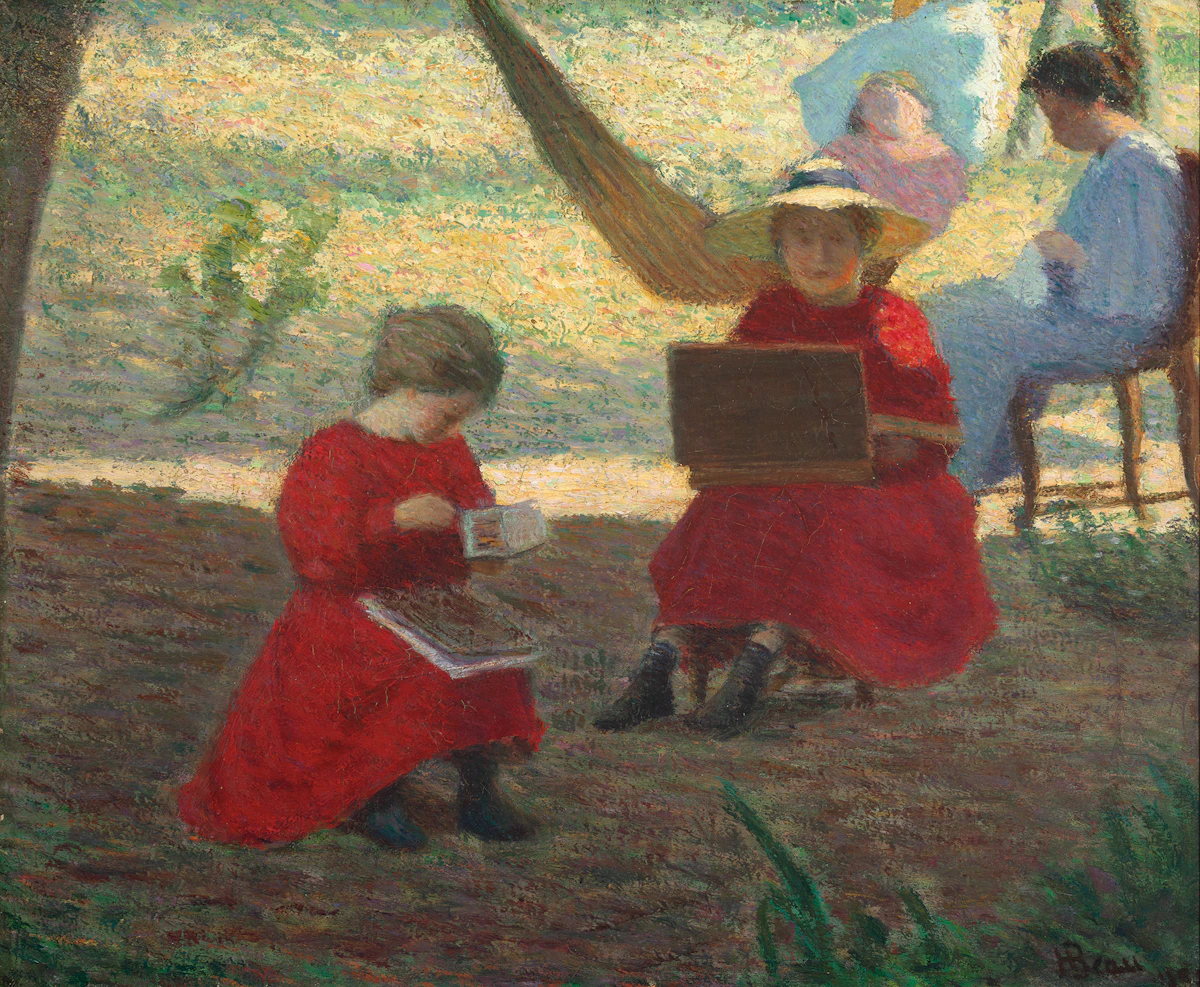
Sotheby’s, auction, Toronto, 3 December 1997, lot 13 as “The Daughters of the Artist”
Private Collection
Exhibited
“Art canadien: L’enfant et son univers|Canadian Art: A Child’s World”, Galerie Eric Klinkhoff, Montreal, 28 October‒11 November 2017, no. 8
“Our Children: Reflections of Childhood in Historical Canadian Art”, Varley Art Gallery of Markham, 13 April‒23 June 2019 as “Painting in the Garden”
Literature
A.K. Prakash, “Impressionism in Canada: A Journey of Rediscovery” Toronto, 2015, page 752,765, reproduced page 442, plate 13.2 as “Summer in the Garden”
The Montreal-born Henri Beau arrived at age twenty-five in Paris, where he sought to further his artistic education under the French Academic Jean-Léon Gérôme and broaden his experience. Like many of his fellow Canadian artists who crossed the Atlantic during the 1890s, Beau was greatly influenced by Impressionism, which he was introduced to in commercial galleries and at the Salon d’Automne and the Salon des Indépendants.
Inspired by the works of Claude Monet and Camille Pissarro, he would leave the city for the countryside whenever possible in order to better study the effects of light and atmosphere upon the natural landscape. Here, the artist has depicted a small group of female figures whiling away the afternoon hours. In the foreground, young girls in vibrant red dresses are shown creating pictures underneath the shade of a tree. While the female figure at the left glances down to select colours on a palette, the other appears to be looking straight ahead as if lost in contemplation. This pastoral tableau is completed with two other figures in the background, where one is shown seemingly fast asleep in a sun-drenched hammock. By applying small dabs of pigments in cream and russet tones, Beau created a richly textured surface and delineated the areas of light and shade on the canvas. Ultimately, his soft and warm palette is quintessentially French, recalling the warm air of the Provence countryside.
In the end, Beau’s evocative “en plein air” paintings would contribute to establishing the foundation of modernism in Canadian art, emphasizing one’s subjective interpretation of nature and exploration of the transitory effects of light.