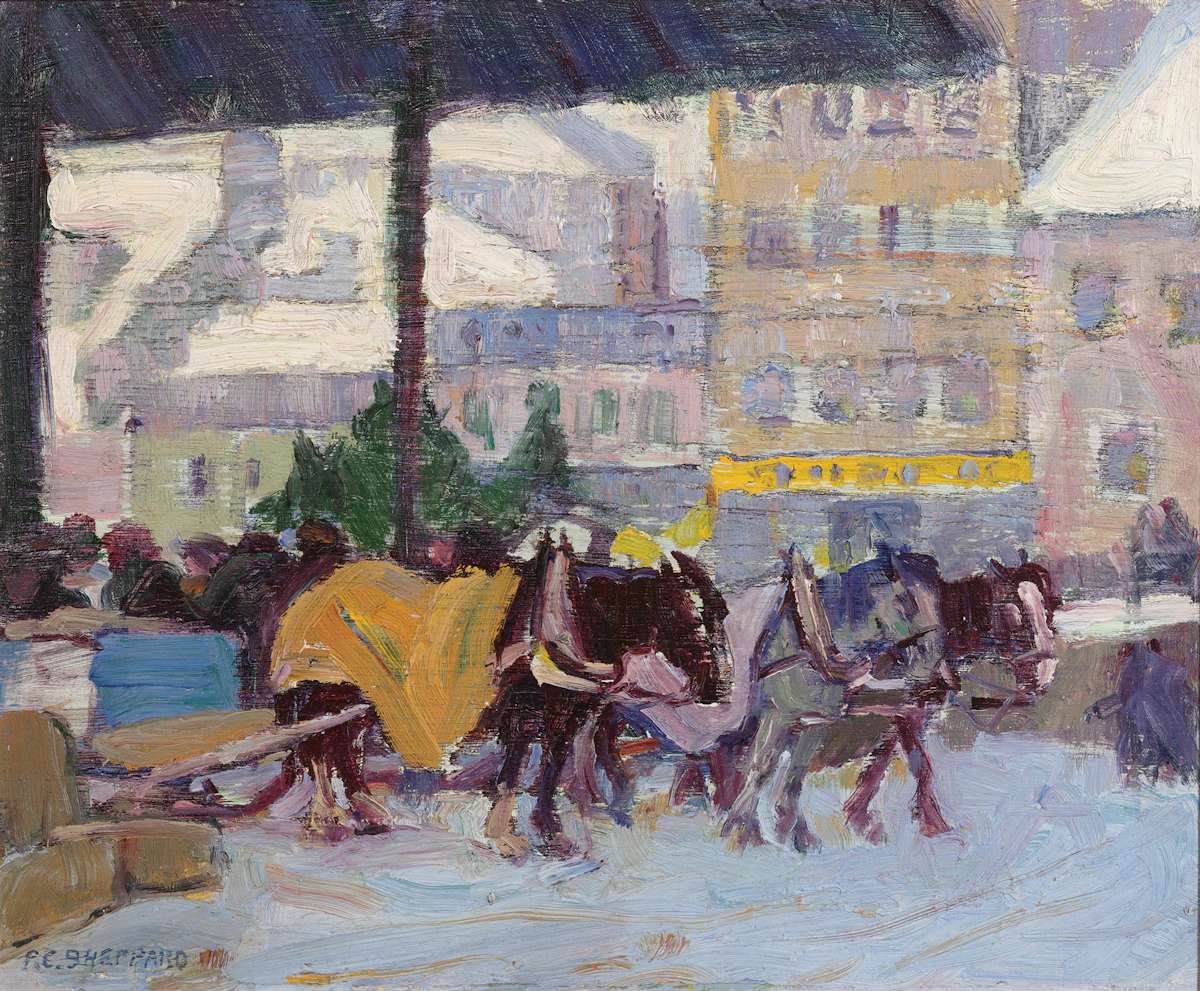
Tom Smart, “Peter Clapham Sheppard: His Life and Work”, Richmond Hill, Ontario, 2018, pages 124, 139
A Toronto native, Peter Clapham Sheppard occupies a place in Canadian art history among a generation of artists that established a distinctively Canadian school of art. While the painter studied, sketched and exhibited alongside members of the Group of Seven, Sheppard found inspiration in more broad subject matter, including landscapes, portraits, still lifes, city and harbour scenes. Sheppard bore witness to the steady construction and urbanization that took place in Canadian and American cities during the first half of the twentieth century, which inspired much of his artistic oeuvre.
Author and art historian Tom Smart writes that “[i]n artistic terms, Sheppard identified with human subjects in gritty urban settings.” Smart elaborates further on Sheppard’s talent in painting city scenes, remarking that he “captured an essential liveliness, apparently easily, gesture and rhythms of line and colour simulate as if by magic the cacophony and harmonies of his subjects.” “In Bonsecours Market”, the viewer can sense this liveliness of three subjects in view: the horses, the group of people, and the buildings. A cheerful palette is repeated throughout every area of the canvas.
Built in 1847, the Bonsecours market was the main public market in the Montreal area for more than one hundred years. The Neoclassical building brought together a multitude of vendors and shoppers from across the city and out of town. It is a prime subject matter for P.C. Sheppard, as he was particularly captivated by subjects involving a human presence, particularly crowds in city streets, markets, county fairs, circuses and harbour scenes.