Provenance
The Artist
Ellen Regan McCluskey, Long Island, New York & Palm Beach, Florida
By descent to a Private Collection, Palm Beach, Florida
Private Collection, Massachusetts
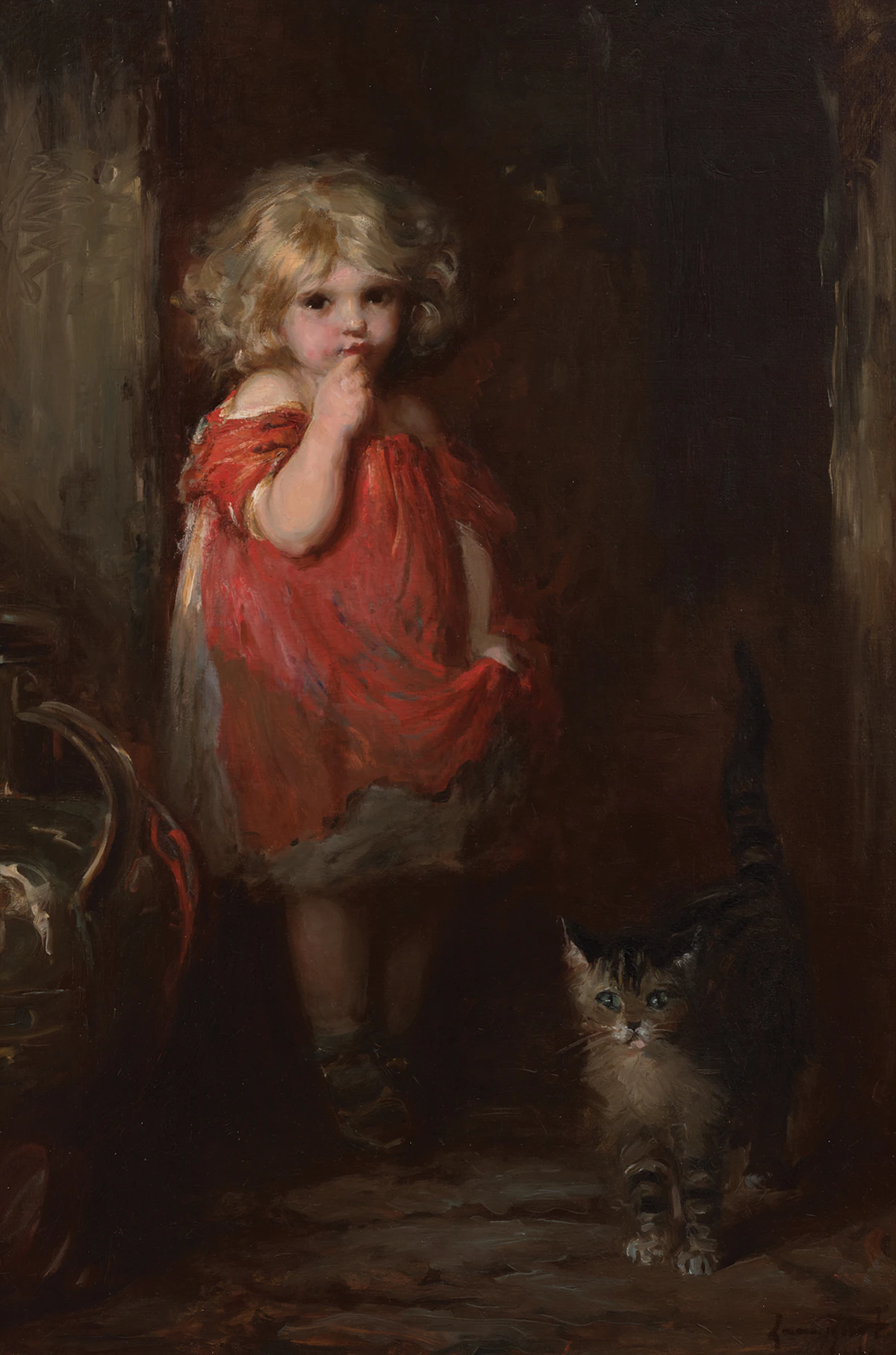
The warmth and naturalness of the subject in Laura Muntz Lyall's “A Little Girl” makes it a picture at which we can look and look again. A little girl with tousled golden hair gives the viewer a steadfast stare, hand held to mouth in a childish gesture, absorbed in thought. Her other hand clutches a red garment she wears off her shoulders. In front of her, a kitten looks at us with an equally oblique stare, alert. Light falls on the girl's face and body, and on the wall behind her, on the basket next to her which reflects the red dress, and on the kitten. It's a startlingly vivid tour-de-force of observation: the child's intense look, the hand held to mouth, the hand that clutches, the reflection of the skirt in the brass basket, the staring kitten, the light on the face of the child.
Lyall left Toronto and went to New York in March 1904 for a visit. At the time and later, Lyall was considered a trailblazer for women artists in Canada. She had shown at the Paris Salon, the mark of an artist's reputation of the day. She was concerned with the modern world and interested in psychology. She drew on naturalism and combined it with Impressionism in her work. She was versatile in her choice of subject matter and acknowledged as the “incomparable” painter of children's portraits. Ambitious for contacts and places to exhibit and sell her work, since her means were modest.
In Canada, Lyall was respected as a stalwart of the Royal Canadian Academy, the Art Association of Montreal and many other societies and groups, but she had begun to reach out to new places to exhibit in the United States. In 1901, she had shown her work at the Pan-American Exposition in Buffalo and in 1903, at the Rochester Art Club. In 1903, she showed work in New York at the Water Colour Club. In 1904 in April, after she arrived in the city, she showed her work at the “Annual Exhibition of the Society of American Artists”, in Chicago at the Art Institute's “Annual Exhibition of Watercolors by American Artists” and in St. Louis at the “Canadian Exhibition at the World's Fair Louisiana Purchase Exposition”, where she won a prestigious bronze medal. She returned to Canada in the summer.
She sent “A Little Girl” to New York to the National Academy of Design exhibition in January 1905. The academy was known to exhibit artists established on the American scene, but some artists had found it too conservative and left to be included in an informal group that came in time to be called the Ashcan School and advocated painting urban scenes. Members of this group (Robert Henri, William Glackens, George Luks, John Sloan, Arthur B. Davies and Maurice Prendergast) had a show at the National Arts Club in January 1904. In 1908, an enlarged group had a landmark show at the Macbeth Galleries in New York.
When Lyall returned to Toronto, any knowledge she had of the up- and-coming art scene in New York would have made her want to assert something individual on her part. She decided to concoct a portrait not of a city child, but more of a country girl, with a setting to indicate, not city, but country life. She dressed “A Little Girl” in clothes that while not rags, are not new, and certainly are not city dress-up clothes. She even made the kitten, which she had painted before, as a beloved pet in a 1903 portrait of an older child titled Kitty, add to the effect. Now she made it into a watchful kitten that might live in a barnyard, to keep down the mice. But Lyall was not heavy-handed. Her picture is subtle, all hints and suppositions which feed the viewer's imagination.
Lyall's response to the challenge posed by showing a major work in New York proved to be a happy one. “A Little Girl” expressed her subject's combination of innocence and reserve and even pointed to the kind of girl Lyall portrayed, with unusual distinction. The painting not only charms but is a masterpiece that reveals her lifelong engagement with light and colour and of course, her subject – childhood, rarely so engagingly treated in her work as here. “A Little Girl” is one of the greatest works in a long career which shows her outstanding skill, creativity and technical prowess.
Lyall might have judged that in the context of American art of the time, her work would have success – and it did. Lyall sold it to Ellen Regan McCluskey of L.I., New York and Palm Beach, Florida and it remained in the family, a treasured possession, until recently.
We extend our thanks to Joan Murray, Canadian art historian, for contributing the preceding essay.