Literature
Robert Ayre, 'Housser and Goldberg: Contrasting Traditions', "The Montreal Star", 25 January 1958, page 23
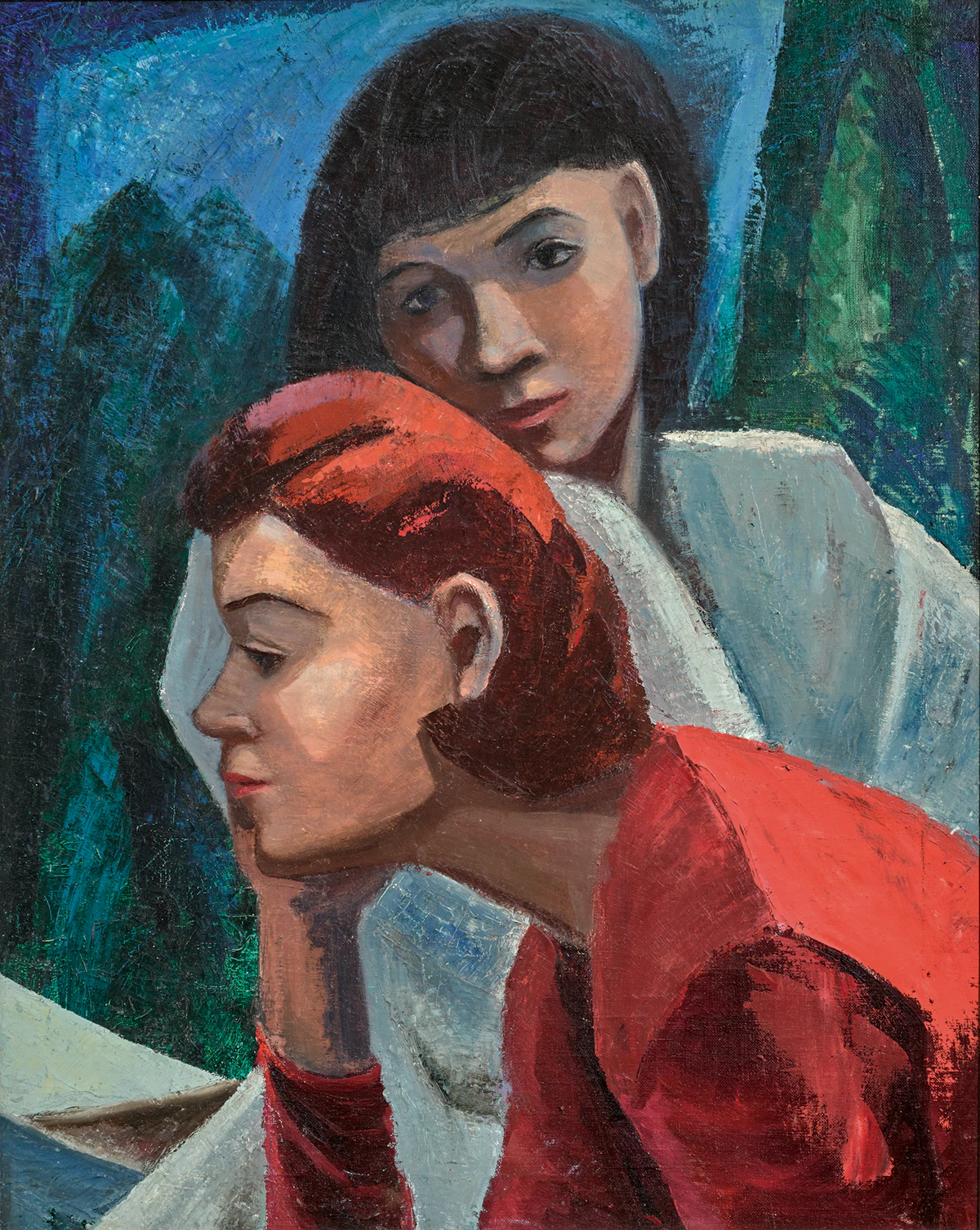
A.K. Prakash, "Independent Spirit: Early Canadian Women Artists", Richmond Hill, 2008, reproduced pages 174-175 as circa 1934 with the note: “While the identity of the sitters is not known, in all likelihood, the title of the work aside, the traditional typology of the double portrait suggests they were sisters.”
Yvonne McKague Housser’s "The Sisters" is a powerful painting which is both an evocation of the Canadian north and the people that live there and a study in what is now called, ‘gender relations,’ or to put it more succinctly, sisters. It is also a study in differing kinds of people–one standing, looking at the other with a caring, watchful glance, the other, bent over and secretive.
The painting achieves what Arthur Lismer, Housser’s teacher, told students they had to do, “select the significant and relative forms” and focus on them. His theme of landscape was meaningful to the Group of Seven and to his acolytes. But, of course, like every real artist, Housser wanted to be her own person, and explore her own point-of-view. In this painting, she chose a Canadian statement of a theme but went beyond that to something more progressive that reflects new forms of expression, the very quality she found in the Canadian Group of Painters, the group she had helped found, in 1933.
Few would argue that through the first fifteen years of its existence, the CGP as it was called, served as a vital force on the scene. In a similar way, "The Sisters", overtly, essayed energetically a northern scene. The woods recall the woods in Housser’s portrait of a Canadian who lived in the north, Marguerite Pilot, who was a woman half First Nations, half French-Canadian from Lake Nipigon which she painted in around 1932. But in "The Sisters", she strove for a new effect, which spoke of decade-long studies in the United States.
In 1949, her friend, Alexandra Luke, gave Housser Hans Hofmann’s book, "Search for the Real" (1948). She read it carefully, marking a passage in the introduction that said aesthetic meaning results from perceiving relationships. These words were important to her and stayed with her the rest of her life, particularly throughout the 1950s, when she was experimenting and growing as an artist. She studied with Hofmann in 1952 and 1958, going with Luke to Provincetown, Massachusetts to the successful summer school where he taught, the Hans Hofmann School of Fine Arts. He advocated improvisation and relied on empathy and feeling, both qualities that attracted her and she liked particularly his ideas of composition and colour but although she began to paint abstractly, she still returned often to representation but changed it to capture subjects of new interest to her, such as psychology.
When she was honoured with a show with Eric Goldberg at the Montreal Museum of Fine Arts in 1958 in the prestigious Gallery XII series (the museum’s exhibition area in which it showed modern art), she chose to make it an occasion for a representative showing of her work. She wanted something which demonstrated her Canadian art roots, so chose "The Sisters" as a starting point. It was No. 1 on her list of 24 works.
Robert Ayre, the pioneering art critic for the "Montreal Star" who wrote about Canadian art for 20 years (1950-1970), reviewed Housser first in his article about the show as befitted her stature as a major Canadian painter who was a role model for younger women painters. He said there was something in Housser’s work of the Group of Seven, “for the kind of country she looks at and what she sees in it of simplification and rhythm” but she soon “deviates into her own fantasy, setting out a decorative pattern...of spruce spires” and “formalizing nature”. He added that she makes her point “without getting sentimental about it” and concluded, in agreement with her paintings, “The austerity of the country is behind it”.
"The Sisters" is a work that reveals the evolution in Housser’s approach to art. It captures something of the anxiety-filled atmosphere that surrounds family relationships, but intertwined with it is a new way for Housser of addressing art, and particularly Canadian art, with its references to Cubism in the simplified forms and the complex psychology of relationships. Housser in this painting spoke to the future and of her faith in feelings, empathy, and women’s complexities.
We extend our thanks to Joan Murray, Canadian art historian, for contributing the preceding essay. Joan, the Director Emerita of the Robert McLaughlin Gallery in Oshawa, has written many books on Canadian artists, including "The Art of Yvonne McKague Housser", the catalogue for a 1995 retrospective exhibition on the artist.