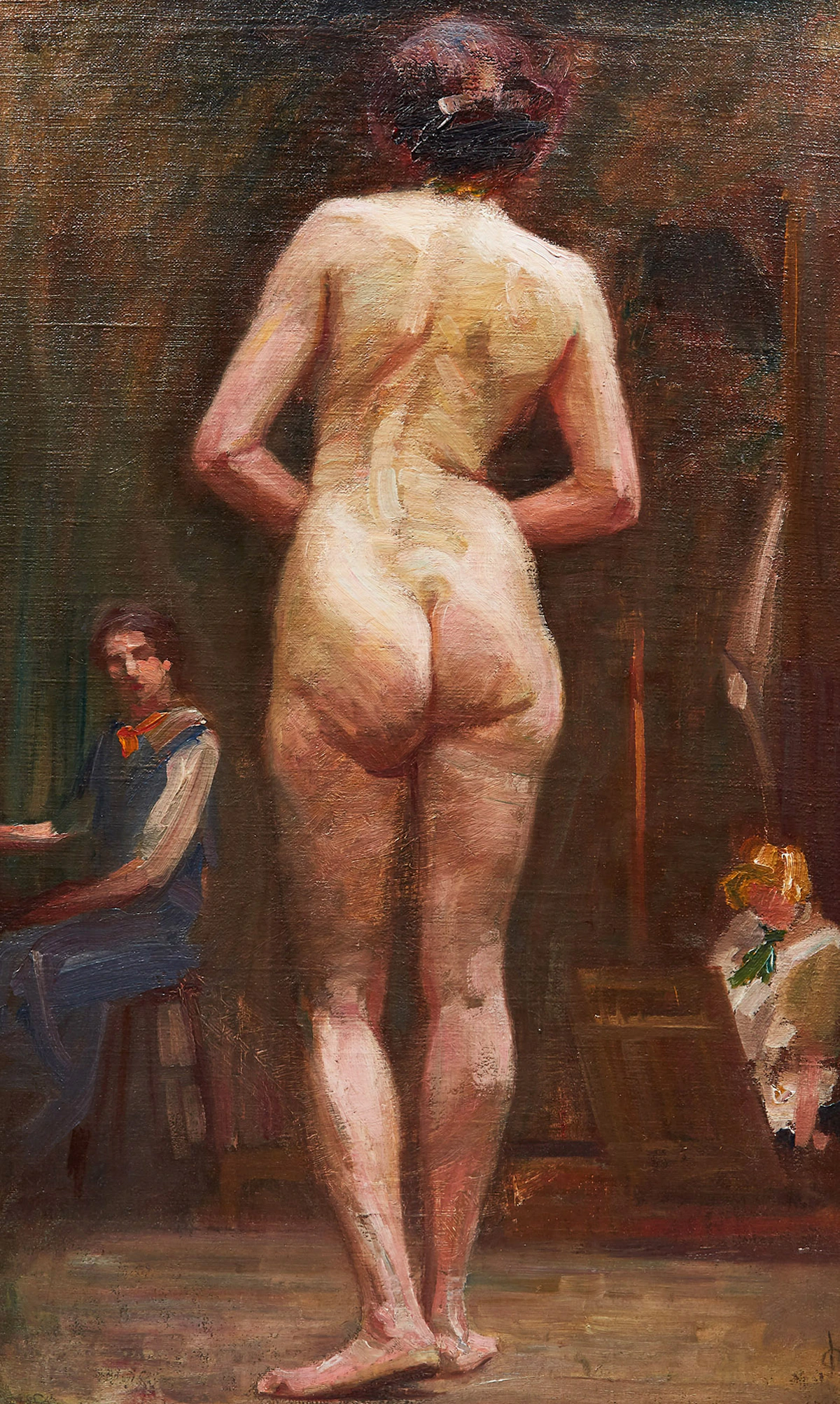
Tom Smart, “Peter Clapham Sheppard: His Life and Work”, Richmond Hill, Ontario, 2018, pages 78 & 79
P.C. Sheppard studied life drawing extensively under his teacher and mentor J.M.W. Beatty. Beatty returned to Toronto in 1908 after an extended trip to Europe. In 1912, George Reid, who was the principal of Ontario College of Art at the time, hired Beatty to teach life drawing at the school. Sheppard was a student there at the time, and was one of Beatty’s first students. Author Tom Smart writes that “the innovation that met Sheppard while he was Beatty’s life-drawing student was that the models were undraped. Nude. Although this was a common practice in European art schools, it was revolutionary, perhaps even scandalous, in the eyes of prim Toronto.” Beatty was otherwise traditional and academic in his drawing and painting methods, dissuading his students from experimenting in Cubism and Expressionism.
Smart remarks on Sheppard’s artistic development as a result of these classes, writing that “[he] absorbed Beatty’s lessons well, particularly involving those drawing from the nude. He clearly had a natural affinity for drawing the figure with a view to capturing its life and energy without diminishing the importance of effectively rendering the model proportionately.” The above statement can be used to effectively describe Sheppard’s oil on canvas “Nude Figure Study”, which depicts a nude figure posing in a classroom.
Sheppard won the Ontario College of Art Honourable Mention award for the 1912-13 year (for subjects of still life painting, painting, composition, drawing from the draped model, drawing from the nude), the Stone Scholarship for his “proficiency in the department of drawing from the nude” and the award of a Sir Edmund Walker Scholarship for drawing the nude figure in the following school year. The timing of these awards certainly suggest that Sheppard learned much from his life drawing teacher. In fact, throughout the rest of Beatty’s life, he and Sheppard remained close friends.