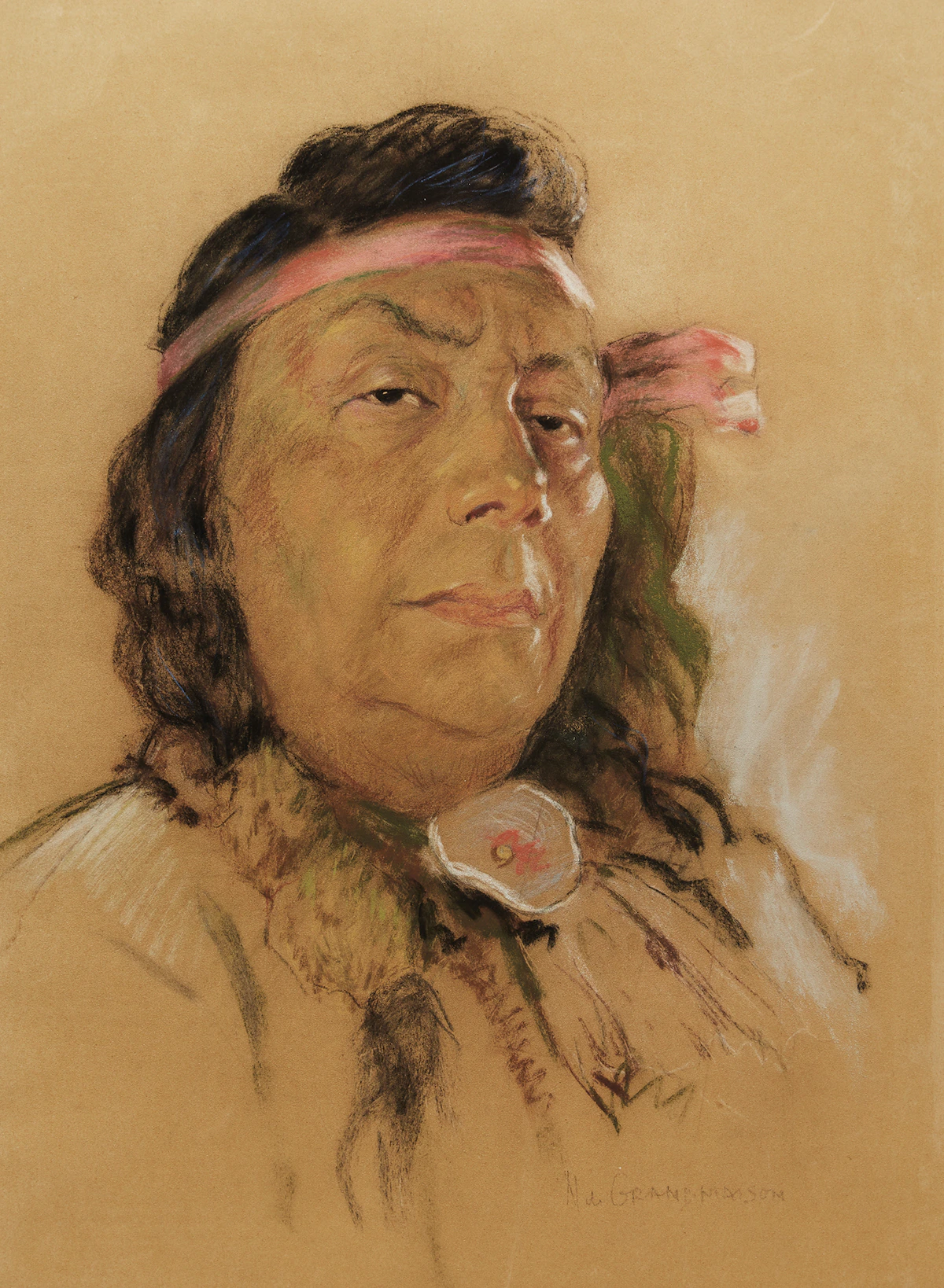
Hugh Dempsey, “History in Their Blood: The Indian Portraits of Nicholas De Grandmaison”, Vancouver, 1982, page 46
Nicholas de Grandmaison spent four years in a German prisoner of war camp during the First World War, interned with Allied officers from France, Great Britain, and other countries. His military training had given him the basic skills of drawing regarding cartography and topography, but his talent for portraiture developed during this period as he sketched fellow prisoners and even German officers. After the war, the artist moved to Manitoba to work as a farm worker, before shifting to Winnipeg to begin his artistic career as a portraitist. By 1930 De Grandmaison was finding success and exploring farther afield, portraying subjects he encountered on his excursions – trappers, prospector, fur traders, Métis and Indigenous peoples. Blood 148, a First Nations reserve in Alberta, became his main source of inspiration. He frequently visited to paint the people of the Kainai Nation, or Blood Tribe.
De Grandmaison devoted his life to recording the faces of the Kainai Nation. “I wish to preserve their faces for posterity”, he wrote, “I shall paint them until I die.” Using pastel paper imported from France and Grumbachers pastels, he recorded the fine nuances and warm textures of the faces of these figures, never allowing clothing to distract. The vitality of the man depicted in “Untitled Portrait’ is captured with loose strokes of pink and purple in the facial form, while flourishes of ochre and turquoise add strong shadows. In the thoughtful lines of the brow, De Grandmaison has acutely captured his sitter’s razor-sharp and strong personality.