Greg Hill, Lee-Ann Martin and Chris Dueker, Alex Janvier, National Gallery of Canada, Ottawa, 2016, pages 12, 18 and 23
One of Canada’s most celebrated Indigenous artists, Alex Janvier leaves an indelible mark on Canadian art history. Living on Cold Lake First Nation territory for the majority of his life, Janvier has an intimate relationship with the land as its custodian and advocate. In the creation of his artworks, Janvier draws upon his traditional Dene cultural views, merging Indigenous and Western visual languages.
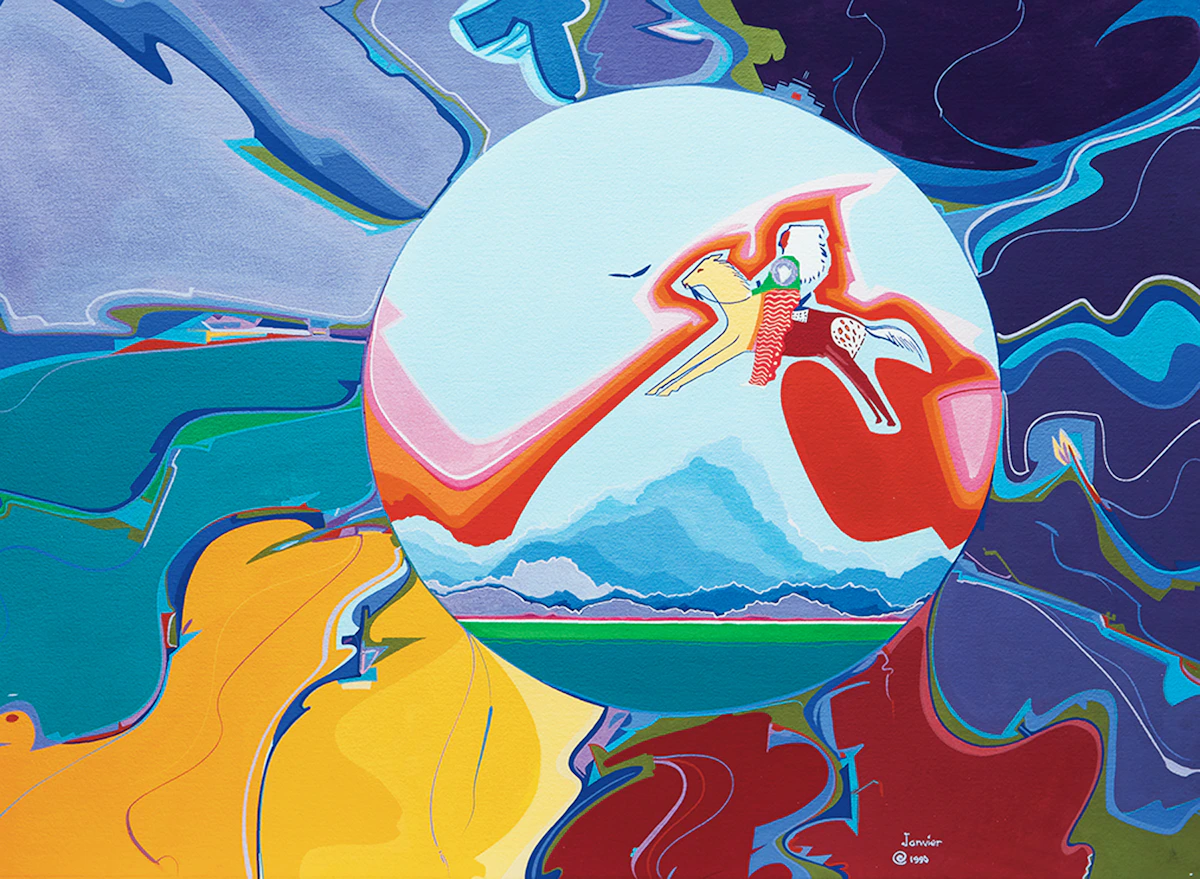
Janvier’s distinctive swirling tendrils of colour in “#26 Amerindian Time Capsule” twist and drift over the surface, segregating bands of bright colours with smoke-like movement. As the inset rider and horse float above the mountain range, red ribbons of colour move aerodynamically over the forms, visually communicating the spiritual connection of man, animal and land to creation.
Curator Lee-Ann Martin explains that the socio-political issues of the Oka Crisis and Primrose Lake land claim hearings of the 1990s deeply impacted Janvier. Martin writes: “Janvier’s paintings took a sharp turn toward representation. It was an especially active period of resistance on the part of Indigenous protectors of Land and resources to stand up against oppression. It coincides with the development of Janvier’s ideas of landlordship and the need to communicate these values and the historical misdoings of the dominating society.” In this painting, the idea of landlordship is acutely expressed. The rider takes the form of the overseer of the land in a custodian capacity, reflecting Indigenous teachings and views on human interaction with nature.