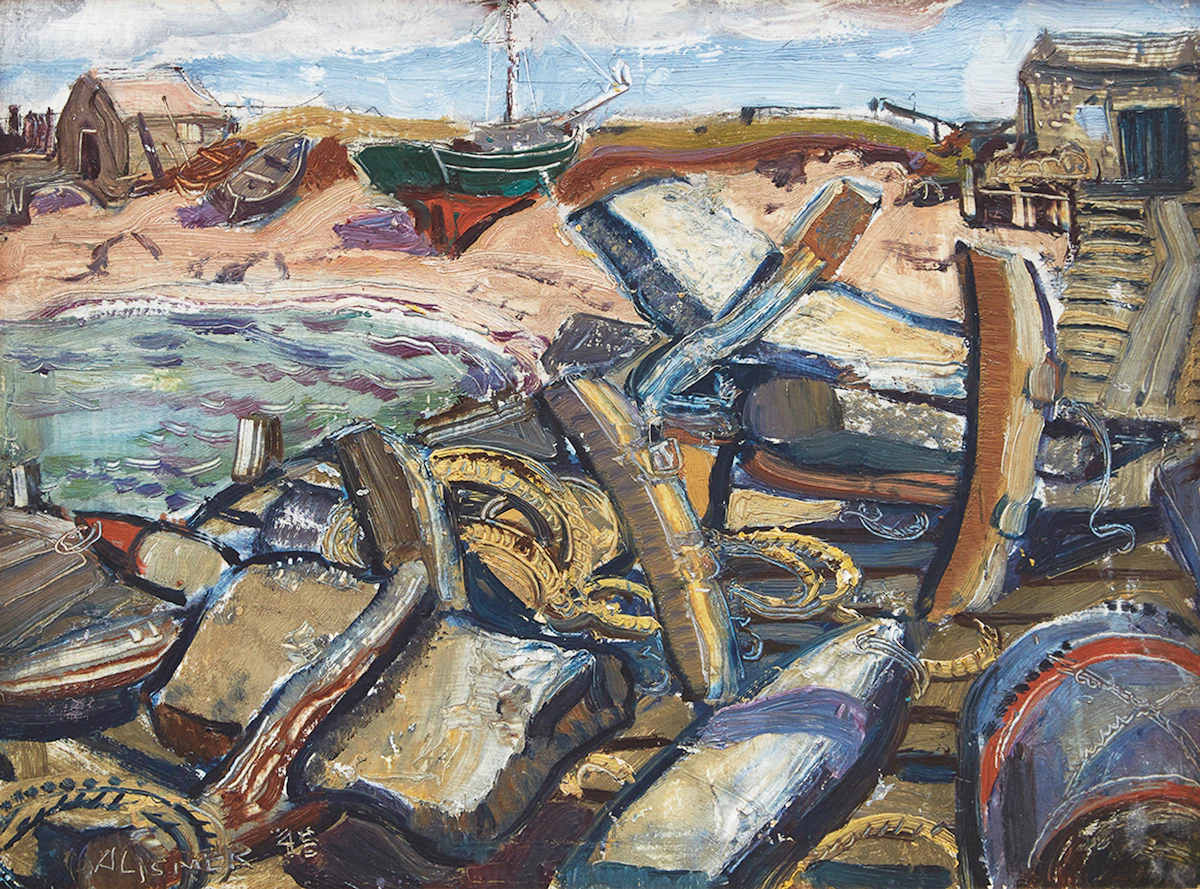
Fisherman’s Gear, Cape Breton Island, Nova Scotia, 1945
oil on board
signed and dated 1945 lower left; signed, titled, dated 1944 and inscribed “N. Ingonish - NS” on the reverse
12 × 15.75 in (30.5 × 40.0 cm)
Auction Estimate:$20,000 - $30,000
Sale date:June 9, 2021
Price Realized
$24,000
(including Buyer's Premium)
Provenance
Private Collection, Ontario
Literature
Dennis Reid, Canadian Jungle: The Later Work of Arthur Lismer, Art Gallery of Ontario, Toronto, 1985, page 37
Between 1940 and 1950, the east coast of Canada would become a regular sketching destination for Arthur Lismer. In August of 1940 Lismer and his wife, Esther, made their first trip to Cape Breton Island, travelling to the small fishing community of Ingonish, located at the north eastern tip of the island.
On this first trip Lismer employed brush and ink in his sketches. As Dennis Reid writes, “Lismer returned to Ottawa at the end of the month with a few oil sketches and ink brush drawings of a type unlike any he had done before. Close-up studies of barrels and buoys, short lengths of rope, killicks (homemade stone and wood anchors), and other bits of fisherman’s gear he saw on the wharfs of Cape Breton, they are like still lifes but are finally not.” Reid goes on to quote Lismer: “they seem to have as well the same feeling of weather as pine trees...To rearrange them into formal still lifes would be to kill them.”
In “Fisherman’s Gear, Cape Breton Island, Nova Scotia”, Lismer hasn’t “rearranged” any of the equipment but has left it as he found it. His approach is very similar to his paintings of undergrowth in which he is interested in how the forms and colours interact with each other. Lismer has emphasized certain areas by scratching away pigment, while in other areas he has employed a thicker application of paint to capture the ruggedness of a piece of rope or an anchor.