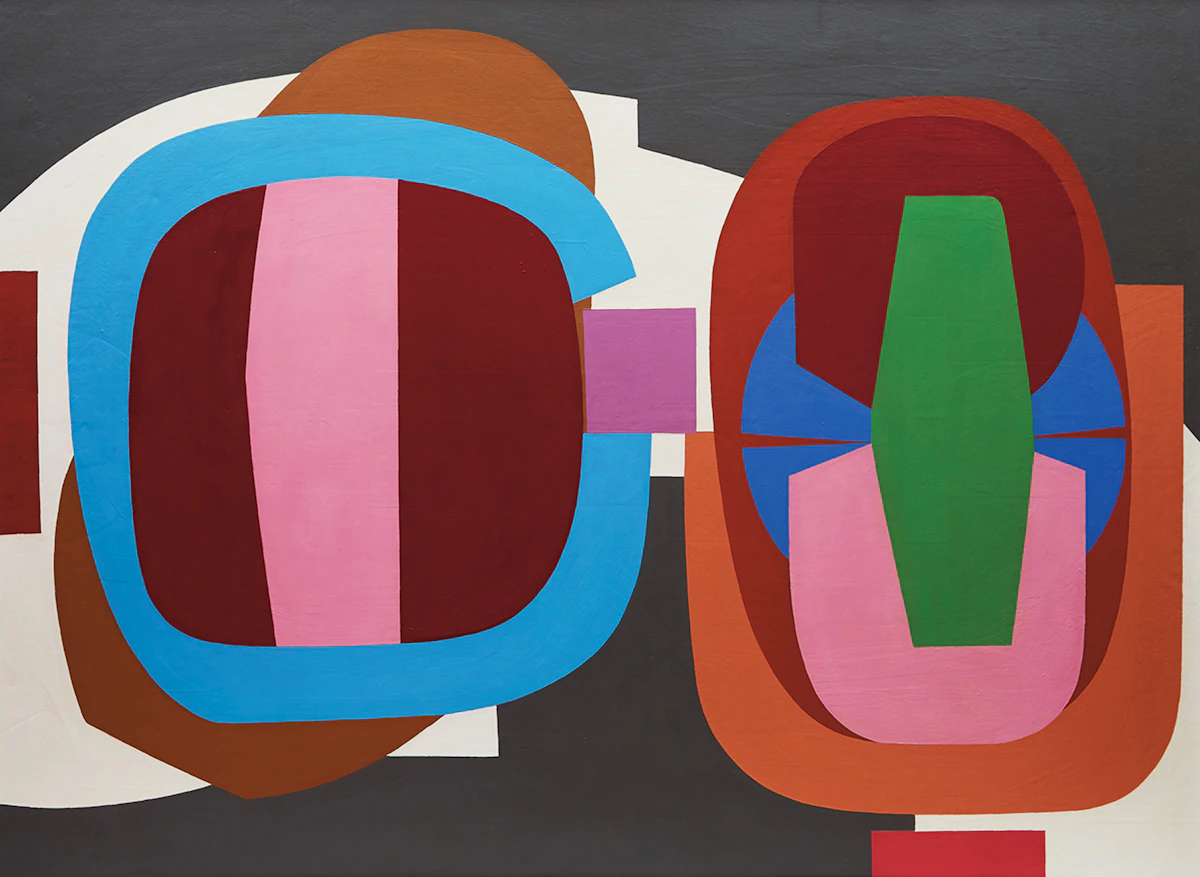
artist name, titled and dated 1965 to a label on the stretcher
60 × 80 in (152.4 × 203.2 cm)
Auction Estimate:$14,000 - $18,000
Sale date:June 9, 2021
Price Realized
$26,400
(including Buyer's Premium)
Provenance
Galerie du Siècle, Montreal
Private Collection, Toronto
Literature
Roald Nasgaard, Abstract Painting in Canada, Vancouver/Toronto, 2007, pages 156-58
Born in Winnipeg, Douglas Gibb Morton studied under Group of Seven member Lionel LeMoine FitzGerald before continuing his art training in the United States and Europe. Returning to Canada, Morton participated in several iterations of the Emma Lake Artists’ Workshop in Saskatchewan in the late 1950s and early 1960s. The workshops allowed him the opportunity to interact closely with a number of internationally acclaimed modernist painters. Morton eagerly embraced the workshop’s spirit of artistic experimentation, introducing unusual materials into his work such as Styrofoam and wood in order to physically extend his imagery. He investigated unconventional approaches, working with industrial paints and applying paint with squeeze bottles.
Morton ran his family’s business, MacKay-Morton Ltd., in Regina between 1953 and 1967, still managing to maintain a regular studio practice. In 1961, Morton was included in a travelling National Gallery of Canada exhibition entitled “Five Painters from Regina”. The Regina Five, also including Kenneth Lochhead, Arthur McKay, Ted Godwin and Ron Bloore, earned national attention as artists on the forefront of abstract art in Canada. Morton developed a distinct visual vocabulary which eschewed both expressionistic, gestural brushwork and hard-edge geometric abstraction. Instead, he favoured collage-like arrangements of flat forms, at times reminiscent of the late-period cut-outs of Matisse. Morton’s work also demonstrates his innate skill as a colourist, with a predilection for high-key, commercial colours which paralleled Pop Art. On the occasion of Douglas Morton’s 1994 retrospective at the Art Gallery of Victoria, artist Ron Bloore commented on Morton’s skill with colour: “‘Isn’t this a beautiful colour?’ Doug had just come down from his studio to show me a touch of pigment on a fingertip. To me it was a repulsive greyed-off yellow ochre. To the question, however, my response was probably non- committal...Later the same day...I went upstairs where that utterly vulgar colour had been transformed in his painting into a glorious radiant golden hue. What I had seen in isolation, he had envisioned in the complex context of adjoining colours and carefully controlled forms of unique hues.”
Often beginning his paintings spontaneously, Morton gradually clarified and fine-tuned his compositions as he worked. In “Two with Grey” from 1965, Morton layered shapes into two central forms which avoid settling into a recognizable, pictorial reference. The flat planes of colour efficiently depict depth through their apparent layering in space. The vivid colours pull forward in the pictorial space, while the white and grey areas recede into an illusionistic background. Morton’s distinctive version of post-painterly abstraction introduced levity and playfulness into Canadian abstract art.
Douglas Gibb Morton - Two with Grey (1965) | Cowley Abbott