Dorothy M. Farr, J.W. Beatty, 1869-1941, Agnes Etherington Art Centre, Kingston, 1981, page 38
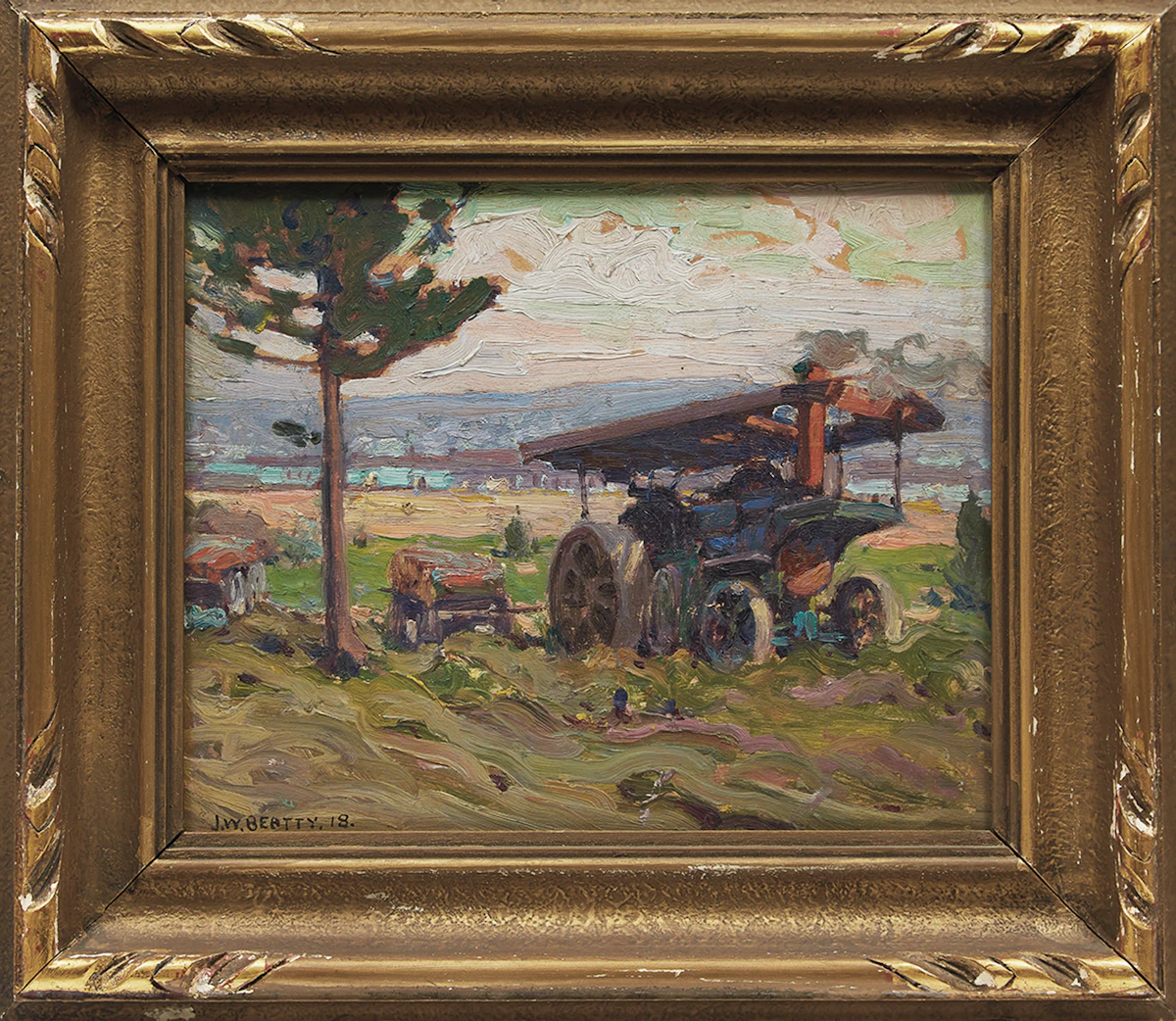
J.W. Beatty sought to depict the Canadian landscape as a patriotic statement. He was a forerunner to the Group of Seven, sharing with them a nationalist pride in painting a uniquely Canadian landscape. “Farm Machinery” demonstrates the increasingly lighter and more decorative palette of Beatty’s paintings throughout his career. The artist abandoned the dark and moody colour scheme of the traditional French and Dutch schools, in favour of more vibrant tones.
During World War One Beatty was an official war artist, leaving for France in March of 1918. Unexpectedly Beatty’s wife became ill and the artist returned to Canada in October of that same year, after having spent the summer months painting the battlefields of France. This diminutive composition of a tractor was perhaps observed and completed while overseas, documenting the important role that mechanization and farmers played during the war.
Following Beatty’s death in 1941, Helen Bannerman remarks on the artist’s pleasing and patriotic artistic oeuvre, stating: “There is a cheerful zest about Beatty’s work that is most refreshing in these jaded times, when most artists, particularly young ones, are obsessed with a ‘message’. Beatty bothers with no message except perhaps an unconscious one urging us to glory in the beauties of Canadian landscape as he does.”
We extend our thanks to the Estate of J.W. Beatty for assisting with the researching of this artwork.