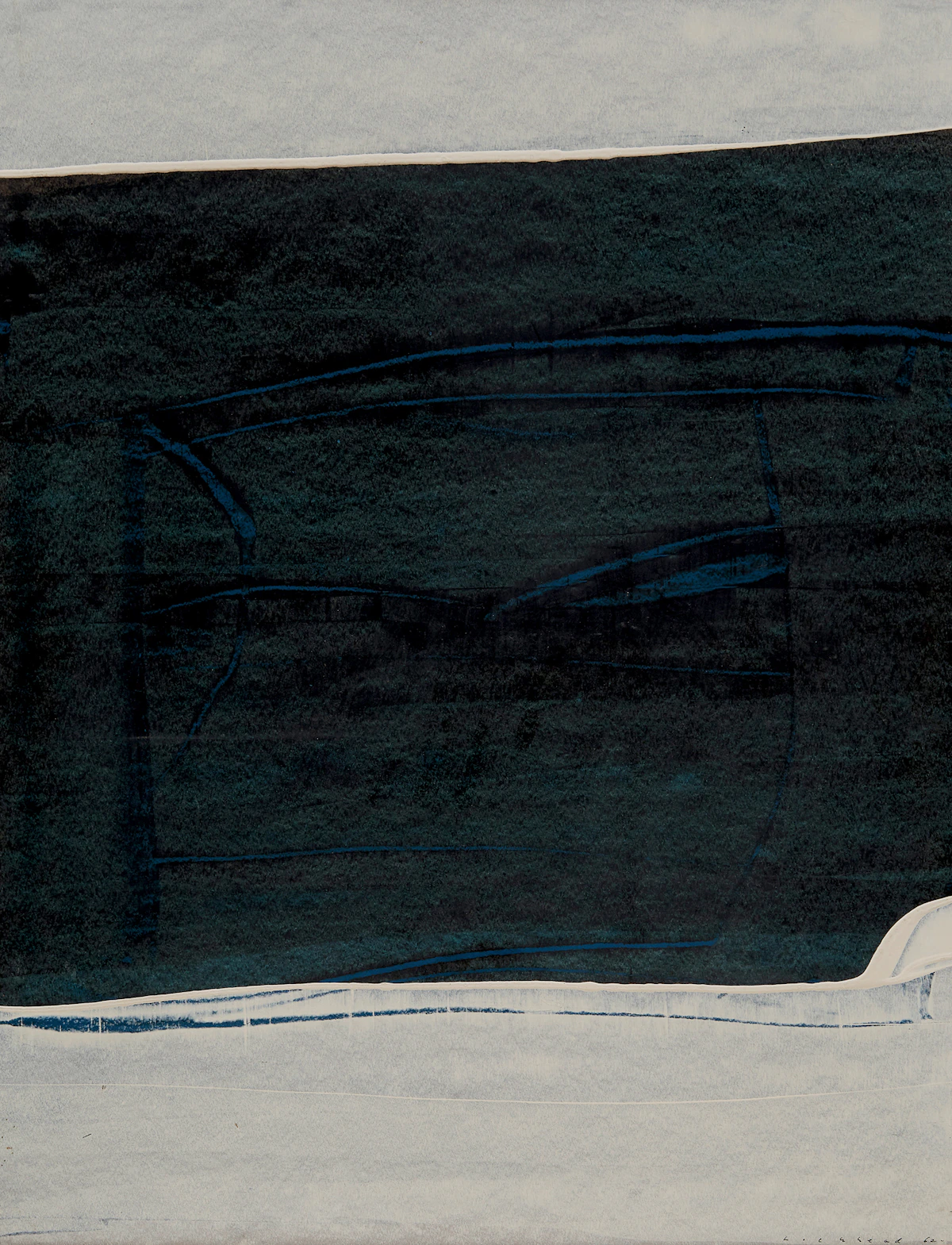
Bonham’s Canada, auction, May 31, 2010, Lot 268
Private Collection, Calgary
Literature
Ted Fraser, “Kenneth Lochhead: Garden of Light”, The MacKenzie Art Gallery, Regina, 2005, published to The Centre for Contemporary Canadian Art [online]
“Terrence Heath interview with Ken Lochhead”, July 13, 1989 in “Terrence Heath, Ronald L. Bloore: Not Without Design”, MacKenzie Art Gallery, Regina, 1991 [online]
A leading member of the Regina Five, Ken Lochhead had been painting in an entirely non-representational manner since the beginning of the 1960s, participating in the Emma Lake Professional Artists’ Workshops since 1955. Guest workshop leaders included Abstract Expressionist painters and critic Clement Greenberg. It was the 1962 workshop with Greenberg that was the catalyst of change to hard edge abstraction for Lochhead. The works produced just prior to this workshop exemplify the exploratory potential of the artist's work.
Lochhead worked closely with Ron Bloore and was very aware of the Toronto art scene during the late 1950s and 1960s. Similar to Bloore, Lochhead experimented with a calligraphic lexicon in his works of the early 1960s, evidenced in “Untitled” with the tonal traces of geometric patterning within the segments of the composition. Like Michael Snow's late works of the 1950s, such as “Off Minor” (1958), Lochhead's “Untitled” pays homage to the tradition of landscape painting within Canada but abstracts the pictorial field into geometric swaths of layered segments, punctuated with high contrast of light and dark. Ted Fraser discusses these early works of the 1960s, explaining that they “explored the massing of lines based on landscape.” In an interview with Lochhead from 1989, Terrence Heath explains that “Ken Lochhead remembers his fascination with the objects that imaginative individuals made in towns and farms of the Prairies and in the geometric patterns which resulted from the various processes of dry land farming.” Inspired by familiar elements, the fence-like pattern at the lower third of the white foreground subtly references the rural farms of the Prairies. In this work, the viewer bears witness to the emerging hard edge abstraction brewing in Lochhead's artistic progression, an important token of the artist’s shift from the landscape tradition to modern abstraction within the canon of Canadian art history.