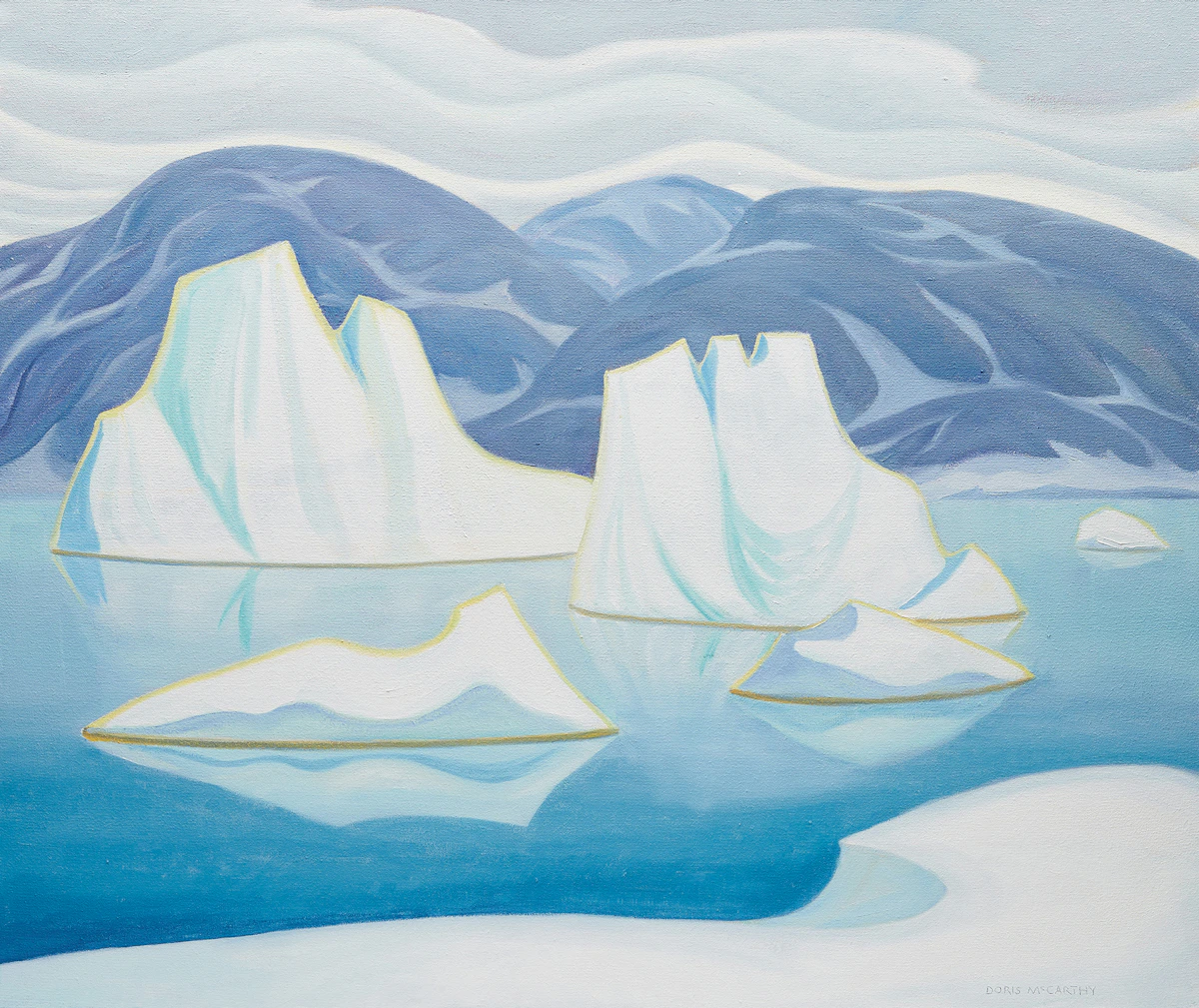
signed lower right; dated “980717” (July 17, 1998) on the reverse
30 × 36 in (76.2 × 91.4 cm)
Auction Estimate:$30,000 - $35,000
Sale date:September 24, 2020
Price Realized
$48,000
(including Buyer's Premium)
Provenance
Wynick/Tuck Gallery, Toronto
Private Collection, Toronto
Literature
Murray Whyte, “Doris McCarthy exhibit speaks to the artist as lover of life”, Toronto Star, June 27, 2010
Stuart Reid, “Island Sketches: Thoughts on the Watercolour Paintings of Doris McCarthy” in “Celebrating Life: The Art of Doris McCarthy”, McMichael Canadian Art Collection, Kleinburg, 1999, page 36 (chronology) and pages 212, 214 and 219
Born in Calgary and raised in Toronto, Doris McCarthy is recognized as one of Canada’s foremost landscape painters. In a 2004 interview with Harold Klunder, the artist remarked: “I was influenced very strongly by the tradition of going out into nature and painting what was there. I bought it. And I still buy it.” Among McCarthy’s influential teachers and mentors, were Group of Seven members, Arthur Lismer, A.Y. Jackson, J.E.H. MacDonald and Lawren Harris. She graduated with honours in 1930 and began teaching at Toronto’s Central Technical School in 1931, a position she held for 40 years.
Painting mainly in oils and watercolours, McCarthy developed a personal style that was consistently praised for its vitality, boldness and skillful explorations of hard-edged angles, form and colour.
Throughout her career Doris McCarthy enjoyed many painting adventures across Canada and abroad. In 1950, she embarked on a 14-month sabbatical in Europe, during which she painted full time. She also embarked on a year-long solo world tour in 1961, which she refers to as her ‘Long Year,’ visiting several countries in Asia, the Middle East and Western Europe. In 1972, the year of her retirement from teaching, Doris made her first of many trips to the Canadian Arctic. McCarthy was fascinated with the topography of this territory and the new painting opportunities it provided her. Her paintings of icebergs and the Arctic landscape, including “Iceberg & Floes”, are considered to be among the artist’s best known and most celebrated works. Author Stuart Reid praises McCarthy’s Arctic scenes, writing: “Within all her great body of work, gleaned from her travels that have taken her around the world, perhaps the most powerful and poetic works she has completed are those which address the grand, mysterious islands of ice.”
In some instances McCarthy painted on site, and other times she took photographs to refer to later in her studio. During the latter, she “relied on sensual recollections of light, the wind and weather, the character of the place.” The monumental canvas “Iceberg & Floes” would have been completed in the studio, where she effectively preserved the feeling of the crisp air and the still channel of water reflecting the icebergs above.