Canadian Fine Arts, Toronto
Private Collection, Toronto
Exhibited
“Espace 55”, Montreal Museum of Fine Arts, February 11-28, 1955, no. 3 or 4
Literature
Matthew Teitelbaum (ed.), “Paterson Ewen”, Toronto, 1996, pages 47, 49 and 51
Espace 55, Montreal Museum of Fine Arts, exhibition catalogue, February 11-28, 1955, unpaginated, listed as no. 3 or 4
A Montreal native, Paterson Ewen attended the School of the Montreal Museum of Fine Arts from 1948-1950, studying under Goodridge Roberts and Arthur Lismer, among others. As a student he was also influenced by European Post-Impressionist artists, which is apparent in the fractured surfaces of his landscapes, still lifes and portraits. Ewen’s painterly approach shifted upon encountering Françoise Sullivan, an automatist dancer, whom he would marry in December 1949. He was introduced to automatism through Sullivan’s writings, as well as her friendships with Quebec abstract painters of the Automatistes, Jean-Paul Mousseau and Pierre Gauvreau. Ewen’s entry into the largely francophone art scene through his wife came
at a moment when the Automatistes were separating and disagreeing over intellectual positions. Yet these artists took a liking to Ewen and encouraged his early 1950s figurative paintings which demonstrated a breakdown of subject matter. Nevertheless, they of course rejected any representational imagery, believing that “abstraction offered the truest release from the constraints of order.”
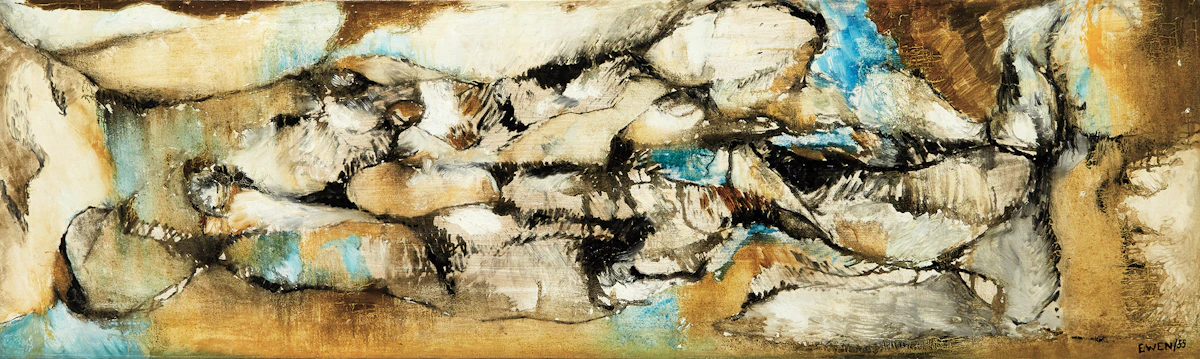
“Untitled” (1955) was painted during Paterson Ewen’s breakthrough into completely non-representational works. Ewen’s work of the time was characterized by a “dominant, gridlike calligraphy that was opened, centralized, and organized by concentric thrust.” The twisting lines of Untitled contain a calligraphic effect that would recall the writing and drawing of Surrealist automatism. However, unlike the Automatistes, who relied heavily on effects of the palette knife and dripping paint, Ewen maintained a more flattened composition with muted colours. “Untitled” is painted in thin layers of earth tones and black, accented by patches of blue. During these years, Ewen found himself a latecomer to the Montreal abstract art scene and never fully associated with a particular group or approach, be it the gestural technique of the Automatistes or the rigid canvases of Les Plasticiens. His “predominant aesthetic was a loosely based abstract lyricism rooted in the observation of natural phenomenon.” Ewen’s preliminary non-representational compositions of the mid-1950s, such as “Untitled”, are more gestural than those of the subsequent ten years, where he explored geometric forms, loosely aligned with hard-edge painting.