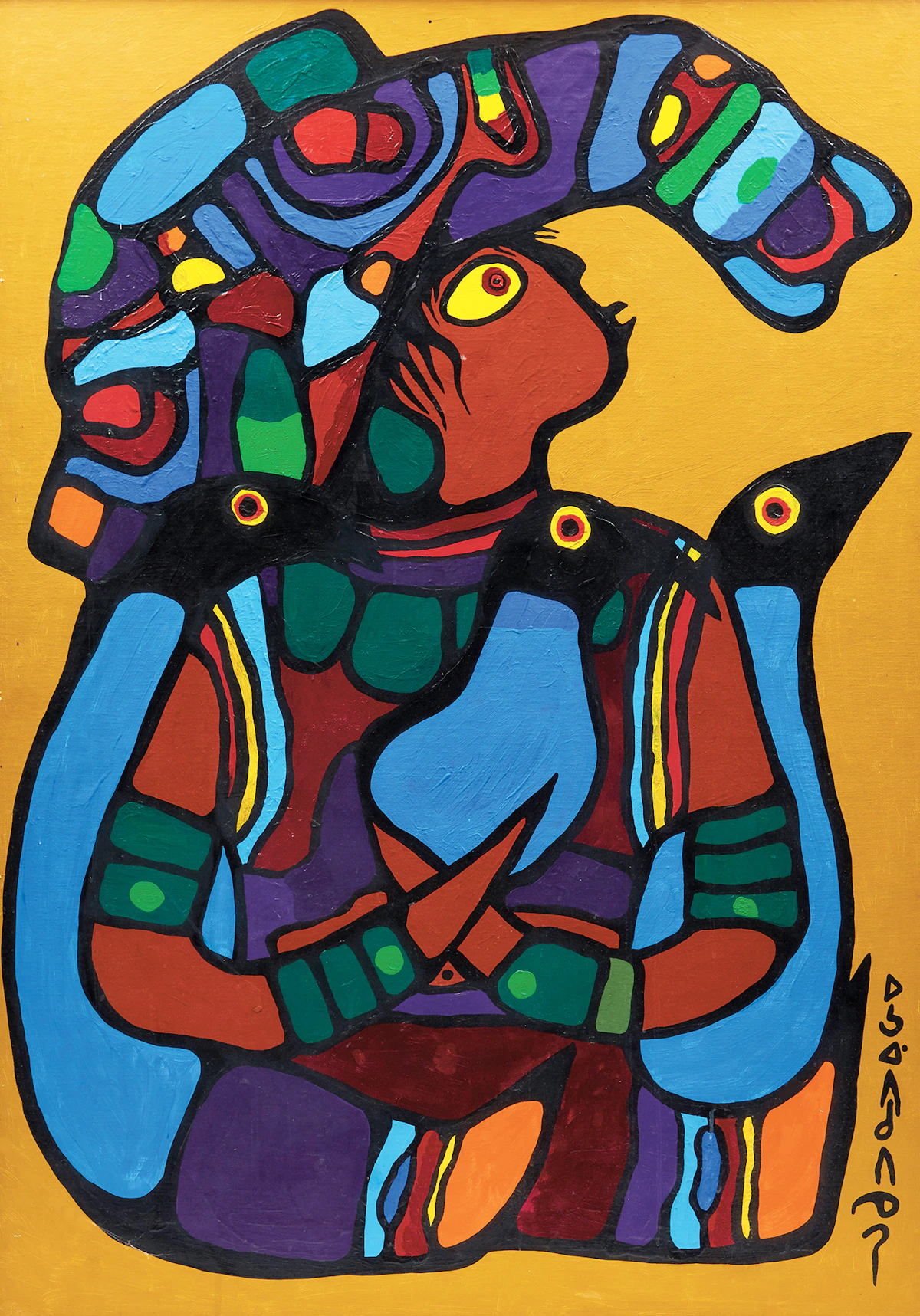
Purchased directly from the artist (1973) by the present Private Collection, Toronto
Literature
Norval Morrisseau, “Norval Morrisseau: Return to the House of Invention”, Toronto, 2005, pages 8-9
Elizabeth McLuhan and Tom Hill, “Norval Morrisseau and the Emergence of the Image Makers”, Art Gallery of Ontario, Toronto, 1984, pages 30-31
Norval Morrisseau’s complex visual language was rooted in cultural traditions which included the Shaman artists of the Midiwewin scrolls, the Agawa Bay rock paintings and the Peterborough petroglyphs. Morrisseau’s innovative and expressive artistic vision would provide an essential influence for the artists of the Woodland School.
This lot, as well as lot 20, are both depictions of Harriet Kakegamic, the artist’s wife. Morrisseau commented to the owner that the works represent “two separate periods in his relationship with his wife; the first angry and belligerent, the second peaceful and conciliatory.” Morrisseau first met Harriet in 1956 while hospitalized by tuberculosis in Fort William (now Thunder Bay). The couple married the following year and started a family. This marked the beginning of an important and productive period for Morrisseau, who responded to his new responsibilities by applying himself to his art-making with increasing dedication. Painted in striking colours, the images of Harriet are portrayed with several birds. The artist’s distinctive sinuous black lines envelope and integrate the human and bird elements, symbolizing the spiritual unity of all life so fundamental to Morrisseau’s beliefs.
Lots 19 and 20 were purchased directly from Norval Morrisseau in May of 1973 by the current owner, a Toronto doctor. A young ophthalmologist, the owner worked for a week out of a CNIB Eye Van in Kenora, Ontario, providing ophthalmic care to the local population near Lake of the Woods. The doctor had viewed some of Morrisseau’s work at the Pollock Gallery in Toronto and a pair of artworks caught his eye when he attended a local art exhibition and met Morrisseau. The portraits have remained in the doctor’s collection for forty years.