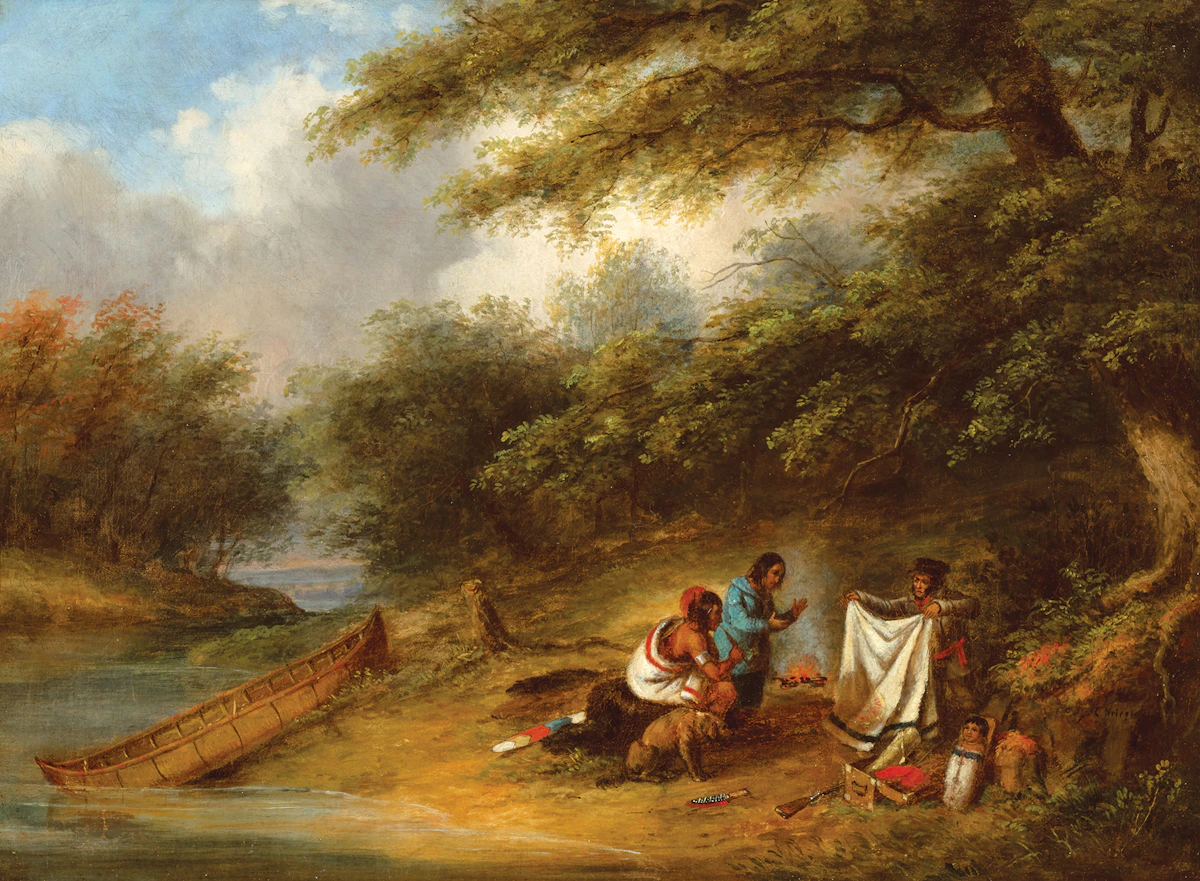
Hudson Bay Trader (Early Trading with the Indians), circa 1845-47, circa 1845
oil on canvas
signed lower right
11.5 × 15.5 in (29.2 × 39.4 cm)
Auction Estimate:$40,000 - $60,000
Sale date:November 19, 2019
Price Realized
$47,200
(including Buyer's Premium)
Provenance
T.A. McGinnis, Kingston, Ontario
The Estate of Norah Aileen McGinnis Glen, Baie D’Urfé, Quebec
Joyner Fine Art, auction, Toronto, November 20th, 1998, lot 40
Private Collection, USA
Exhibited
Exhibition of Paintings by Cornelius Krieghoff, 1815-1872, National Gallery of Canada, Ottawa, February, 1934, no. 72. Also shown at the Art Association of Montreal, Montreal, March, 1934.
Literature
J. Russell Harper, Krieghoff, Toronto, 1979, pages 47-49
Marius Barbeau and Thoreau MacDonald, Cornelius Krieghoff, Toronto, 1948, pages 20-21
Albert Henry Robson, Cornelius Krieghoff: 1882-1939, Toronto, 1937, page 16 and 17 for the work reproduced in colour
Marius Barbeau, Cornelius Krieghoff: Pioneer Painter of North America, Toronto, 1934, page 22, listed page 28
Marius Barbeau, Exhibition of Paintings by Cornelius Krieghoff 1815- 1872, Ottawa/Montreal, 1934, page 6
Marius Barbeau, “Krieghoff Discovers Canada”, Canadian Geographical Journal, VIII, no. 3, March 1934, reproduced page 112
In 1842 Cornelius Krieghoff settled in Longueuil and naturally grew interested in the Iroquois people from the village of Caughnawaga, located on the south shore of the St. Lawrence River in Quebec, just upstream from the Lachine Rapids. The paintings produced during Krieghoff’s Longueuil and Montreal period, from 1840-1853, are broad in style, expressing the artist’s mastery of detail and colour.
Marius Barbeau describes “Hudson Bay Trader (Early Trading with the Indians)” as “two Caughnawaga Indians, man and woman in a clearing, facing a trader who spreads a Hudson’s Bay blanket in front of them...a cradleboard with child stands near [a] tree; a dog near the Indian facing the trader... a typical early Krieghoff.” Krieghoff’s aim was not to document prominent leaders or systematically catalogue different nations, but to record the details of everyday life. As Albert H. Robson observes of Hudson Bay Trader, the “actual human drama of the scene is full of interest with its colourful accessories of birch-bark canoe, papoose, dog and costumes.”
Barbeau stipulates that there are only three known works by Krieghoff that illustrate the subject matter of fur traders interacting with Native Americans. These compositions were perhaps inspired by the work of Coke Smyth, specifically “Indians Bartering” (1840) which shares the solid central figure of a man sitting on a log or stone, smoking his
pipe in profile, as he gazes at the goods presented by the Hudson’s Bay trader. This particular figure is one that Russell Harper discusses as appearing in many paintings of the ‘New World’.
Krieghoff found vast inspiration in the heart of French Canada and the rugged wilderness of Quebec, developing a distinctive style and technique that grew out of early compositions such as “Hudson Bay Trader”.
Cornelius Krieghoff - Hudson Bay Trader (Early Trading with the Indians), circa 1845-47 | Cowley Abbott