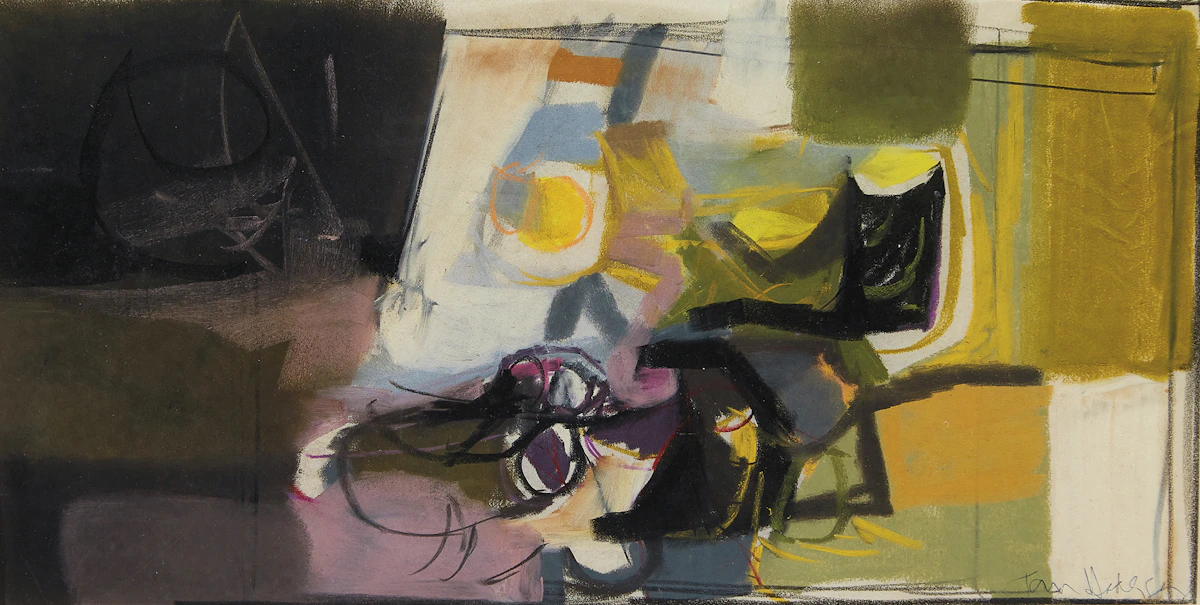
Tom Hodgson's first period of abstraction between 1947 and 1964 was one of his most transformative periods. Growing tired of the rigour and restrictions of this formalism and figural works, the artist rejected realism in favour of abstraction. Often photographing still lifes and objects in his immediate vicinity, Hodgson would later use the photographs as reference, distorting, abstracting and rotating the objects in the final execution. Bold colours and an emphasis on thick black outlines typify this period of abstraction for the artist and also reference international trends by artist's like Picasso, Miro and Kandinsky. “Study for Dark then Mostly Light” typifies this integral part of the artist's career and his experimentations with abstraction. Favouring bright contrasting blocks of yellow, chartreuse, eggplant and lavender, punctuated with swirling, strong, black lines, Hodgson presents a visually dynamic and luminous study with very little deviation in the final 1956 canvas work.