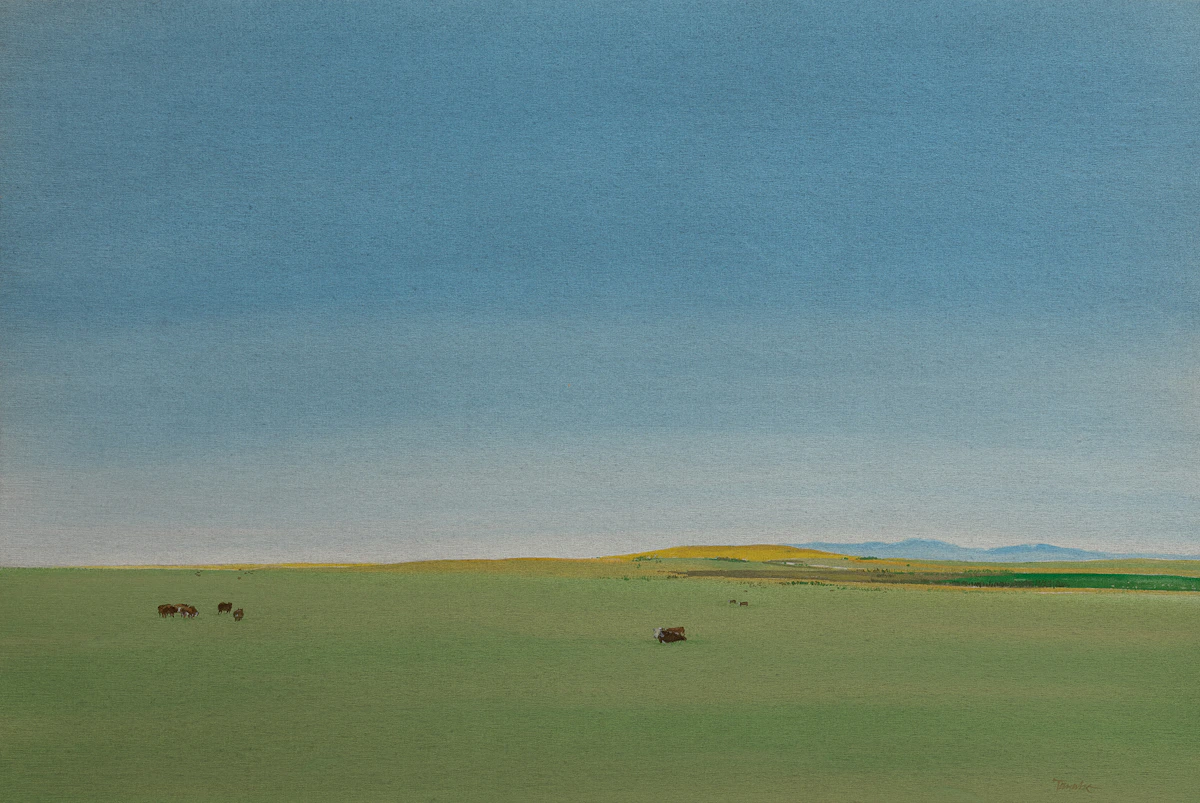
signed lower right; signed, titled, dated “8/83” and inscribed “Errington” on the reverse
34.25 × 51.25 in (87.0 × 130.2 cm)
Auction Estimate:$25,000 - $35,000
Sale date:November 19, 2019
Price Realized
$24,190
(including Buyer's Premium)
Provenance
The Collection of TC Energy, Calgary
Literature
Roger H. Boulet, Takao Tanabe: Wet Coasts and Dry Lands, Kelowna Art Gallery, Kelowna, 2000, page 9
Ian McNairn, 7 West Coast Painters, Vancouver International Festival Exhibition, The University of British Columbia, 1959, not paginated
Nancy E. Dillow and Jane Rule, Takao Tanabe, 1972 - 1976: The Land, University of Regina, Saskatchewan, 1976, page 7
Nancy Dillow writes that “Tanabe’s paintings of the land are the outcome of intense personal discipline and a search for the subtleties of landscape.” One of his favoured subjects were the foothills found at the edge of the Prairies. Influenced by his travels through the Canadian landscape, Tanabe was particularly moved by the flattened landscapes of the Prairies.
“Foothills Looking West” showcases Tanabe’s classic use of a soothing blue sky and vibrant green foreground. The lounging and grazing brown cows speckled within the fields further suggest a comfortable leisurely calm and expanse about the work. On Tanabe’s technique and style, Robert Boulet writes that “there is no great effusion of self-expression. The paintings are cool, calculated, yet enormously affecting.” The horizontality of the composition presents the viewer with strong visual drama of the landscape with a high gracefully layered horizon. The blocking of compositional elements also lends to the artist’s early abstract artworks and the trend of hard edge abstraction. Here however, Tanabe has softened the lines of pigments and elements to build the landscape. Ian McNairn explains: “Tanabe’s painting is essentially poetic. Perhaps all painting is poetic but in this case it is lyrical, delicate and hypersensitive. His work shows a refinement of taste and touch which is often lost in the technical process of contemporary painting.” In an era when expressive abstract painting dominated the art discourse, Tanabe’s works emerged as hovering between abstract and landscape traditions and cementing the artist’s unique place within the dialogue of Canadian art.