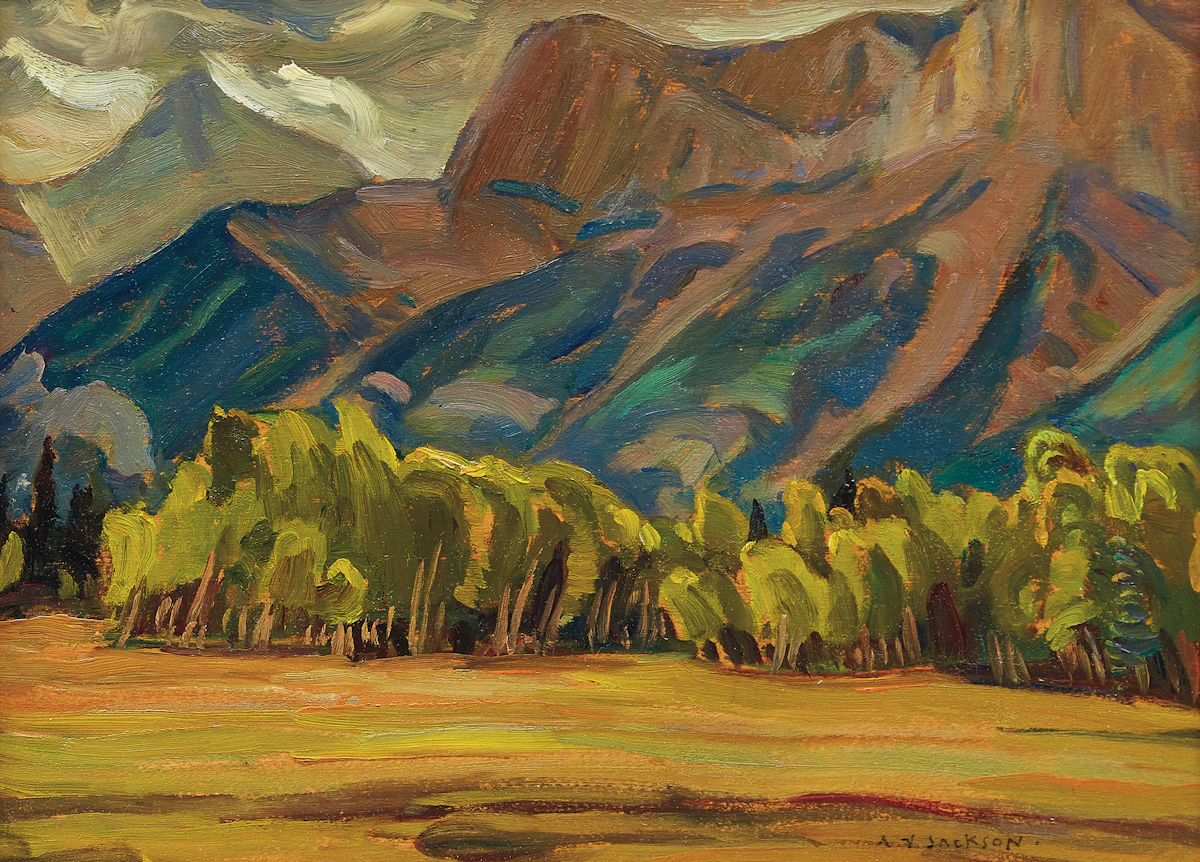
signed lower right; titled on the reverse upon a composition of a landscape of grain elevators
10.5 × 13.5 in (26.7 × 34.3 cm)
Auction Estimate:$15,000 - $20,000
Sale date:April 13 - 27, 2021
Price Realized
$28,800
(including Buyer's Premium)
Provenance
Dominion Gallery, Montreal
Art Mode Gallery, Ottawa
Private Collection, St. John’s
Literature
A.Y. Jackson, A Painter’s Country, Vancouver/Toronto, 1958, page 122
Catharine M. Mastin (ed.), The Group of Seven in Western Canada, The Glenbow Museum, Calgary, 2002, page 114
A.Y. Jackson made brief visits to Alberta as early as 1914, visiting his older brother Ernest Jackson. The artist also ventured to Great Slave Lake to sketch with Dr. Frederick Banting in 1928, though Jackson’s first major trip to Alberta was in 1937, visiting Lethbridge. He described the appeal of the west in a letter to Anne Savage in 1933, writing “the great open prairies tugged strongly with [their] promise of vast space and unfettered movement, of an escape to freedom, of renewal.”
Alberta’s varied terrain offered a wondrous selection of environments to portray. On his western sketching trips, Jackson recalls, “underneath the burned-up land was wealth untold, which only a few people then visualized. Hills rose from the prairies, range after range of them, and then the mountains rose abruptly out of the hills. The countryside offered all kinds of motifs for composition.” Jackson found beauty in the landscape no matter its state. Dry land offered the opportunity to paint in rich rusts and ochres; mountains rising from the flatlands gave the artist inspiration to capture the dramatic compositional contrasts and the rich variety of flora often inspired Jackson’s affinity for experimentation with texture and movement within his work. The double-sided “Mount Rundle at Canmore” showcases Jackson’s rhythmic ribbons of paint, moving across the panel in rich tones, contrasted with vibrant blues and greens, presenting complexity and drama, standard fare within the Rockies region of Alberta.
Alexander Young Jackson - Mount Rundle at Canmore | Cowley Abbott