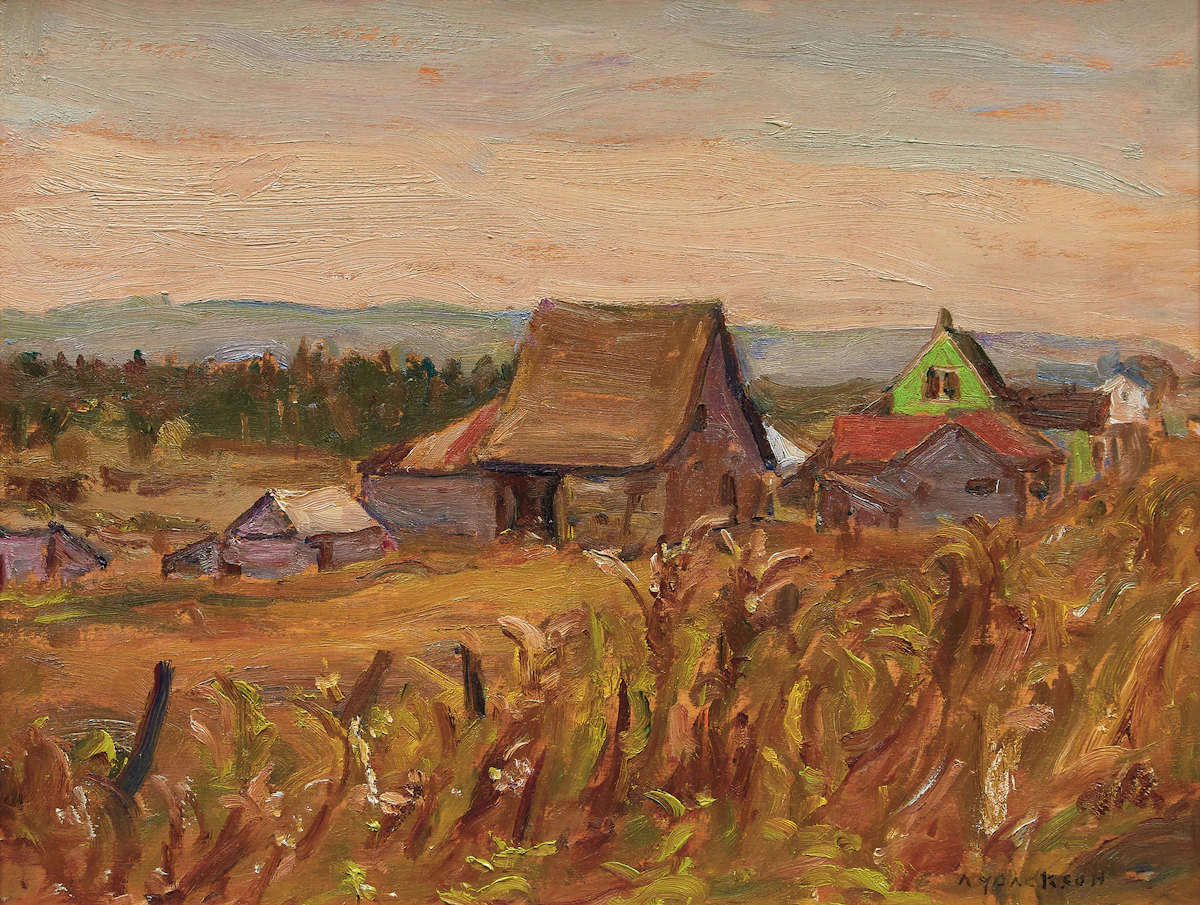
signed lower right; signed, titled and dated “Oct. 1967” on the reverse
10.5 × 13.5 in (26.7 × 34.3 cm)
Auction Estimate:$14,000 - $18,000
Sale date:May 22 - June 2, 2020
Price Realized
$14,400
(including Buyer's Premium)
Provenance
Alex Fraser Galleries, Vancouver
Private Collection, Vancouver
Literature
Charles C. Hill, “Canadian Painting in the Thirties,” National Gallery of Canada, Ottawa, 1975, page 11
By the 1960s, A.Y. Jackson had left the legendary Studio Building in Toronto and was living in Manotick in a new studio that he had built. The pattern of his sketching trips had changed – though he continued to regularly visit Georgian Bay and the east shore of Lake Superior, he would now explore more rural locales as well, in search of varied communities outside of the popular painting spots. An avid outdoorsman, these travels also offered Jackson opportunities for personal travel and excursions.
The artist travelled to the very small francophone community of New Brunswick, Sainte-Anne-de-Madawaska, in the fall of 1967. Today, it has a population of only approximately one thousand inhabitants. The village is located on the Saint John River, 30 kilometres southeast of Edmundston, near the Maine border. The artist likely continued inland following one of his many sketching trips up the Saint Lawrence River. Jackson was acutely aware of his role within the landscape as an active participant; rather than omit the villages, communities and settlements within the Canadian land, he instead sought to elevate the importance of human existence, resilience and reliance on the land in these more remote locales. The importance of life in rural communities was central to many of Jackson’s works and was a subject which was integral to his oeuvre. In “Sainte-Anne-de-Madawaska, NB”, overgrown pasture in the foreground leads to a string of charming barns and farmhouses with colourful roofs. The fallow in the foreground and hay behind the barns appear to be turning brown, signalling the change of season in New Brunswick. Charles C. Hill remarks on Jackson’s preference to portray these time periods in the Canadian landscape: “It was the changing seasons that attracted A.Y., not the bright greens of summer, nor the blank whiteness of winter, but the flow of winter to spring or the blaring up of summer into autumn.”