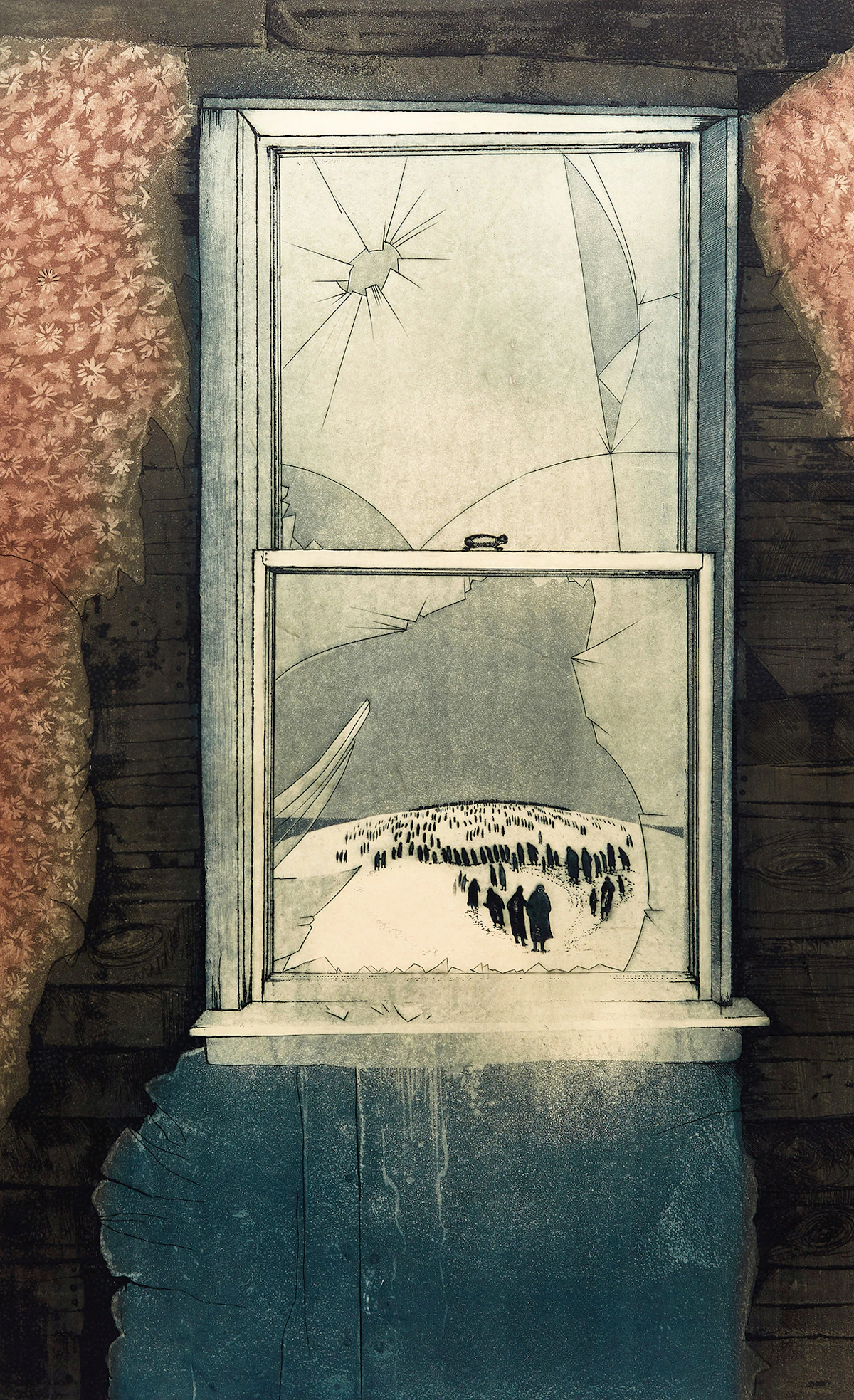
signed, titled, dated 1969 and inscribed “Artist’s Proof” in the lower margin
34 × 22.25 in (86.4 × 56.5 cm) (sheet)
Auction Estimate:$5,000 - $7,000
Sale date:May 28, 2019
Price Realized
$4,720
(including Buyer's Premium)
Provenance
Private Collection, Newfoundland
Literature
William Gough, David Blackwood: Master Printmaker, Toronto, 2001, page 59
A prophetic and surreal image, Blackwood's “Gram Glover's Dream” harnesses the artist's signature drama and complex emotion of the people of Bragg's Island, forced to leave their homes and livelihoods on the eve of confederation with Canada.
A remote settlement, Bragg's Island was inhabited by less than 200 people, sustained by the fishing industry. A notoriously inhospitable and harsh region of Newfoundland, the remote island was only accessible by crossing the rough waters. Bureaucrats and politicians had argued that the isolated and harsh locale was too difficult to send basic health and education services to, which spearheaded the discussion and eventual referendum on resettlement. A sad and defeating moment in Newfoundland's history, the story of Bragg's Island was among similar histories of 250 other coastal villages of Newfoundland, forced to resettle between 1950 and the early 1970s.
In this work, the tattered wall paper, broken window panes and ice trailing in at the window sill act as relics of a once loved and inhabited home, forced to be left behind by its owners. Blackwood had recounted the story of Gram Glover's prophetic dream when he was a young boy:
“Gram Glover had a dream. I can remember her coming down to the kitchen that morning. 'Well, well, well,' she said. ‘I had a funny dream last night, that we all had to pack up and leave this place. That we had to pack up and everything was torn to pieces, like there was another war coming. The whole place was in a shambles. There must be another war coming!”
Blackwood's own grandfather locked himself in his shed when the time came for resettlement, refusing to leave. The family home where marriages, births and celebrations were had, was forced to be left behind and demolished, a story not unfamiliar to nearly all of the inhabitants of Bragg's Island.
Through the window we see the hunched figures walking in single file away from their homes, a dramatic and solemn visual of the end of a community and shared experience.