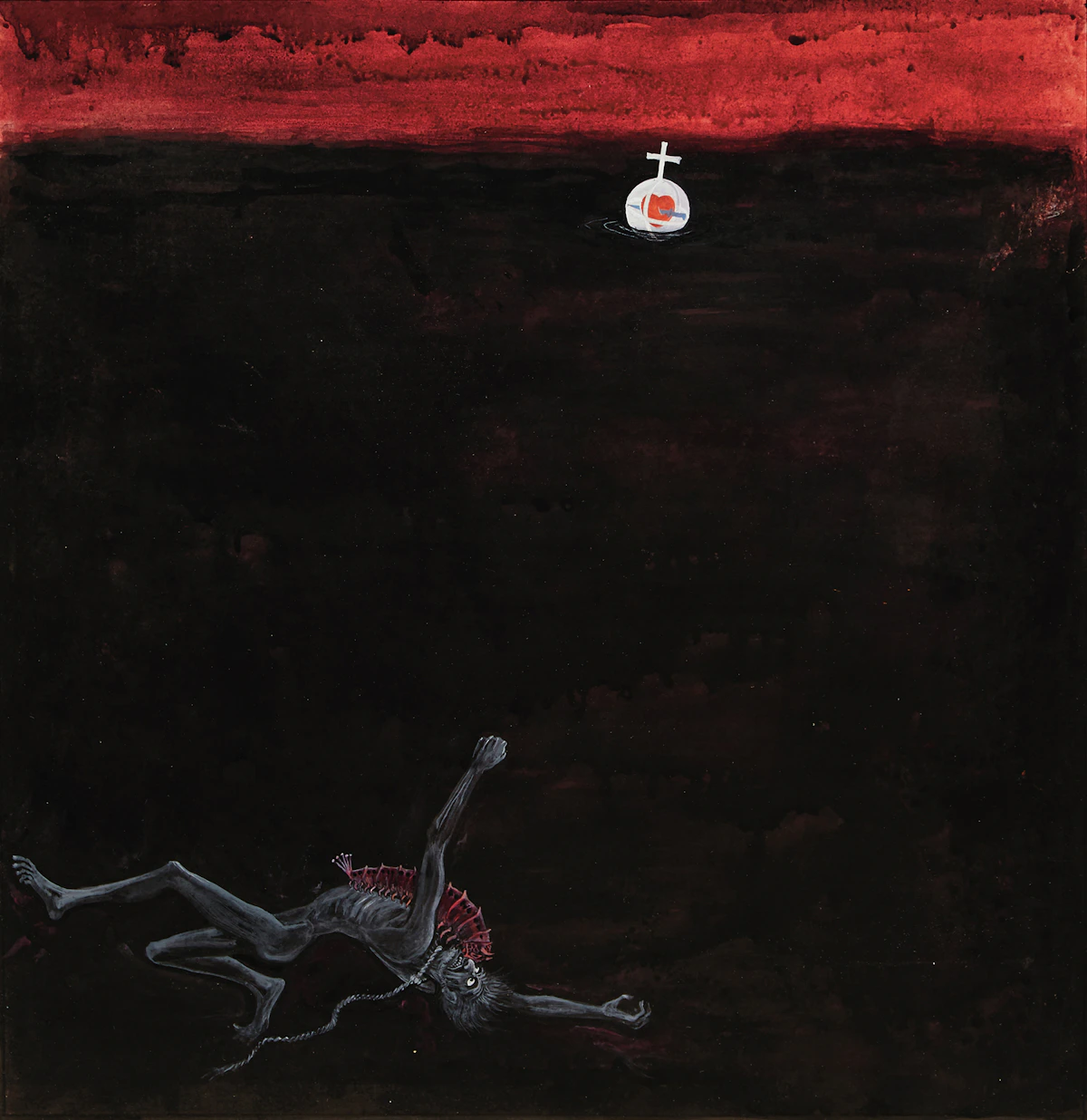
dated 1961 on the Isaac’s Gallery label verso; titled on a remnant of the original framing (attached verso)
19.25 × 19 in (48.9 × 48.3 cm) (subject)
Auction Estimate:$15,000 - $20,000
Sale date:November 20, 2018
Price Realized
$24,780
(including Buyer's Premium)
Provenance
Isaac’s Gallery, Toronto
Private Collection, Ontario
Literature
Kurelek’s response to Malcolmson quoted in Ramsay Cook, William Kurelek: A Prairie Boy’s Visions, William Kurelek Memorial Lectures, 1978. Reprinted from the Journal of Ukrainian Studies, Volume 5, 1980, pages 45 and 46
William Kurelek, Someone With Me, Cornell University, Ithaca, 1973, pages 359, 363-64
As a cornerstone of the artist's practice, religious symbolism and motifs are among some of Kurelek's most complex and insightful oeuvres. Having a long history of battling his own demons with mental illness, Kurelek had documented in detail his own struggles with good and evil, particularly when converting to Catholicism. Through this process, the artist grappled with questions of morality and worked through many of his quandaries through his artistic process.
A bold and graphic work, “Judas in Hell” is a heavily symbolic piece rooted in biblical and mythological prose. The titular Judas appears to be submerged in the artist's rendering of hell. The inky black body of water appears to reference the River Styx, the principle river in the Greek underworld forming the border between the underworld and the world of the living. Floating safely on the surface of this river, the image of the sacred heart protected by a globus cruciger symbolizing Christ's divine love for humanity. The globus cruciger—the orb and cross—is a classic religious symbol dating to early medieval religious iconography. It is the Christian symbol of authority where the cross represents Christ's domination of the orb of the world. Here, Kurelek uses the symbol to signify goodness over evil—Judas. Visually, Kurelek places Judas in Hell and the sacred heart safely above, depicting two worlds and a religious binary of good and evil.
On his practice of marrying his own imagination and medieval adaptations in his contemporary practice of the time, Kurelek responded to his critics, directed at Harry Malcolmson in particular, stating: “Did Hieronymus Bosch, a recognized master in representation of Hell himself go to Hell, and come back before he tackled it? No one has come back from the dead to record his experiences there and yet great classical writers like Milton and Dante waded right into it. Obviously they must draw their experience of those things partly from similar earthly experiences partly from personal or mystical intuition.”
In his autobiography, Kurelek further explains in detail: “In the end in this study I launched of Catholics, I found I had to accept the standard Christian approach to the problem. And it is this: leave the final judgment of every individual to God. Only He truly knows a man's heart.” He continues, “We forget that this life is not a resting place but a testing place for the next and final one.”
“Judas in Hell” has been executed with Judas still with his noose wrapped around his neck signifying Judas' suicide by hanging upon learning that Christ was to be crucified as a cause of his betrayal. Judas had later attempted to return the money paid by the chief priests in exchange for his action, however he was denied. The attempt to atone failed Judas and overcome with the consequences of his actions, he took his life—a sin in and of itself.
The work is imaginative and surreal, blending classic mythologies, medieval symbolism and visual languages. Kurelek pointedly brings light to the consequences of sin and the perseverance of good over evil. It is not written or interpreted that Judas had in fact been damned to hell, however this is a classic example of Kurelek's interpretation of biblical narrative and his own artistic vision married in his artworks.