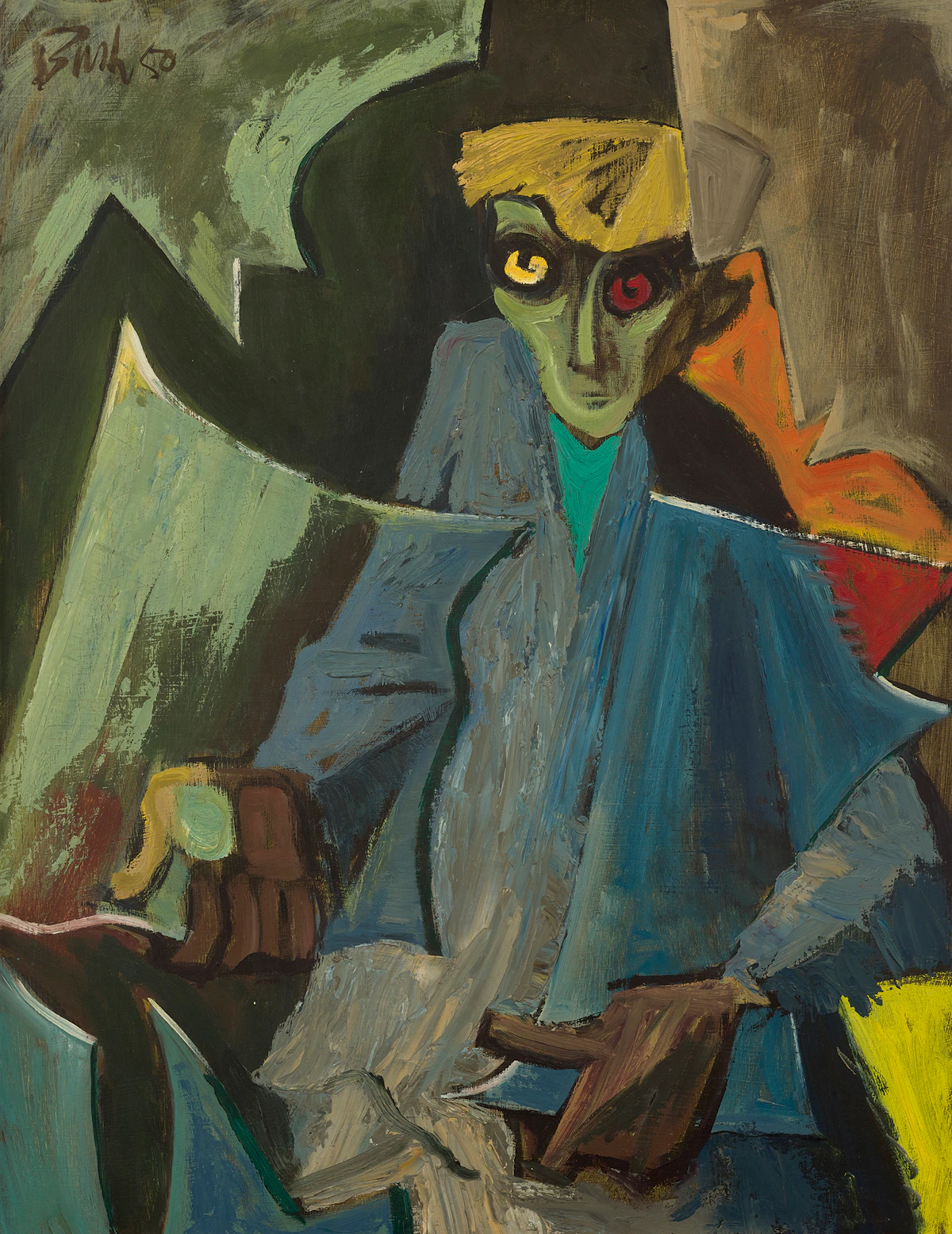
signed and dated 1950 upper left; “Jack Bush Art Estate” and “Jack Bush Heritage Corporation” labels attached to the reverse
26 × 20 in (66.0 × 50.8 cm)
Auction Estimate:$20,000 - $30,000
Sale date:November 20, 2018
Price Realized
$23,600
(including Buyer's Premium)
Provenance
Private Collection, Ontario
Exhibited
Hymn to the Sun: Jack Bush Early Work 1929-1956, Art Gallery of Algoma, Sault Ste. Marie, 1997 (also presented at the Dalhousie Art Gallery, Halifax)
Jack Bush, National Gallery of Canada, Ottawa, November 13, 2014 – February 22, 2015, no. 36
Literature
Christine Boyanoski, Jack Bush: Early Work, exhibition catalogue, Art Gallery of Ontario, Toronto, 1986, pages 18-19
Jack Bush, exhibition catalogue, National Gallery of Canada, Ottawa, 2014, reproduced page 131, listed page 247, no. 36
Dennis Reid, “Jack Bush: The Development of a Canadian Painter,” in Jack Bush, ed. Karen Wilkin, Toronto, 1984, page 18
Michael Burtch, “Hymn to the Sun: Jack Bush Early Work 1929-1956”, Art Gallery of Algoma, Sault Ste. Marie, 1997, reproduced page 85
Marc Mayer, “Jack Bush: A Double Life,” in Jack Bush, exhibition catalogue, National Gallery of Canada, Ottawa, 2014, pages 16-18
In the latter half of the 1940s, Jack Bush’s work took a sombre turn. Persistently dark in palette and theme, many of the works Bush painted in this era exude a formal and psychological uneasiness seemingly at odds with the radiant self-assuredness of the mature paintings for which the artist is best known. Precursors to Bush’s sumptuous abstract canvases of the 1960s and 1970s, figurative works from this formative period of the artist’s career are striking studies of tension: there is a palpable angst to Bush’s tortured subjects, barren landscapes, and haunted houses of the postwar era. Often interpreted as indexes of a collective or personal malaise (Bush sought medical treatment for “tension” beginning in September of 1947), works like “The Broken Window” are among the most charged of Bush’s early efforts—not only for their increasingly personal and emotive content, but also for their unmistakably modern appearance. To wholly ascribe these significant formal shifts to the artist’s state of mind or to the dour zeitgeist of Bush’s times would be to overlook the crucial influence of international modernist traditions on the eventual development of his singular approach to abstraction.
If the first two decades of Jack Bush’s career had been marked by an engagement with the aesthetic preoccupations of his contemporaries in the Toronto art scene, his works of the late 1940s and early 1950s reveal an expanded awareness of the formal qualities of American and European modern art. As both Christine Boyanoski and Marc Mayer have noted, by 1947 Bush had grown dissatisfied with the direction his practice had taken. Already troubled by his “double life” as a commercial illustrator by day and painter by night, Bush and his critical judgment were further tested by exposure to contemporary periodicals and to traveling exhibitions of modern art held at the Art Museum of Toronto (now the Art Gallery of Ontario). By 1950, however, Bush seemed newly invigorated: he had begun to paint more freely and intuitively and had been elected to two prominent artist groups—the Canadian Group of Painters and the Toronto chapter of the Art Director’s Club. It was in his capacity as a member of the latter organization that Bush travelled to New York City in 1950. There, he visited the Museum of Modern Art, viewing works he had until then known only in reproduction. If the artist had been unsure about adopting abstract techniques prior to his trip, he returned to Toronto more willing than ever to put what he had learned to the test in works like “The Broken Window”.
Painted between December 1950 and January 1951, the composition intrigues with its hybrid character and enigmatic subject. Seeming to combine the flattened, geometric planes of synthetic cubism with the jagged angst of German Expressionism, “The Broken Window” is an investigation of the affective potential of elemental form and colour. As Dennis Reid has written of Bush’s works from this era, “form is simplified,” and “colour is used exclusively for its symbolic, emotional value. Not only does the colour have nothing to do with verisimilitude, but it functions independently of the forms.” Here, the chromatic melancholy of Bush’s bleak houses and funereal landscapes of the mid-1940s has lifted, and the artist’s colours begin to approach their signature vibrancy. Earthen tones have given way to rich green, turquoise, and yellow pigments applied in flat strokes to form angular planes delineated by a network of calligraphic black lines and white highlights that hearken to Bush’s training in the graphic arts. With his shock of straw-coloured hair, mismatched swirls for eyes, and triangular gash of a nose, Bush’s boldly outlined figure is strongly geometricized, and his eerie pallor and erratic limbs lend him an otherworldly character. Holding in his oversized hands the shattered fragments of a broken pane that had separated him from the viewer, he, like Bush, stands at the cusp of a literal breakthrough.
Jack Hamilton Bush - The Broken Window | Cowley Abbott