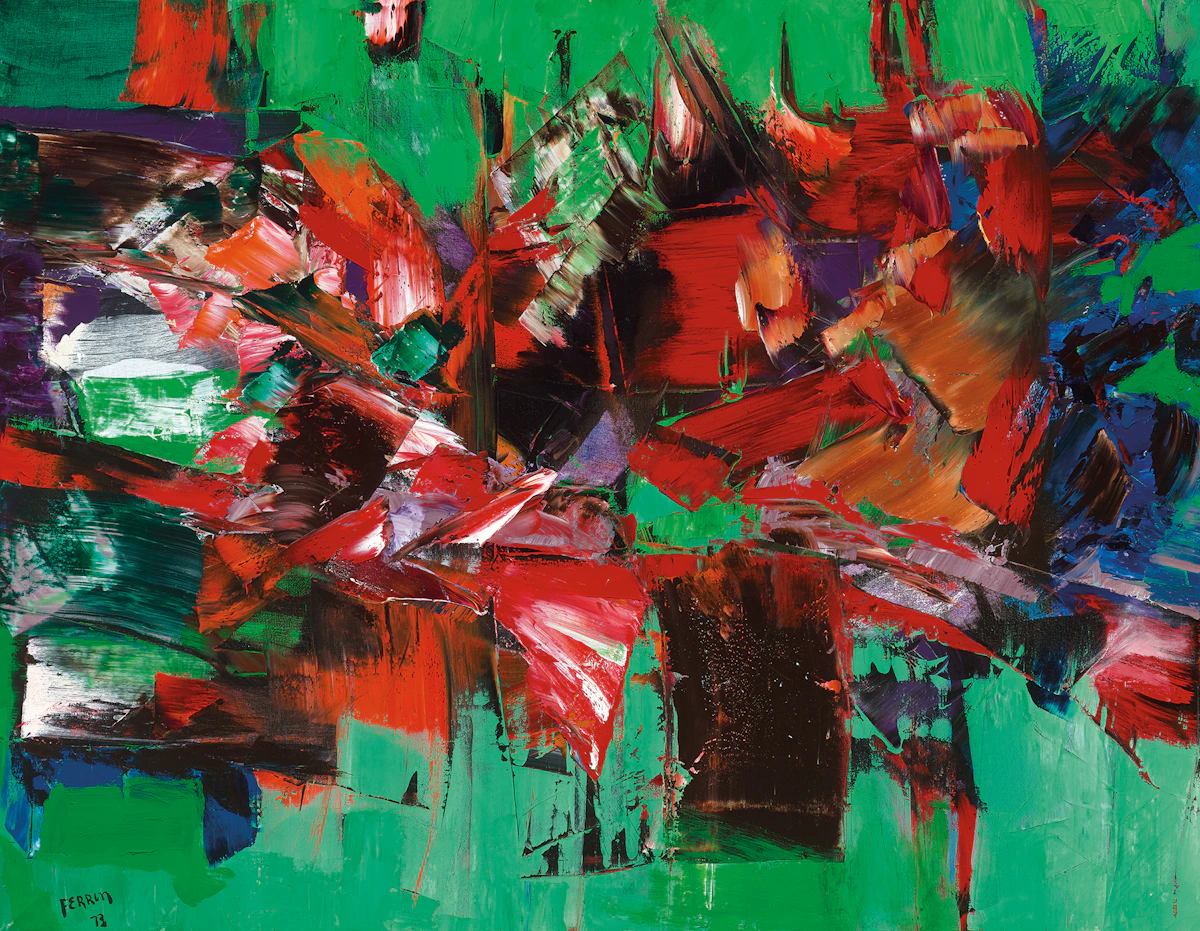
signed and dated 1973 lower left; signed and dated on the reverse
45 × 57 in (114.3 × 144.8 cm)
Auction Estimate:$30,000 - $40,000
Sale date:May 29, 2018
Price Realized
$49,560
(including Buyer's Premium)
Provenance
Private Collection, Montreal
Literature
Ed. Simon Blais, Marcelle Ferron: Monograph, Montreal, 2008, pages 8, 13 and 20
Marcelle Ferron remained faithful to automatism throughout her career; she was driven by the aesthetic, the solidarity of the group, and especially the teaching of Borduas, who promised her at their first meeting that he would show her how to find the “joy” in her painting. Ferron had undergone an artistic crisis in the period preceding her meeting with Borduas in 1946, and his art and personality had a life-changing and enduring effect on the young painter. A signatory of the Refus Global in 1948, Ferron was one of seven women to sign the manifesto, and one of the youngest to do so, at age twenty-four.
By the mid-1950s Ferron had achieved significant success in Quebec and Canada. She moved to Paris in 1953 and exhibited throughout Europe until 1965. Ferron was granted a silver medal at the Sao Paulo Biennale in 1962, which marked the most recognition a female artist from Quebec had ever received. In 1966 Ferron abandoned painting to work in stained glass for several years, she was drawn to creating public art that would reach out to the “ordinary people” she loved so much.
“Sans titre” was created in 1973, marking the first year of Ferron’s return to painting. Curator Réal Lussier writes of her return that “her handling had lost nothing of its expressiveness or energy, nor her palette any of its brilliance: both reflected an unchanged sensibility. Picking up where she had left off, she executed a number of large paintings that generally combined broad contrasting fields of almost monochrome colour with bursts of lively spatula strokes radiating in all directions, almost like the results of an explosion”. This work exemplifies the above statement, as Ferron contrasts wide strokes of complementary shades of green and red on a large canvas. A characteristic that set the artist’s work apart was her consistent preference for structure and shape over line and gesture. While Ferron readily employed the palette knife, her canvases, such as “Sans titre”, appear to be a cohesive arrangement of shapes, and are never graffiti-like or splattered with paint. Art historian Robert Enright comments on the pleasing structure of Ferron’s mature works, stating: “They have an irresistible physical presence and an equally compelling rhythm. The paintings frequently appear to be composing themselves, as if they were made from a deck of cards forever in the process of being reshuffled.”