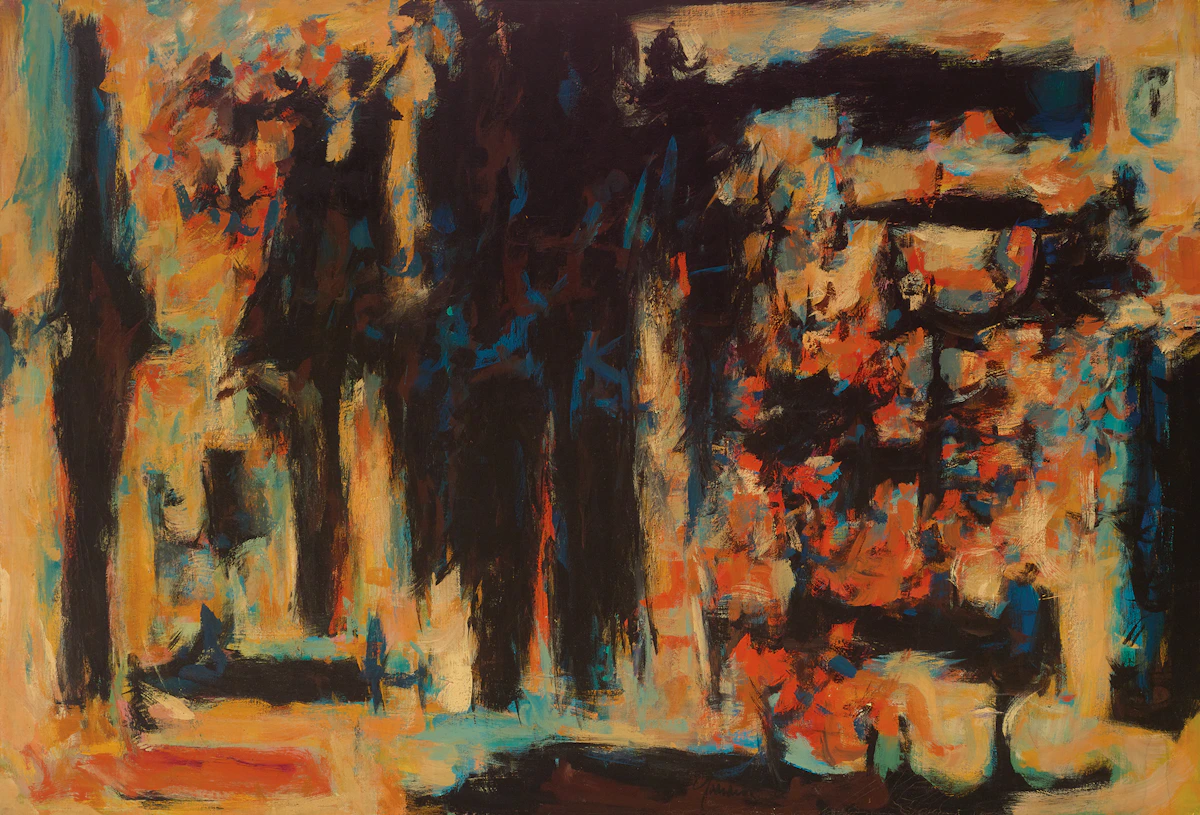
signed and dated 1957 lower centre; titled on the stretcher
48 × 72 in (121.9 × 182.9 cm)
Auction Estimate:$10,000 - $20,000
Sale date:May 29, 2018
Price Realized
$18,880
(including Buyer's Premium)
Provenance
Private Collection, Toronto
Literature
Iris Nowell, Painters Eleven: The Wild Ones of Canadian Art, Vancouver/Toronto, 2010, page 278
Focusing on powerful colour palettes of contrasting warm and cool tonalities, the artist oscillated between pure abstraction and semi-figural abstraction throughout the 1950s. In paintings of this period, sculptural elements can be interpreted on the two-dimensional compositional plane with cubist qualities of sculptural forms rotating and simultaneously being captured in space. In keeping with the mandate of the Painter’s Eleven, the exploration of abstraction and a distancing from the traditional figure and form were paramount.
Upon travelling to Buffalo, New York with fellow artists Harold Town and Tom Hodgson, the works of the American abstract expressionists influenced Yarwood. Rather than the obvious players of Jackson Pollock and Mark Rothko, inspiration seemed to have sparked with the works of Clyfford Still; one of the founding artists of the American Abstract movement. In both Yarwood's and Still's bodies of work, large organic swaths of rich colours are explored in jagged shapes of colour.
On the artist’s exploration of contrasting colour, Iris Nowell writes: “Nothing is overdone in his strong colours; it’s as though a buzzer in his brain alerted him when to stop.” Yarwood had a particular eye and judgment when economizing and rationalizing colour choice and application. Yarwood’s “Autumn Woods” is charged with energy as the tones of deep indigo, crimson and ochre contrast with each other, bringing dynamic movement across the canvas.