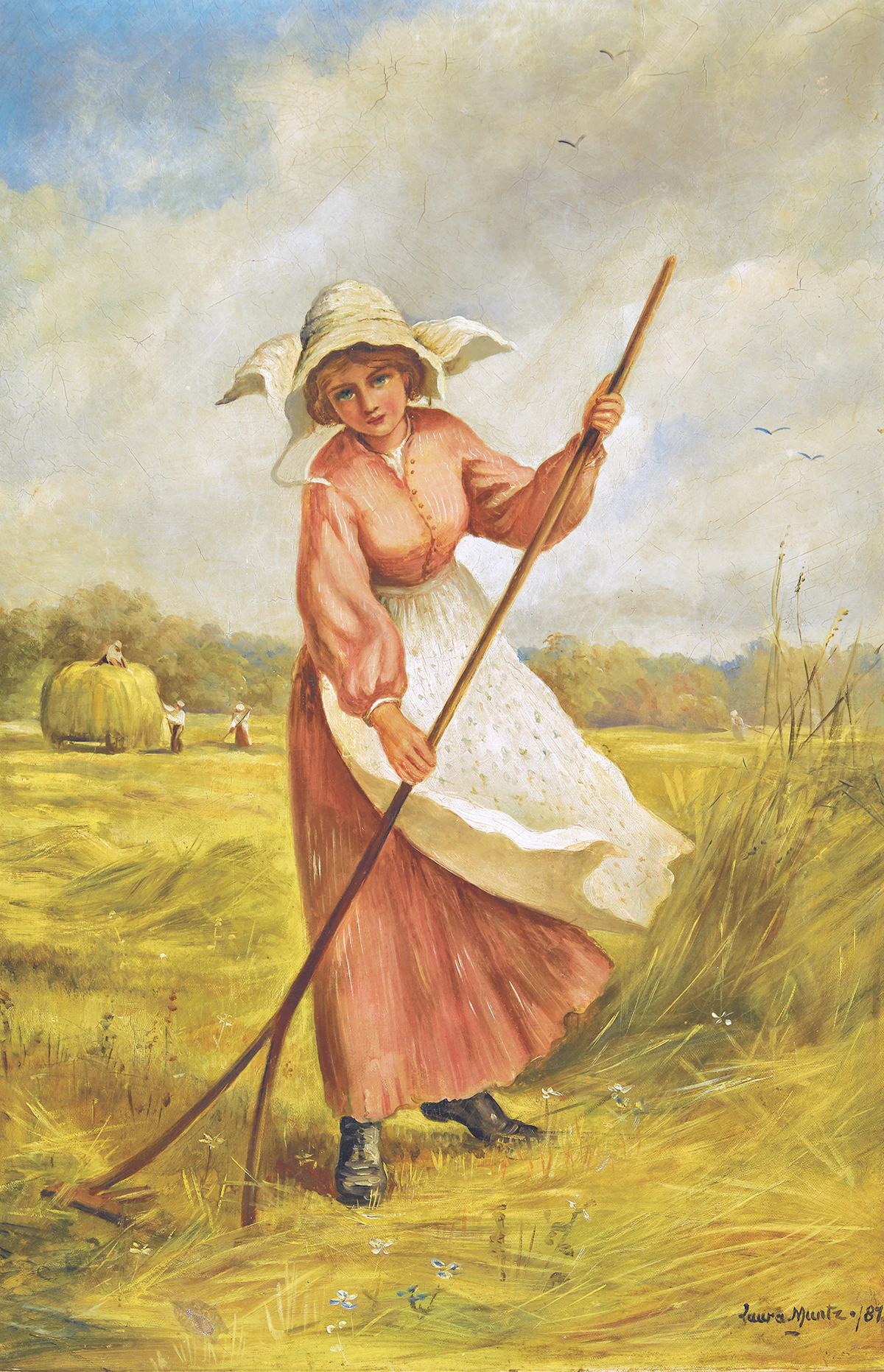
Laura Muntz's paintings of women and children captured a time when the choice of subject was thought especially suited, in the opinion of the day, to the sensibility of women painters. Young women, children, embodied innocence and the promise of the future, and, in addition, allowed her to revel in forthright candid storytelling with a naturalism she learned through long study and practice.
Born in Warwickshire, England, but growing up in Canada, in various rural settings, she was encouraged to paint by a congenial artist from Dublin, William Charles Forster (1817-1902), who taught art in Hamilton, Ontario. In time, Muntz herself taught art, preliminary to study in Toronto, and later, England and France.
This painting reflects the strong, new identity for herself that Muntz was forging in this early period of her work. Her attempt to draw the figure accurately in a pleasingly rural setting, and the way the paint is handled, is handled, embody a kind of striving on Muntz`s part, an ambition, that would make her one of the important painters of the day.
Characteristic of her work is her lively rendering of her subject's bonnet and the apron, as well as the movement of the young girl`s body and the placement of her feet. In these, and other, details, she celebrated the picturesque qualities to be found in rural subjects. Another picture done in the same period shows her interest in anecdote and story-telling: in it, she told a story from Charles Dickens. Possibly, this painting reflects literature of the day. A young female farm worker was the subject of many novels.
There is a record that Muntz sold her first painting in oil in 1887. She doubtless added the money to the savings she made for going abroad. It is temping to think that this is the painting that gave her the funds she needed for further study. It is extraordinarily bold for a first painting, but helps us understand how Muntz got to be called “incomparable” later, when she was praised for the “great charm” of her paintings and her “vigorous” subjects, qualities that abound here.
We extend our thanks to Joan Murray, Canadian art historian, for contributing the preceding essay.