Gallery Moos, Toronto
Mr. Daniel Hechter, Paris, France
A Canadian Corporate Collection
Literature
Paul Duval, High Realism in Canada, Toronto/Vancouver, 1974, pages 78, 80 and 84
Paul Duval, Ken Danby: The New Decade, 1984, pages 105 and 108
Paul Duval, Ken Danby, Toronto/Vancouver, 1976, page 130, reproduced page 137
One of Canada’s preeminent realist artists, Ken Danby was most noted for his depictions of sport and leisure with a keen sense of capturing the human condition—whether the physical strain of a sculler working against the currents or the sharp focus of a snooker player hunched over the game table. Beginning first as a young artist in Toronto exploring abstract art like many other contemporaries in similar circumstances, it was not until a trip to Buffalo, New York in 1962 to visit the Albright-Knox Gallery and take in a solo exhibition of American realist, Andrew Wyeth, that changed the course of his artistic career. Inspired by Wyeth, “the impact made by these paintings convinced Danby that he should forsake abstract painting, which he was increasingly becoming dissatisfied with and return completely to his devotion to realism.”
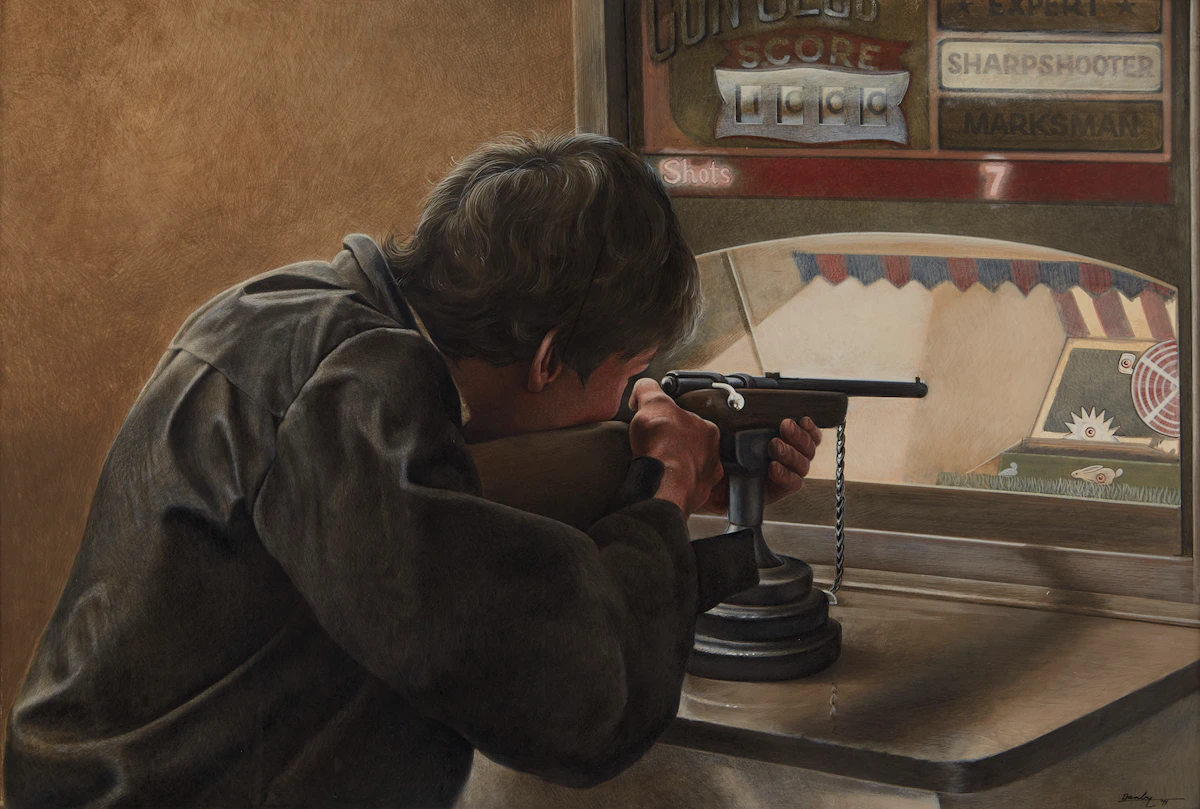
Growing up in Sault Ste. Marie, Danby was driven to return to Southern Ontario to explore the happenings of youths in surrounding cities and towns. Throughout the early 1970s, Danby was occupied with the lives and tendencies of the modern teenager as barometers for change and youthful fun. Frequenting arcades, Danby could observe and capture the care-free excitement and entertainment of the modern teenager.
In this high realist work, Danby's subject turns away from the viewer, the dark figure set upon a lighter background. Duval notes that “[t]o collect material for ‘Sharpshooter’, Danby spent a day looking at shooting galleries at the Canadian National Exhibition and in Toronto's penny arcades.” “Sharpshooter” captures the subject in a moment of intense concentration with the brilliant arcade lights glimmering in the background, unbothered by the viewer. The work focuses on the subject in a moment of tension between the light-hearted frivolity of the arcade as a refuge and intense focus of its patrons. Mirroring the transitionary period of teenage life growing away from childhood, but not fully matured into adulthood, these works explore the human condition of growth through the lens of youthful fun. A short but important period, this foray into a pseudo-anthropological study of the modern teenager produced many graphic studies and four highly detailed and major tempera paintings in the artist’s body of work.