Terry Rigelhof, Philip Surrey (1910-1990): Retrospective Exhibition, Walter Klinkhoff Gallery, Montreal, 2004, page 2
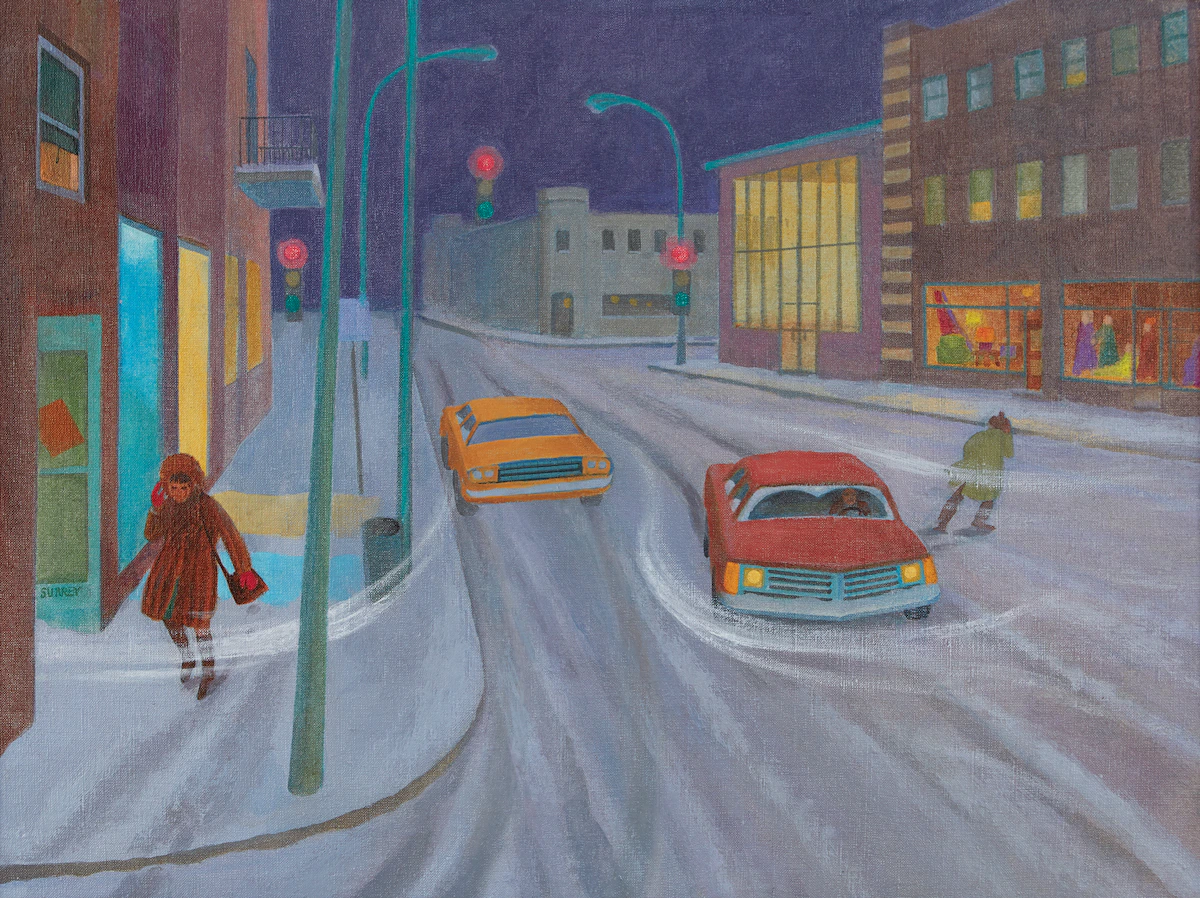
A skilled interpreter of both physical and psychological space, Philip Surrey was known for depicting scenes of Montreal’s streets and their inhabitants. His paintings of the forties and fifties are characterized by sombre colours, mysterious shadows, and an eerie stillness. Surrey's studies of isolation within society add emotional depth to his Montreal street scenes. From the 1960s on, his work is brighter and and more stylized with gregarious urban dwellers. In “Winter Street Scene”, Surrey revisits the sombre approach of his earlier paintings. The canvas illustrates a particularly bleak time of year, heightening the feeling of loneliness and isolation that recurs in the artist’s work. A figure walks on the sidewalk toward the viewer, bundled up and engulfed in a gust of wind, while another crosses the street, which is covered in a thin layer of snow. During a time when days are short, the storefronts and stoplights are the only sources of light.
Recognized as the “leading exponent of urban landscape painting in Canada,” Philip Surrey received the Order of Canada in 1982; the citation reads: “His Montreal street scenes convey an emotive vision of the modern city, with its anonymous crowds and individual solitudes. His expressive style and a poetic humanitarianism constitute a unique contribution to Canadian art.” The distinct sombreness and stillness to the painter’s work has been compared to the mood of Giorgio de Chirico’s piazzas and Edward Hopper’s American street scenes, and has established a significant rank for Surrey in Canadian art history.