Sandra Gwyn and Gerta Moray, introduction to Mary Pratt, Toronto, 1989, pages 1 and 23
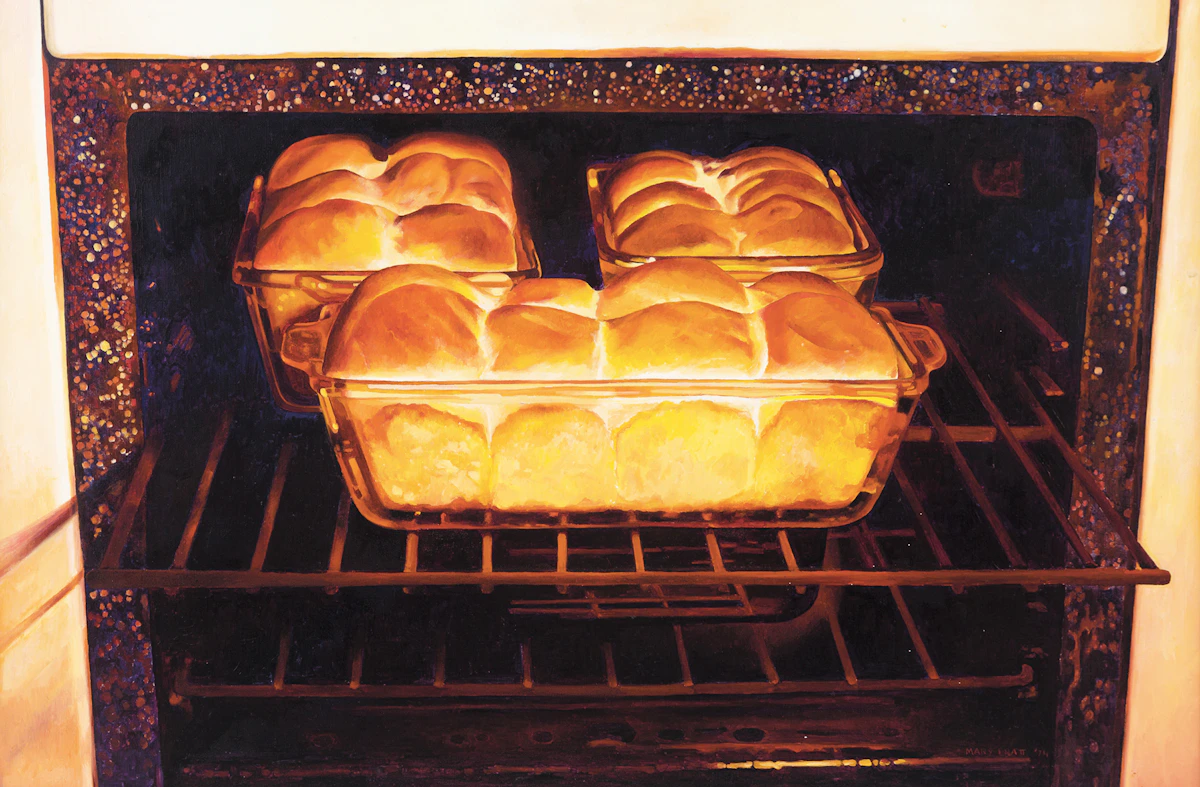
While her husband painted full-time, Mary Pratt did so only when she had a spare moment in her homemaking duties. She found her subjects in her daily routine, and she elevated these images of everyday household objects from the banal to something beautiful and significant. With regards to her choice of subject matter, the artist declared: “The things that turn me on to painting are the things I really like... I’m getting supper and suddenly I look at the roast in the oven or the cod fillet spread out on the foil, and I get this gut reaction. I think, ‘that’s gorgeous, that’s absolutely wonderful, and I must save it.’” Pratt undoubtedly had this sentiment in her conception of “Baking Bread”, as one is easily drawn to the delectable aroma of bread baking in an oven and peeking at its rising golden crust. “Baking Bread” exemplifies Pratt’s celebration of the ordinary, a pervading theme in her work throughout the 1970s.
Pratt was particularly interested in capturing effects of light to add a dramatic or theatrical aspect to her artwork, as evidenced in the warm glow of this composition. She painted from photographic slides projected onto a canvas, so as to capture and accurately depict the light of one particular moment. Sandra Gwyn states that “the strength of Mary Pratt’s paintings lies in the fact that they...openly acknowledge the photograph, which is inseparable from the process of their making.” Interestingly, the artist had no idea that her choice of style was consistent with those of the New Realist movement, a contemporaneous group of Canadian and international artists who also adopted the practice of painting from photographs. Rather, Pratt arrived at this approach on her own as a result of convenience and her immediate surroundings, in addition to her formal training from Alex Colville and Mount Allison University.