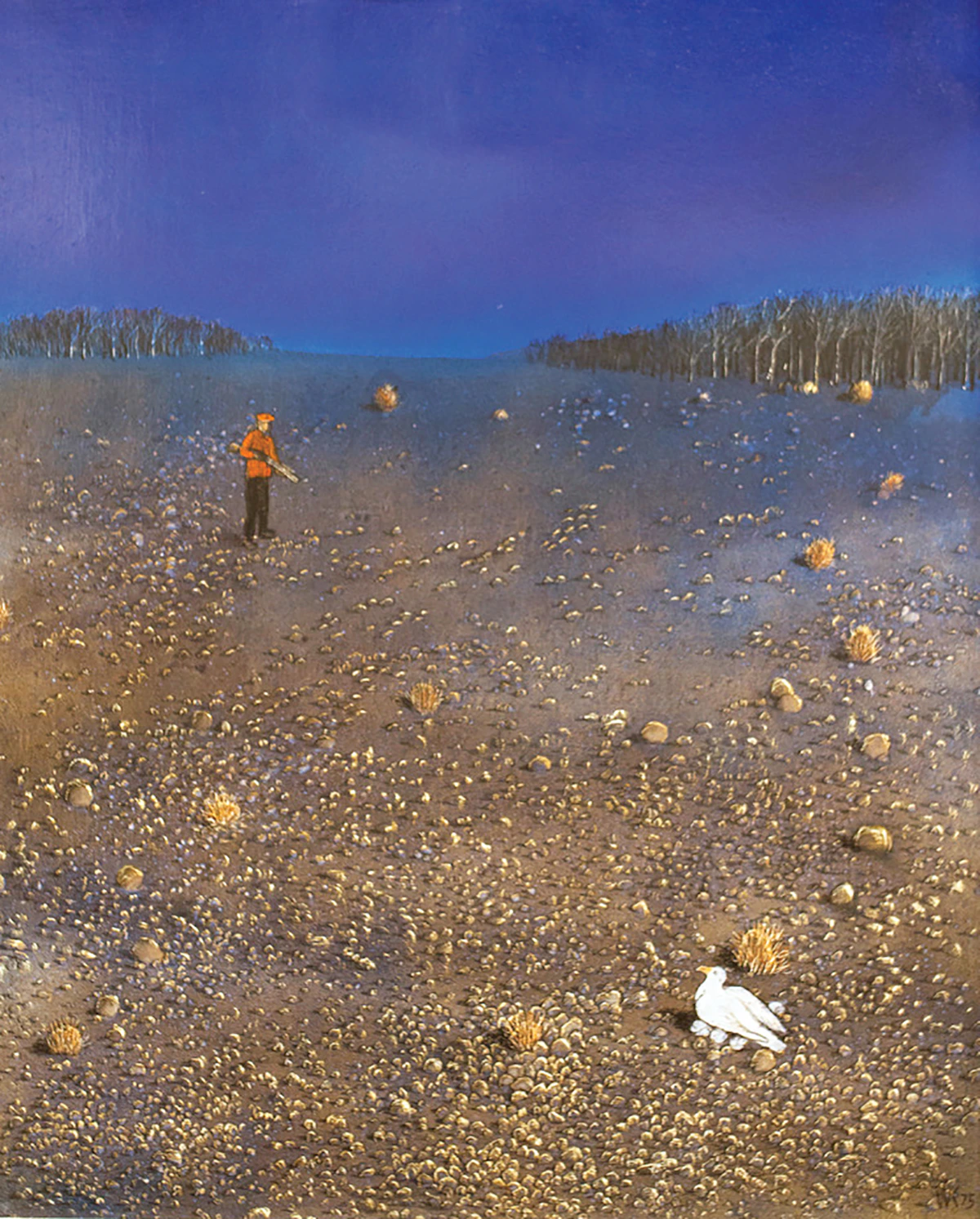
The Killing Instinct (Temptations in the Desert Series)
mixed media on board
signed with initials and dated 1975 lower right; signed, titled and dated 1975 on the reverse
20 × 16 in (50.8 × 40.6 cm)
Auction Estimate:$12,000 - $15,000
Sale date:May 25, 2017
Price Realized
$11,500
(including Buyer's Premium)
Provenance
Private Collection, Winnipeg
Literature
Mary Jo Hughes, “The William Kurelek Theatre Presents William Kurelek A Epic Tragedy”, William Kurelek: The Messenger, Art Gallery of Greater Victoria, Art Gallery of Hamilton and Winnipeg Art Gallery, 2011, page 52
Patricia Morley, Kurelek: A Biography, Toronto, 1986, pages 220 and 332
Joan Murray, Kurelek's Vision of Canada, The Robert McLaughlin Gallery, Oshawa, 1982, pages 10-22 and 73
The “Temptations in the Desert” series comprised of twenty works produced for the purpose of exhibition in Olha and Mykola Kolankiwsky's Art Gallery and Museum near Niagara Falls. Longtime collectors and patrons of the arts in Toronto, the Kolankiwskys had a gallery across from Isaacs Gallery in Toronto and developed a close personal and professional relationship with Kurelek. Purchasing Kurelek's entire Passion series in 1970, the couple displayed the artist's work in their gallery and supported Kurelek's religiously-motivated works.
Paralleling passages and stories from both the Old and New Testament, Kurelek re-contextualizes the representation of earthly vices first seen in Medieval and Renaissance masters. Strongly influenced by Pieter Bruegel and Hieronymus Bosch, the artist was deeply connected to the religious morals executed in grand visual narratives. This series symbolically represents contemporary and traditional temptations such as alcohol, killing, hiding from conflict and keeping bad company, situated in simplified landscapes referencing Kurelek's experience in the Prairies. The titled series references the Genesis cautionary story of Adam and Eve as well as the story of the Temptation of Christ.
On his religious works, Kurelek states that “the subject is not dictated to me as it often was to medieval artists. I choose it myself and paint a theme that I strongly feel needs to be made public, and I deliberately use the popularity of my other more pleasant memory-recording type of painting so that I can attract the public.” For Kurelek, his work was in the service of God and the completed works were a way for the artist to share and translate the religious morals he felt so strongly connected to. Recognizing the sensitivity of religious undertones in his work, Kurelek explains: “I can't help but paint the sense of impending doom of our times; and the way of salvation too. I would be callous and dishonest if I buried my head in the sand.”
William Kurelek - The Killing Instinct (Temptations in the Desert Series) | Cowley Abbott