Literature
David P. Silcox, The Group of Seven and Tom Thomson, Toronto, 2003, pages 18 and 294-95
Nils Ohlsen, “This Is What We Want To Do With Canada – Reflections of Scandinavian Landscape Painting in the Work of Tom Thomson and the Group of Seven,” Painting Canada: Tom Thomson and the Group of Seven, London, 2011, page 49
In January, 1913, Lawren Harris and J.E.H. MacDonald, recent friends and frequent sketching partners, travelled to the Albright Knox Museum in Buffalo, New York to view the Exhibition of Contemporary Scandinavian Art. The show inspired the pair, Harris and MacDonald moved not only by the subject matter, the depictions providing a distinct view of the Northern European countries’ terrain, but also the handling and stylization within the landscapes. Of the paintings included in the exhibition, parallels (or “correspondence”, as described by MacDonald) can be perceived between the handing of the snow-laden trees in Gustav Vjæstad’s “Vintermånsken” (Winter Moonlight) and the trees we find as a focus in Lawren Harris’ work in the following years.
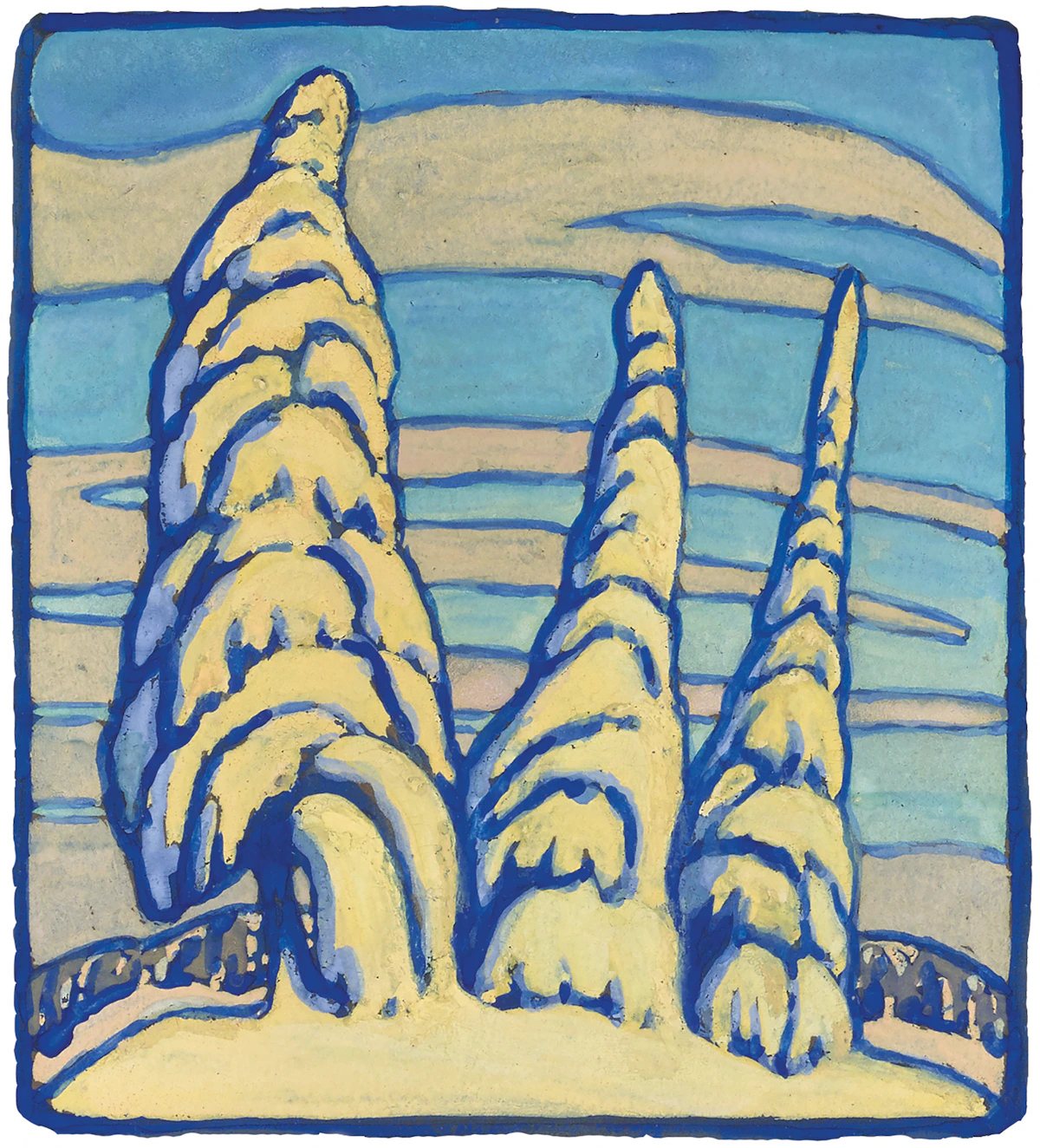
In 1915’s “Snow II” (Collection of the National Gallery of Canada), three masses of large trees populate the foreground in soft shadow, partially screening the sunlit far shore of the background lake. The boughs are weighed heavily by the bluish snow, allowing only glimpses of the foliage beneath, the trees’ overall shapes softened by the precipitation. “Winter Sunrise”, the 1918 canvas in the collection of the MacKenzie Art Gallery provides a focus of three large coniferous trees, Harris presenting them in a more triangular shape, the snowy the branches forced downward with gravity’s pull.
This gouache by Harris possesses strong aspects of Harris’ continued stylization of the Canadian wilderness toward his eventual arrival in abstraction. The three trees, their bases huddled together, are completely cloaked in heavy snow, the bluish white layers smoothing the three into tight cones. While the tree on the right points sharply toward the sky, the other two curve slightly, further indication of the weight of the thick blankets. The painter’s low, curving horizon ensures an upward focus upon the three trees, set in front of a massive sky. Long, finger-like clouds stretch across the composition, reminiscent of many of the painter’s handling found in his later depictions of Canada’s west and far north.