Mayberry Fine Art, Toronto
Private Collection, Toronto
Literature
Constance Naubert-Riser, Jean McEwen, Colour in Depth: paintings and works on paper 1951-1987, Musée de Beaux-Arts de Montréal, 1987, pages 23-27
Jean Albert McEwen left Montreal to spend a year in Paris in 1951. Paul-Emile Borduas had encouraged him to visit the French capital and contact Jean-Paul Riopelle, who had been there since 1946. A decisive shift in painterly approach occurred in Paris due to a combination of several influential factors: McEwen encountered the art of the museums, as well as the exhibitions of contemporaneous avant-garde abstract artists. He saw Riopelle’s solo show in December, followed by those of Sam Francis and Jackson Pollock in the spring of 1952. McEwen’s simultaneous discovery of these three artists linked to the “allover” style of Abstract Expressionism initiated a transformation in his work. His style at the time had been akin to that of Borduas, consisting of plant-like forms hovering amid an indeterminate background, and evolved into an approach closer to abstract “field” painting, with no focal-point in the composition nor any reference to landscape or plant motifs.
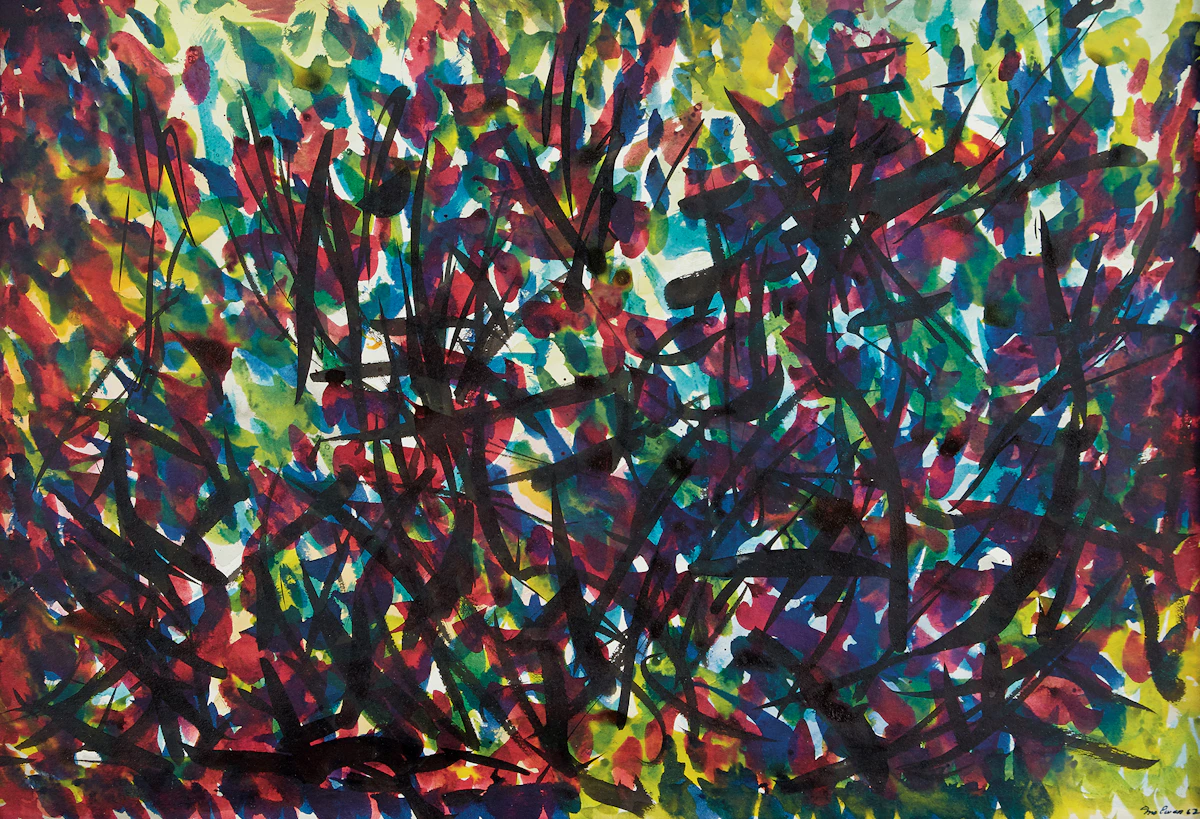
“Untitled Abstract” is one of many watercolour and ink on paper artworks that McEwen produced during the summer of 1952 in Belle-Ile-en-Mer, where he was accompanied by Riopelle. This series of watercolours bear a resemblance to those by Riopelle of the same period, characterized by a rhythmic brushstroke application. Constance Naubert-Riser compares the work of the two artists and describes McEwen’s series as composed of “a network of black strokes in India ink - quite non-linear, unlike the one employed by Riopelle in his watercolours from the same period - was superimposed on another series of strokes in brightly-coloured links.” These watercolours served as experiments that lead to McEwen’s first truly all-over oil canvases.