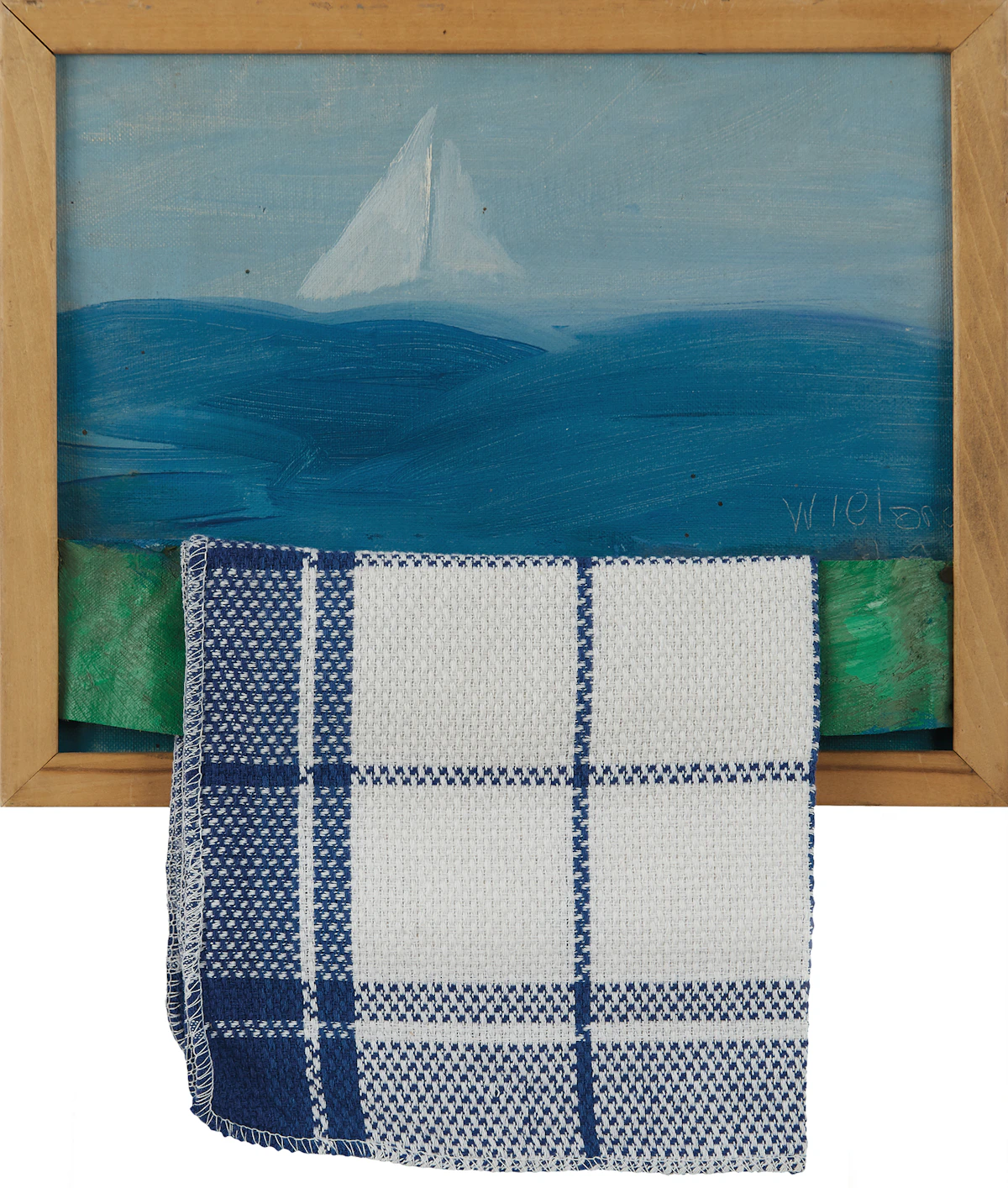
signed right; signed and titled on the reverse; dated 1973 on a gallery label on the reverse
8 × 12 in (20.3 × 30.5 cm) (overall)
Auction Estimate:$5,000 - $7,000
Sale date:November 22, 2016
Price Realized
$5,750
(including Buyer's Premium)
Provenance
Isaacs Gallery, Toronto
Private Collection, Calgary
Literature
Johanne Sloan, “Joyce Wieland” (online publication), Art Canada Institute, Toronto, 2014, pages 3-10
Throughout the 1970s, Wieland often experimented and produced works of sculptural assemblage marrying her training in painting and personal exploration into contemporary art practices influenced by Pop and Conceptual art. Having lived in New York City throughout the 1960s with then-husband Michael Snow, Wieland became more concerned with the current politics, nationalism and activism with a particular interest in what these themes meant in Canada. Gender politics was a key issue for the artist often exploring the place of a woman both within national political dialogue and art historical canons.
Created in 1973, “Rack” was the predecessor of Wieland’s feature film, “The Far Shore,” produced in 1976. The artist was script writer, director and co-producer for the project. The film presented an alternative history to the myth-like history and persona of Tom Thomson. Wieland’s inclusion of Thomson’s fictional female lover in the film introduced a more contemporary critique of both gender politics within Canadian art history and the relationship between gender and the landscape. As an activist for ecological issues as well, contemporary politics of the landscape and the literal changing of the Canadian landscape and displacement of communities played a large role in the artist’s practice.
Here, the artist quite literally inserts the woman into the landscape of this work. Using traditional symbols of gender, Weiland weaves the tea towel into the landscape; the towel representing traditional femininity as a token of women’s role in the home. The background landscape represents the masculine symbol both in Canada’s history of men conquering the land and the male painters who famously captured the landscape. Moreover, the tea towel is tactile, three dimensional and has been actively inserted into the passive flat landscape - perhaps a visual representation of the artist’s own fierce commitment to her practice and experiences as a political activist, inserting her voice as a woman in a predominantly male-dominated field. Though small in scale, “Rack” is an important work charged with complex socio-political themes and visual dialogues.