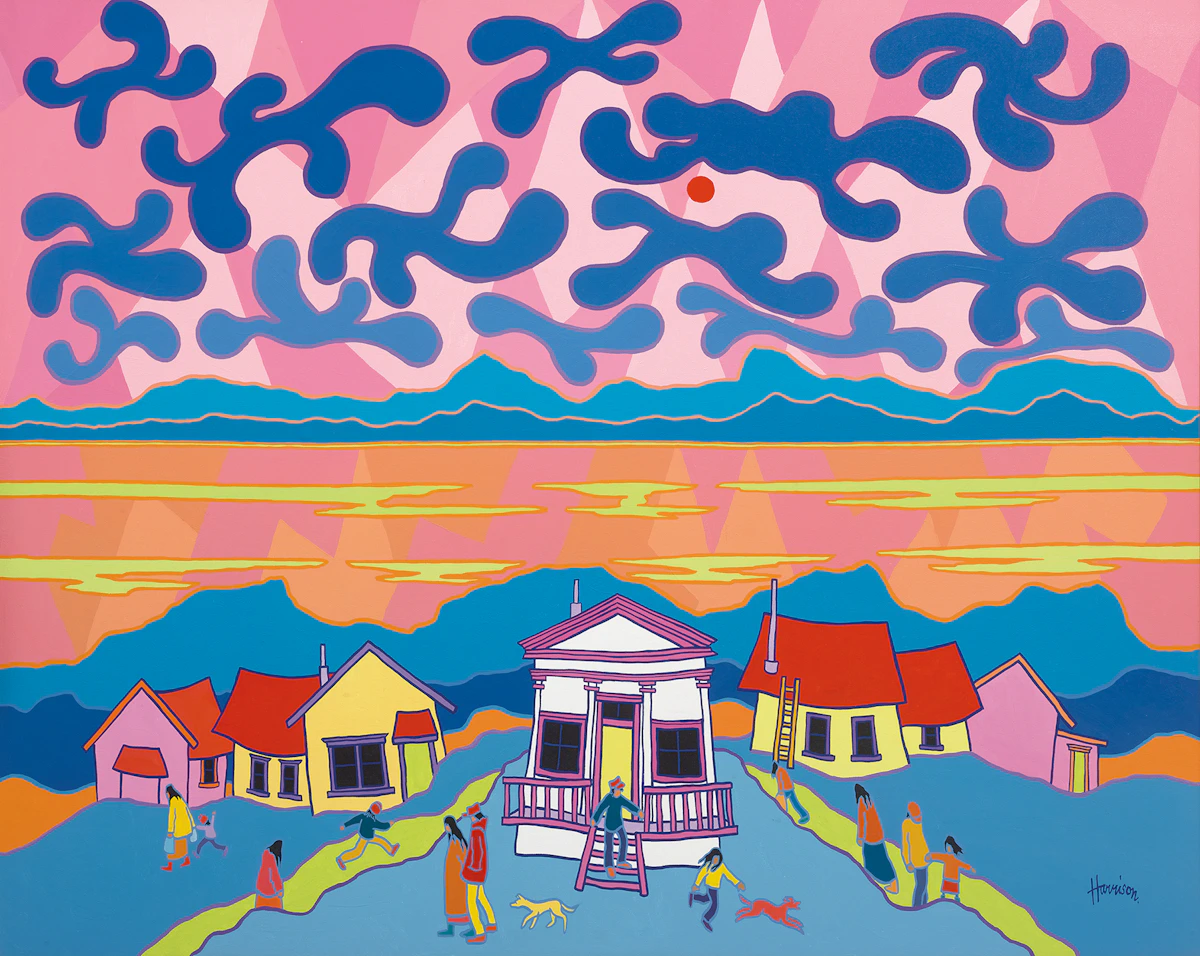
signed lower right; signed, titled and dated 1982 on the reverse
48 × 60 in (121.9 × 152.4 cm)
Auction Estimate:$30,000 - $40,000
Sale date:May 25, 2017
Price Realized
$34,500
(including Buyer's Premium)
Provenance
The Shayne Gallery, Quebec
Private Collection, Texas
Exhibited
“Ted Harrison,” The Shayne Gallery, Montreal, November 4-20, 1982 (artwork reproduced on the cover of the invitation)
Literature
Stan McNeill, “The Yukon Territory is Painter’s Shangri-La,” “The Hamilton Spectator,” October 18, 1980, page 88
Robert Budd, Introduction to “Ted Harrison Collected,” Madeira Park, British Columbia, 2015, pages 5-7
It was an advertisement in a United Kingdom newspaper which initially brought British-born Ted Harrison to Canada’s North, filling a teaching position on the Alberta Indian reservation of Wabasca. The award-winning artist had previously held teaching positions in New Zealand and Malaysia, but felt a pull to the Arctic, however Harrison’s arrival in Wabasca was met with some disappointed due to the flatness of the surrounding landscape. During his time in Wabasca, Harrison played a significant role in developing a new Alberta teaching curriculum for Cree and Metis students, leading later to the bestselling “A Northern Alphabet.” When a teaching post became available in the village of Carcross, south of Whitehorse, the artist leapt at the opportunity after confirming the surrounding mountainous terrain (the salary for the new job was a secondary concern). The Yukon landscape inspired and challenged Harrison: “Never before had I attempted to paint a landscape so gigantic in scale, whose colors dictated to me not only what I should paint but also on what terms I should paint them.” The artist laid aside the formal training he had received as an academic painter in the old tradition and concentrated on “simplifying his work and creating a personal style.”
While the landscape and environment of the North invigorated and forever altered Ted Harrison’s work and life, the people and community of his new home were vital to his work. The large scale of “The Grecian House” envelops the viewer, much as the Arctic captured the painter, the canvas a perfect balance of colour, shape and energy.
A bustling community is sampled by the many men, women and animals populating the composition, heading in all possible directions, many with a level of energy that borders on dance. The slightly-skewed angling of the colourful buildings seem to possess the same rhythm. Typical with Harrison’s signature work, the colour and vivacity of the people and buildings are simpatico with the land and sky, the imperfect and tonal shapes from foreground to icy sea to horizon to abstracted clouded sky each presenting distinct colouring and forms but always maintaining a harmony to the overall composition. Every element has a strong sense of belonging, relaying the very connection, community and peace that Harrison found in the North.
Featured in a November, 1982 exhibition at the Shayne Gallery in Montreal, which Harrison attended, “The Grecian House” was reproduced on the invitation for the opening. A copy of the invitation is included with this lot.