Bruce Head, R.C.A., Winnipeg
Private Collection, Toronto
Exhibited
“Figure Ground: The Paintings and Drawings of Ivan Eyre”, Winnipeg Art Gallery, 2005, cat. no. 4
Literature
Pavillion Gallery, “Ivan Eyre: The Paintings”, Assiniboine Park, 2004, pages 18-19, and 254
Denis Cooley, Amy Karlinsky and Mary Reid, “Figure Ground: The Paintings and Drawings of Ivan Eyre”, Winnipeg, 2005, pages 17-18, reproduced page 54
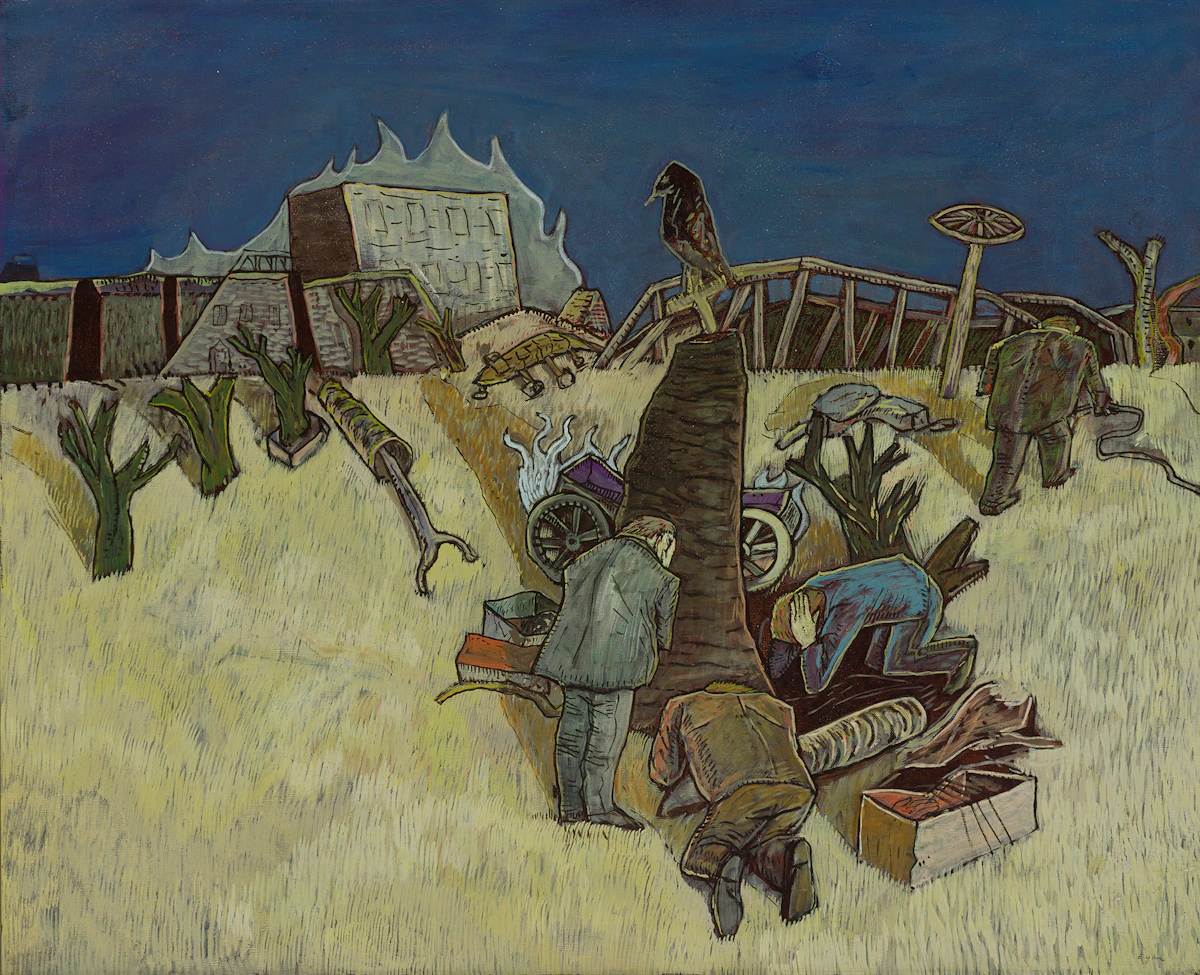
Born in Tullymet, Saskatchewan in 1935, and completing his university studies at the University of Saskatchewan and the University of Manitoba, the artist was heavily influenced by the Canadian prairie landscape. Eyre also held a professorship with the University of Manitoba from 1960-1993, during which time he completed “Cairn”.
Drawing on his memory and dreams, Eyre depicts a surreal scene, post-apocalyptic and sombre in nature, but tempered with the calm setting of the prairie wheat field. Tragically poetic with the juxtaposition of the landscape and the scene depicted, this work was part of a process of experimentation for the artist. Memories of the prairie land are evident, but also the artist’s recollections from taking nighttime walks through urban areas are present in the industrial buildings of the scene. An interesting dichotomy, the imagery incorporates the morbidity of German expressionism with the artist’s imagined scenes, resulting in a familiar yet distant landscape.
Eyre created over 100 canvases in this dream-like style in an effort to internalize the landscape through a repeated process of creation based on memory and experience. This project was the precursor for “Man Alone” (1963), a monumental piece that typifies the artist’s style and subject matter of the early 1960s, with many of the works having been destroyed by Eyre. The practice of landscape painting has continued throughout the artist’s career with the Saskatchewan and Manitoba setting figuring prominently as works of imagination, an ode to the artist’s personal history. Eyre comments on the landscape genre of painting: “The subject is inexhaustible. Infinite possibilities exist. It's still possible to make of a landscape a very personal statement̶ even a radical one, different from anything previous.”