“Rita Letendre and Ulysse Comtois”, Canadian Art, January/February 1964, page 11
David Burnett and Marilyn Schiff, “Contemporary Canadian Art”, Toronto, 1983, pages 71-74
Roald Nasgaard, “Abstract Painting in Canada”, Toronto, 2007, page 174
Beginning as an Automatiste painter in the 1950s, Letendre was influenced by Paul-Emile Borduas' revolutionary non-figurative paintings of the period. Taking the lead from the Montreal modern painters of the time, the artist became a leader in the colourist movement. Using a variety of applicators, Letendre fluctuated between brush and spatula to apply thick layers of paint to achieve varying textures on the canvas, always mindful of the gesture of the artist’s hand moving the paint. Working into the mid 1960s with this gestural abstraction, the artist focused on dark tonality interrupted with bursts of colour to create contrast and evoke an assertive energy in the sweeping application.
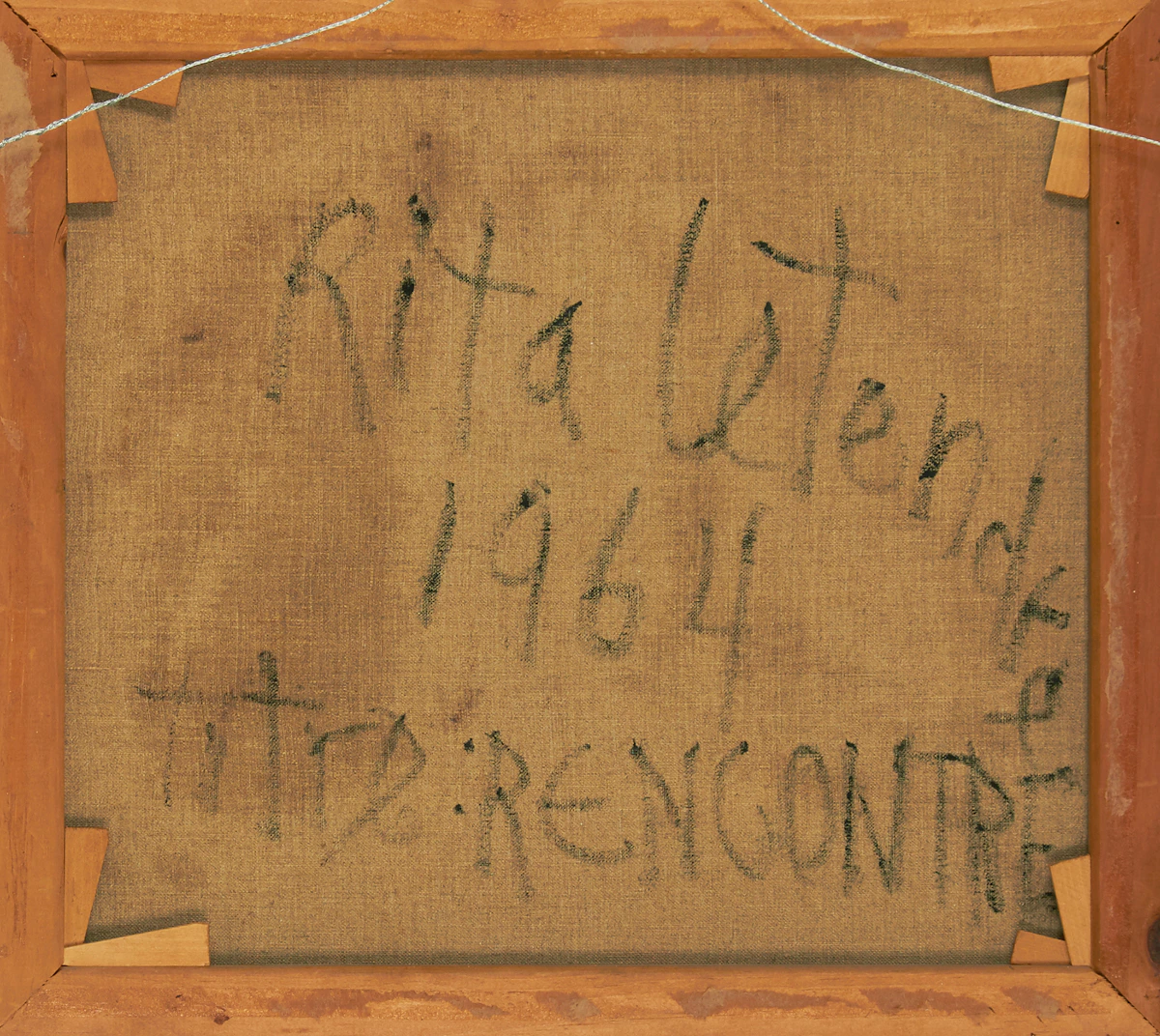
Dramatic and evocative, “Rencontre’s” bright ochres and yellows shoot out diagonally from the central blue form with areas scraped from the canvas with a spatula, released from the immersive dark background. Here, the viewer bears witness to the artist’s use of one point perspective and emphasis on colour to produce distinct energy, practices which influenced her work in the years that followed. “Canadian Art” describes Letendre's “vehemence of her gesture and her voluptuous love of the matière.” The title of the piece, translating to “encounter”, is fitting as the viewer not only has a visual encounter with the work, but also a conjured feeling and energy emoting from the canvas.
A similar work also entitled “Rencontre” (1964) is pictured in David Burnett and Marilyn Schiff’s Contemporary Canadian Art, page 71.